
NYSE Picks Avalanche for Tokenized Stocks: Will AVAX Benefit?

 Prefer us on Google

The NYSE Avalanche partnership has brought a major institutional development into the spotlight after Ava Labs announced that Avalanche technology will support the clearing and settlement infrastructure of an upcoming New York Stock Exchange-affiliated platform for tokenized securities. The November 9, 2026 announcement marks a significant step toward connecting blockchain-based financial infrastructure with traditional U.S. capital markets.
Under the proposed arrangement, NYSE Avalanche infrastructure will provide the core ledger technology to the clearing firm supporting a planned alternative trading system, or ATS. The platform is designed to enable around-the-clock trading, clearing and settlement of tokenized securities, subject to applicable regulatory approvals. It is not yet an operating replacement for the NYSE's conventional stock market.
The NYSE Avalanche development has also renewed attention on AVAX, the native cryptocurrency of the Avalanche ecosystem. According to a WEEX market snapshot recorded on November 10 at 10:31 Beijing time, AVAX spot traded at approximately 8.611 USDT, up 7.13% over 24 hours. Its perpetual futures quotation was also near 8.611 USDT, with a 24-hour increase of 6.55%.
However, institutional use of Avalanche technology does not automatically establish that the NYSE-affiliated platform has purchased AVAX, will settle transactions on the public C-Chain, or will generate substantial AVAX-denominated transaction fees.
The important question is how the proposed platform will operate, why Avalanche was selected for settlement infrastructure, and whether adoption of its technology can translate into measurable economic demand for the AVAX token.
What Did NYSE and Ava Labs Announce?
On November 9, Ava Labs announced that Avalanche would provide the core ledger technology for the clearing firm supporting an upcoming NYSE-affiliated digital trading platform.
The official Ava Labs announcement identifies Avalanche as the underlying infrastructure intended to record and settle transactions involving tokenized securities.
The project builds on an earlier plan announced by the New York Stock Exchange in January 2026 to create a digital venue for trading and settling tokenized stocks and other eligible securities.
NYSE is part of Intercontinental Exchange, or ICE, a global operator of exchanges, clearinghouses and financial data services.
Its planned tokenized securities venue would be an affiliate-led initiative rather than a wholesale conversion of the existing NYSE equities market to a public blockchain.
NYSE Avalanche Partnership: Key Facts
| Category | Announced Details | Important Qualification |
|---|---|---|
| Announcement date | November 9, 2026 | Official Ava Labs announcement |
| Blockchain technology | Avalanche | Core clearing and settlement ledger |
| Trading venue | Upcoming NYSE-affiliated digital ATS | Not the existing NYSE equities market |
| Main function | Record clearing and settlement activity | Separate from order matching |
| Trading design | 24 hours a day, 7 days a week | Subject to regulatory approval |
| Settlement model | On-chain settlement | Technical and operational implementation pending |
| Network architecture | Dedicated Avalanche-based infrastructure | Not automatically the public C-Chain |
| AVAX purchases | No purchase amount disclosed | Token buying cannot be assumed |
| Direct AVAX fee revenue | Not disclosed | Depends on the final configuration |
| Commercial launch | Proposed, not confirmed as operational | Approval and implementation remain necessary |
Sources: Ava Labs press release, November 9, 2026; ICE announcement, January 19, 2026; Avalanche official technical documentation.
The most consequential part of the announcement is the selection of blockchain infrastructure for a regulated financial-market function.
Tokenization projects often focus on issuing representations of financial assets. The NYSE-affiliated project extends that concept into the infrastructure used to record ownership changes and settle transactions after trades have been matched.
Why Is This Different From a Typical Tokenized Stock Launch?
A tokenized stock product can provide exposure to an equity asset through a blockchain-based instrument.
However, creating the token does not by itself establish a complete regulated marketplace for trading, clearing, custody and settlement.
Traditional securities markets depend on multiple institutions and processes, including exchange operators, brokers, custodians, clearing firms and transfer agents.
The NYSE-affiliated initiative is important because it seeks to integrate blockchain infrastructure into these market processes rather than simply introducing another stock-linked token.
For readers examining the underlying products, WEEX's Tokenized Stocks Explained explains why asset backing, issuer responsibilities, shareholder rights and settlement arrangements need to be evaluated separately.
How Would Avalanche Support NYSE Tokenized Securities?
The proposed platform involves several technological functions that should not be confused with one another.
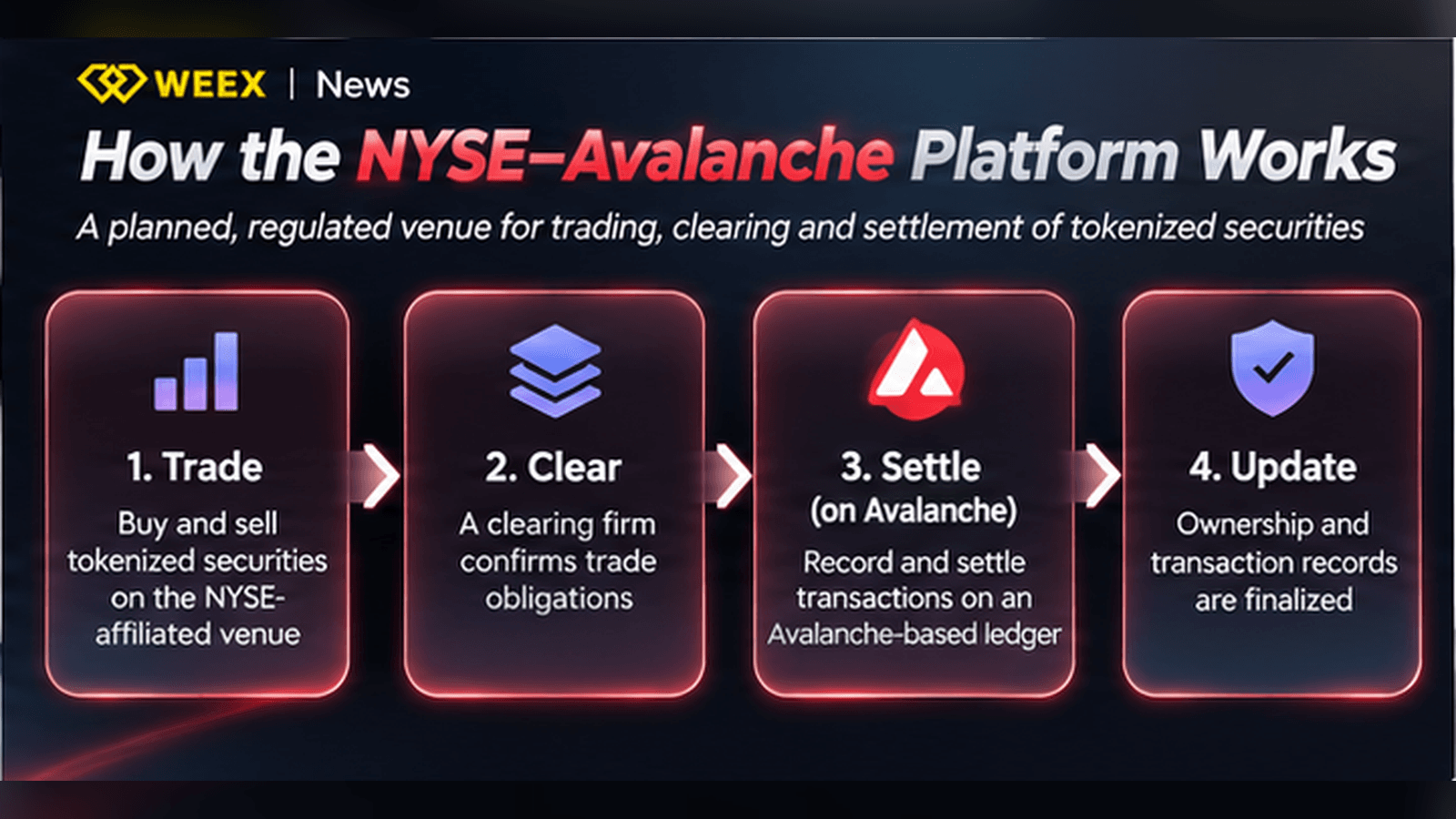
Trading is the process of matching buyers with sellers. Clearing establishes the obligations resulting from completed trades. Settlement is the process of transferring assets and payment entitlements according to those obligations.
Avalanche is being selected to support the clearing firm's ledger, rather than necessarily operating every component of the trading system.
Step 1: Orders Enter the Digital Trading Venue
Eligible investors would submit orders for supported tokenized securities through the NYSE-affiliated trading platform.
In its January announcement, ICE explained that the digital platform was designed to combine NYSE's Pillar matching engine with blockchain-based post-trade infrastructure.
This suggests that order execution would remain part of a specialized financial trading system rather than simply taking place through an ordinary decentralized exchange.
The intended design also includes orders expressed in dollar amounts and potential stablecoin-based funding.
Those features remain subject to the eventual operating rules, regulatory approvals and available products.
Step 2: Matched Trades Create Settlement Obligations
Once orders are matched, the relevant clearing infrastructure must determine the securities and payment obligations of the participants.
Traditional financial-market clearing helps ensure that the appropriate assets and payments are transferred under the applicable market rules.
The planned blockchain-based ledger would record the relevant transactions and support the settlement process.
Its role is therefore broader than publishing a token price or displaying transaction activity on a public explorer.
Step 3: Avalanche Records and Settles Transactions
Avalanche technology is intended to provide the ledger used by the clearing firm.
Ava Labs has emphasized features such as transaction reliability, predictable operating costs, participant controls and support for atomic settlement.
Atomic settlement refers to a mechanism designed to ensure that the related transfer obligations are completed together under predefined conditions, reducing the risk that one side of a transaction is completed without the other.
However, a blockchain-based record does not eliminate every possible operational, custody, legal or counterparty risk.
The platform must also integrate its ledger with the market's surrounding infrastructure and regulatory framework.
Step 4: Post-Trade Records Are Updated
Once settlement is completed, relevant records must reflect the new ownership or entitlement positions.
Depending on the final design, this may involve coordination with custodians, transfer agents and other financial institutions.
The blockchain ledger is one part of a larger system.
The effectiveness of the model will depend on the consistency of records across the participating institutions and the legal recognition of the resulting transfers.
Why Did NYSE Choose Avalanche?
According to the announcement, the planned platform requires infrastructure with high performance, predictable costs and the ability to control participation.
These requirements differ from those of many public cryptocurrency applications, where open access is generally an important design feature.
Financial-market operators must also account for legal obligations concerning market participants, transaction records, operational resilience and settlement finality.
Dedicated Blockchain Infrastructure
Avalanche supports the creation of application-specific layer-1 networks with configurable rules.
These networks can establish their own validator arrangements, transaction policies, execution environments and fee models.
That flexibility can help an institution design infrastructure around its operational and regulatory requirements.
The Avalanche L1 technical documentation describes how dedicated networks can control membership, validation and token economics.
In contrast, a public blockchain generally uses shared network rules and permissionless participation.
The NYSE-affiliated platform's precise technical configuration and access controls should be evaluated through the final published implementation rather than inferred from the broader Avalanche ecosystem.
Predictable Costs and Performance
A securities settlement system must operate reliably under substantial transaction volumes.
Sudden changes in fees or network congestion can complicate financial operations.
Dedicated infrastructure can provide a more controlled environment for managing transaction processing, system capacity and costs.
However, selecting a blockchain technology does not establish that performance targets have already been achieved in production.
The planned platform still requires testing, integration and regulatory authorization.
Controlled Participation
Regulated financial institutions may need to identify and authorize the entities permitted to participate in settlement.
Avalanche-based networks can be configured to restrict validator or participant access according to the relevant requirements.
Such controls may be valuable for institutional securities infrastructure.
At the same time, a permissioned network should not automatically be described as offering the same decentralization guarantees as Avalanche's public C-Chain.
The security model depends on who validates the network, how upgrades are governed and what happens if important participants fail.
-- Price
Will NYSE's Avalanche Adoption Increase AVAX Demand?
This is the most important question for AVAX holders.
The announcement establishes institutional adoption of Avalanche technology, but it does not establish a direct economic relationship between the planned NYSE-affiliated settlement venue and purchases of the AVAX token.
Understanding this distinction requires separating the public Avalanche Primary Network from dedicated Avalanche L1s.
AVAX on the Primary Network
AVAX is the native token used for transaction fees and staking on Avalanche's Primary Network.
The Primary Network includes the C-Chain, which supports Ethereum-compatible smart contracts, alongside the X-Chain and P-Chain.
Activity on the public C-Chain generally requires AVAX for transaction fees.
Network participation and validation can also create AVAX-related economic activity.
However, a separate institutional L1 may use a different fee and validator model.
Can an Avalanche L1 Use a Different Gas Token?
Yes.
According to Avalanche's L1 documentation, dedicated networks can choose their own native assets and design distinct transaction-fee arrangements.
An institutional L1 does not necessarily require every transaction to be paid in AVAX.
It may also establish custom validator policies and access rules that differ from those of the public Primary Network.
Consequently, the number of trades settled by a dedicated Avalanche-based institution does not automatically equal the number of AVAX-denominated fees paid on the public C-Chain.
Could There Still Be Economic Benefits for AVAX?
Potentially, but the mechanism must be specified.
Avalanche L1 validators interact with the Primary Network's P-Chain and may incur AVAX-denominated continuous validation fees under the network's current architecture.
Additional connectivity with public Avalanche networks could also create activity involving AVAX, depending on how the platform is configured.
However, the November 9 announcement did not disclose the final fee model, validator structure, commercial terms or expected AVAX consumption.
The scale of any direct token demand therefore remains uncertain.
A useful way to evaluate the announcement is to distinguish three layers:
| Potential Benefit | What Is Confirmed? | What Still Needs Evidence? |
|---|---|---|
| Technology adoption | Avalanche selected for settlement infrastructure | Successful commercial operation |
| Ecosystem reputation | Institutional association with NYSE-affiliated project | Additional institutions adopting related technology |
| Direct AVAX demand | No specific purchases disclosed | Token usage, fee model and economic scale |
| Public network activity | No transaction volume specified | Actual C-Chain or interoperable network usage |
| Long-term business expansion | New institutional use case announced | Revenue, partnerships and sustained adoption |
Source: Ava Labs announcement and Avalanche Builder Hub documentation. Potential token effects are analytical scenarios, not guaranteed outcomes.
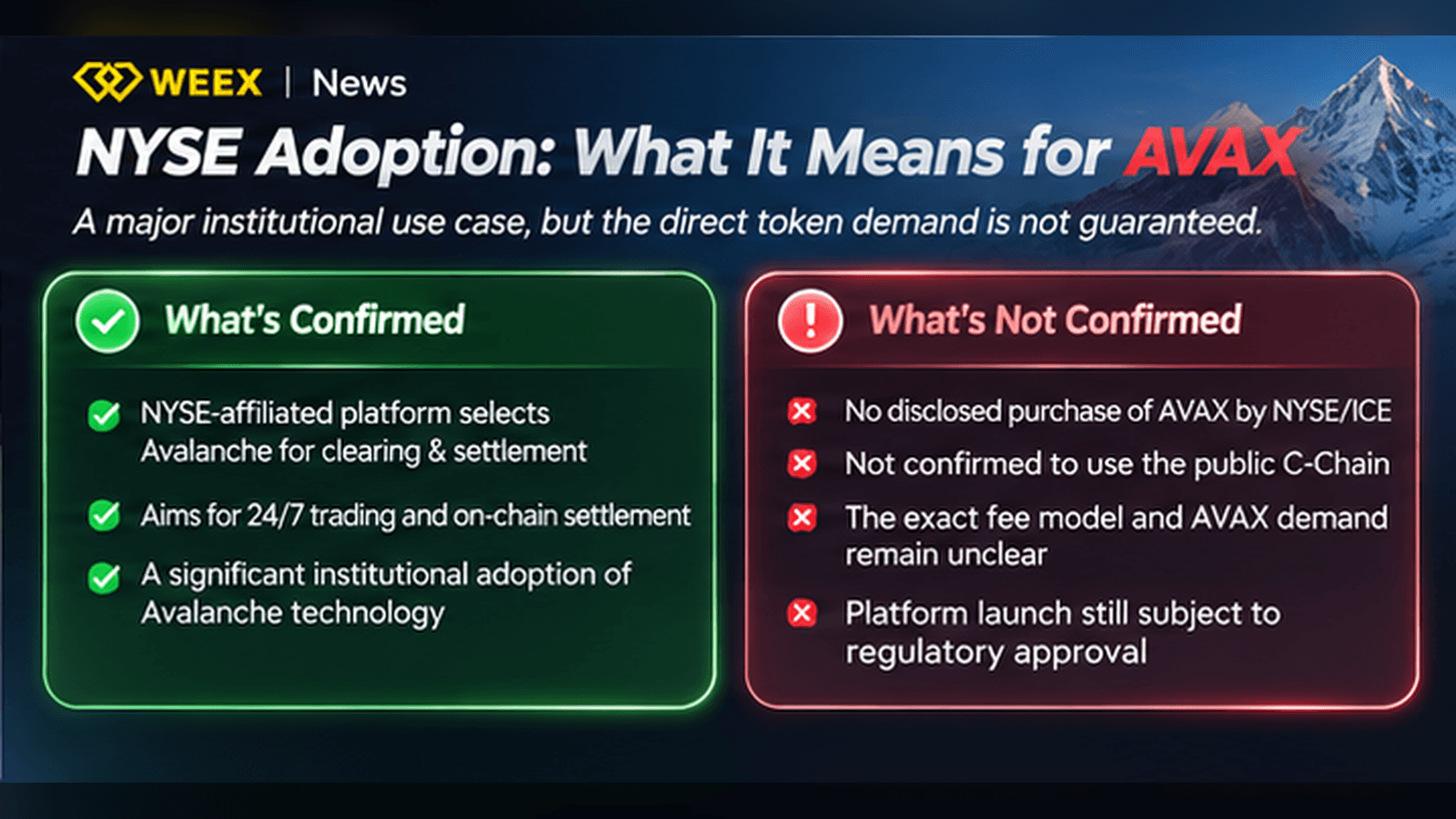
The stronger argument for AVAX is that a major financial institution's technology decision may reinforce Avalanche's relevance in institutional blockchain infrastructure.
The weaker argument is to assume that every future tokenized share trade must consume substantial AVAX.
The first is a plausible market narrative; the second is not established by the announcement.
WEEX previously explored a similar issue in AVAX Futures: Trading the Avalanche RWA Catalyst With Leverage, which examines institutional tokenization headlines alongside actual token demand and derivatives risks.
Has NYSE's Tokenized Stock Platform Already Launched?
No completed public launch was established in the November 9 announcement.
The platform remains subject to applicable regulatory approvals.
NYSE announced the broader development initiative in January 2026, while Ava Labs confirmed the Avalanche technology selection in November.
These are separate milestones.
What Did NYSE Announce in January?
In its January 19 announcement, ICE described plans for a digital trading platform supporting tokenized securities, including U.S.-listed equities and ETFs.
The proposed features included 24/7 operations, immediate settlement, fractional trading and stablecoin-based funding.
The announcement also explained that the platform would require regulatory approval.
Selecting Avalanche for part of the clearing infrastructure advances this initiative, but it does not remove those requirements.
What Regulatory Questions Remain?
The operating venue must comply with the rules applicable to its market structure, securities and participants.
Regulatory approval may affect which securities can trade, who can access the platform, what custody arrangements are permitted and how clearing and settlement are legally recognized.
The final product design may also need to address investor protection, transfer restrictions and corporate actions.
Therefore, the announcement should not be interpreted as confirmation that every U.S. security will become freely tradable on-chain.
Does This Mean Traditional NYSE Stocks Will Trade 24/7?
Not automatically.
The proposed platform is a new NYSE-affiliated digital venue, not a confirmed extension of every existing stock's ordinary trading session.
Different securities may have different eligibility requirements, issuance arrangements and transfer rules.
The planned availability of tokenized trading does not imply that the entire traditional NYSE market has already switched to continuous operation.
How Is NYSE Tokenization Different From WEEX Stock Tokens?
Both involve financial exposure associated with stocks, but the legal and technical structures may differ significantly.
NYSE's proposed platform concerns regulated tokenized securities and clearing infrastructure.
WEEX stock-related tokens are separate digital products designed to track reference stock prices under their respective platform and issuer rules.
The two should not be treated as interchangeable.
Tokenized Securities Versus Synthetic Stock Exposure
A tokenized security can represent a legally recognized interest in an underlying security, depending on the issuer and the applicable legal framework.
By contrast, a synthetic stock-linked product may provide price exposure without actual equity ownership.
WEEX's stock-token rules state that its synthetic products do not automatically provide ordinary shareholder rights such as voting or dividends.
The distinction matters because settlement technology does not, on its own, determine what a token holder legally owns.
For a detailed comparison, see Are Tokenized Stocks Backed by Real Shares?.
Why Do Custody and Investor Rights Matter?
A financial token can be recorded on a blockchain while its legal and economic rights still depend on institutions and contracts.
Important questions include who issues the token, whether underlying shares are held in custody, how redemptions work and how corporate actions are handled.
The NYSE-affiliated initiative seeks to build regulated infrastructure around these market functions.
Whether its final implementation offers advantages over existing arrangements will depend on the approved design and operating performance.
Why Did AVAX Rise Around 7%?
The November 10 WEEX snapshot recorded a 24-hour increase of 7.13% in AVAX spot and 6.55% in AVAX perpetual futures.
The November 9 technology announcement provided a significant Avalanche-specific development during the period.
However, the available evidence does not establish that the partnership announcement alone caused the entire market movement.
Institutional Adoption Expectations
Investors may interpret the selection as evidence that Avalanche technology can satisfy demanding institutional requirements.
Association with a major exchange operator can influence expectations about future enterprise adoption.
That may attract speculative demand for AVAX even before the planned infrastructure begins operating.
However, speculative demand and direct transactional token demand are not the same.
Broader RWA Tokenization Narrative
Real-world asset tokenization has become an important area of blockchain development.
Financial institutions are exploring the use of distributed ledgers for securities issuance, collateral, settlement and operational recordkeeping.
Avalanche's customizable architecture is relevant to that trend.
However, the expansion of tokenization across the industry does not guarantee that a single blockchain or token will capture most of the economic value.
Other networks and financial technology providers are developing competing infrastructure.
Market Liquidity and Short-Term Volatility
AVAX remains exposed to broader cryptocurrency-market conditions, order-book liquidity and derivatives positioning.
A rapid increase following major news can also create short-term volatility if expectations become excessive.
Investors should consider funding rates, trading volume and price slippage when interpreting futures-market movements.
The historical WEEX quotations provide a snapshot of market conditions rather than a forecast.
What Should AVAX Holders Watch Next?
The next stage of the NYSE Avalanche story will depend on measurable progress rather than the initial partnership announcement.
Regulatory approval: Whether the proposed NYSE-affiliated platform receives the required authorizations.
Launch and product scope: Whether the platform begins operating and which securities are initially supported.
Ledger architecture: Whether technical documentation clarifies network permissions, validation, settlement and cross-chain connectivity.
AVAX fee mechanics: Whether the actual deployment generates measurable AVAX-denominated costs or other economic demand.
Institutional participation: Whether brokers, clearing members, issuers and other market participants adopt the platform.
Trading and settlement activity: Whether meaningful transaction volume develops after launch.
Competing systems: Whether similar platforms built on other blockchain technologies affect the relative attractiveness of Avalanche.
The strongest evidence of success would be sustained settlement activity, reliable operations and clearly documented economic relationships between the infrastructure and its participants.
How to Buy and Trade AVAX on WEEX
Users interested in Avalanche can review the AVAX spot and perpetual futures markets on WEEX.
The AVAX cryptocurrency is distinct from the proposed NYSE-affiliated tokenized securities platform. Buying AVAX does not provide equity ownership in NYSE, ICE or Ava Labs.
Step 1: Log In to WEEX
Access your WEEX account and complete the applicable verification requirements.
Confirm that AVAX products are available in your region.
Step 2: Prepare Your USDT Balance
Check that sufficient USDT is available in the relevant trading account.
If depositing funds, verify the supported blockchain network and receiving address before transferring assets.
Step 3: Choose AVAX Spot or Futures
Users seeking direct ownership of the cryptocurrency can review the AVAX/USDT spot trading market on WEEX.
Spot trading involves exchanging USDT for the underlying AVAX token.
Eligible users interested in derivative exposure can check the AVAX/USDT perpetual futures market on WEEX.
Perpetual futures provide contractual exposure to AVAX price movements and may involve leverage, funding payments and liquidation risk.
Step 4: Review the Market and Order Conditions
Check the latest quotation, spread, available order types, fees and order-book liquidity.
For futures, review the margin requirements and the risk of forced liquidation.
A major institutional announcement can increase short-term volatility, making execution conditions particularly important.
Step 5: Confirm and Monitor
Review all transaction details before submitting an order.
After execution, monitor your holdings or open derivatives position and follow the official NYSE and Ava Labs announcements for material developments.
Users should verify live market availability before trading, as product restrictions and circuit breakers may affect order execution.
Conclusion
The November 9 announcement that Avalanche will support clearing and settlement infrastructure for an upcoming NYSE-affiliated tokenized securities platform marks a significant institutional adoption milestone.
The project could help demonstrate how dedicated blockchain networks can be integrated into financial-market infrastructure, particularly where regulatory controls, predictable costs and reliable settlement are important.
However, the platform remains subject to regulatory approval, and its final operating model has not been fully disclosed.
Crucially, the selection of Avalanche technology does not prove that the operator has purchased AVAX, that all transactions will use the public C-Chain or that large amounts of AVAX fees will be generated.
For AVAX holders, the most important next developments are regulatory progress, platform deployment, actual transaction activity and a clearly documented mechanism connecting network adoption to token demand.
The partnership strengthens the institutional adoption narrative, but sustained economic benefits will depend on how the infrastructure operates in practice.
FAQ
1. Why Did NYSE Choose Avalanche for Its Tokenized Securities Platform?
NYSE's affiliate selected Avalanche technology to support clearing and settlement infrastructure because of its capacity for dedicated networks, predictable performance, controlled participation and institutional customization.
2. Has the NYSE Avalanche Tokenized Stock Platform Launched?
The November 9 announcement confirmed a technology selection, not a completed commercial launch. The proposed platform remains subject to applicable regulatory approvals and implementation requirements.
3. Will NYSE's Use of Avalanche Automatically Increase AVAX Demand?
No. Dedicated Avalanche L1s may use customized transaction-fee and validator arrangements. The announcement did not disclose AVAX purchase commitments or a specific direct token-demand mechanism.
4. Will All NYSE Stocks Become Tradable 24/7 on Avalanche?
Not automatically. The planned platform is a separate NYSE-affiliated digital venue, and the securities supported, participation requirements and trading arrangements will depend on the final approved design.
5. How Can Users Buy or Trade AVAX on WEEX?
Eligible users can review AVAX spot and perpetual futures markets on WEEX. Spot trading provides exposure through ownership of the cryptocurrency, while perpetual futures provide derivative price exposure with additional margin, funding and liquidation risks.
This content is provided for general informational purposes only and doesn't constitute financial, investment, legal, or tax advice. Any events, rewards, online promotions, or related information mentioned herein should not be considered a recommendation, solicitation, or invitation to purchase, sell, trade, or otherwise deal in any crypto assets. Crypto assets are highly volatile and may result in loss. The availability of WEEX services, products, and related events may vary by region. You are responsible for ensuring that your participation is in accordance with applicable local laws and regulations.
You may also like
Can I Recover Crypto Sent to WEEX Using the Wrong Blockchain Network?
Why Is My WEEX Deposit Confirmed but Not Credited?
PROJECT CORTEX (XTX) Price: Why a 15.8M% Gain and a $6 Billion Market Cap Are Hard to Trust
USOE Price Drop: Why Did United States Oil Exchange Fall Over 90% in a Week?
NYSE-Linked Avalanche Settlement News: Why AVAX Is Up and What It Does Not Prove
Copy Trading Platforms With Verified Performance: Spot the Fakes
Top 10 Crypto Derivatives Exchanges Worldwide by Open Interest
Beginner Futures Exchanges With Low Entry: What $50 Really Buys
Tesla Cybertruck Refunds: What the Line Shutdown Means for TSLA
User-Friendly Crypto Copy Trading Platforms: 6 Picks Compared
WEEX Review: The Latest Fees, Features, Security and Trading Experience
What Does It Mean to Stake Crypto? Staking on WEEX Explained
Keplr Wallet Security Alert: Is Your ATOM Safe?
NVIDIA Board Opens Probe: What's Next for NVDA?
Midterm Elections Crypto Fallout: $170M Spent, Key Races Lost
Jensen Huang Affair Rumors: What the Alice Huang Report Says
USOR Token Price: Why the Oil Meme Coin Is Down 99% From Its Peak
XLM Token Price Today: Why Stellar's Nov. 23 Bell Vote Matters
FreeBitco.in Shutdown: Frozen Withdrawals and What Users Can Do

How to Stake Solana: Exchange vs Wallet, Rewards and Unstaking
INJ Staking ETF Goes Live: Can 90% Staking Drive Demand?
SNDK Crashes 22%: Is the AI Storage Boom Losing Steam?
Circle Revenue Hits $865M, But Can CRCL Sustain Growth?
Is GM on BSC a CZ Token? What Is Confirmed and What Is Not

What Is GM on BSC? GREEN MORNING Jumps Over 400% on a Reported Musk–CZ Meme Moment
Polygon Proposes Hard Fork to Recover 70.49M POL
Zcash NU7 Upgrade: 25-Second Blocks, Same 21M ZEC Supply
Hyperliquid ICE Deal: What US Perps Mean for HYPE Holders
Ripple National Trust Bank: What OCC Approval Means for XRP
Why Is Bitcoin Down Today? BTC's Slide to $76K Explained
Can I Recover Crypto Sent to WEEX Using the Wrong Blockchain Network?
Why Is My WEEX Deposit Confirmed but Not Credited?
PROJECT CORTEX (XTX) Price: Why a 15.8M% Gain and a $6 Billion Market Cap Are Hard to Trust
USOE Price Drop: Why Did United States Oil Exchange Fall Over 90% in a Week?
NYSE-Linked Avalanche Settlement News: Why AVAX Is Up and What It Does Not Prove
Copy Trading Platforms With Verified Performance: Spot the Fakes
Contents
Popular coins
Latest articles


