
Tommaso Gagliardoni: Skeptical Bitcoiners About Quantum 'Bury Their Heads in the Sand'

 Prefer us on Google



- Gagliardoni considers it prudent for Bitcoin to be protected by 2030.
- Migrating a signature system takes longer than replacing encryption.
Bitcoin will have to migrate to quantum-resistant cryptography. This was warned by Tommaso Gagliardoni, founder of Lucumo Security and research lead at Horizen Labs, who also questioned a part of the community that dismisses this threat.
For the researcher, the discussion is no longer about whether this change will be necessary, but rather when it should begin and how it can be executed without compromising the network. In this sense, he said:
There is a fraction of the Bitcoin community that prefers to 'bury their heads in the sand,' claiming that quantum computers are a scam or that they will never arrive. They adopt this stance because the alternative forces them to make extremely difficult governance decisions.
Tommaso Gagliardoni, founder of Lucumo Security.
The criticism is not only aimed at skepticism about the development of these machines. For the researcher, denying the threat allows for postponing complex decisions about how to adapt Bitcoin if the cryptography currently protecting the network ceases to be secure.
Gagliardoni is a cryptographer specialized in security against quantum computers. He completed his doctorate in this area at the Technical University of Darmstadt, was a postdoctoral researcher at IBM Research, and later led cryptography work at Kudelski Security. Tommaso Gagliardoni during the interview he gave to the YouTube channel NaoX Protocol. Source: NaoX Protocol
His experience is relevant to a discussion that, as he warns, should not wait until there is a quantum computer capable of attacking Bitcoin. "In the long run, Bitcoin will have to migrate to quantum-resistant cryptography, whether for security, regulation, or pure market pressure. If the entire Web3 ecosystem migrates to quantum-safe technology except Bitcoin, trust in Bitcoin as a store of value will be severely compromised," he detailed in an interview published on October 3 by the YouTube channel NaoX Protocol.
That is the point that connects his criticism of skeptics with the technical problem: if the migration takes years and requires difficult decisions, waiting for the threat to be evident may leave little room for action.
The Danger Doesn’t Start with the 'Q-Day'
One of the concepts that Gagliardoni questioned during the interview was the "Q-Day," used to refer to the moment when a quantum computer can break currently used cryptographic systems.
For the researcher, reducing the problem to a specific date can be misleading. "I’m not a big fan of the term 'Q-Day.' Unlike the Y2K problem, where there was a fixed date on the calendar, the quantum transition is much more diffuse. How do you define Q-Day? Is it the moment when a quantum computer solves real-world problems, or when it breaks cryptography? What type of cryptography and what type of break?" he commented.
Therefore, he considered it prudent for systems to be protected by 2029 or 2030. He also warned that the announced capabilities may lag behind what governments or institutions develop behind closed doors. A quantum attacker could theoretically break Bitcoin's security. Source: CriptoNoticias.
Concerns also lie in how long such a transition might take. "Honestly, I think we are a bit late. It's great that things have finally started to move this year, but the crypto community has been sounding the alarm for years," he added.
Gagliardoni stated that regulation can accelerate this process because many companies still perceive cybersecurity as a cost. As an example of the slow pace of these migrations, he mentioned DES (Data Encryption Standard), a symmetric encryption algorithm standardized in the 1970s and considered insecure for years due to its small key size. Despite its obsolescence, it still remains in some legacy applications.
Digital Signatures Are the Real Challenge
For Bitcoin, the researcher focused on digital signatures, which allow proving who is authorized to move certain funds.
"Web3 is almost 100% a digital signature problem. Encryption does not play a central role in Web3. Signatures protect the keys of transactions/wallets and support the consensus layer. If you forge keys in the consensus, you can take over the entire network," he explained.
A powerful quantum computer could, in that scenario, forge signatures and impersonate the legitimate owner of certain assets, as explained by CriptoNoticias. The problem is that replacing that system would not be immediate either.
"Migrating a signature scheme takes much longer than migrating encryption. Encryption is usually at the application level, while signatures are embedded in certificates, firmware signing keys, and physical infrastructure with a long lifespan where the hardware sometimes cannot even be updated," he noted.
Crypto Agility Has Limits
One possible answer would be to design systems capable of changing algorithms when a threat arises, a concept known as crypto agility. However, Gagliardoni warned that putting it into practice is much more complex than it seems.
"Designing applications to be able to swap cryptographic algorithms without changing the architecture is a wonderful idea in theory, but in the real world, it's almost a myth. Applications are built around the constraints of cryptography. You can't just swap one algorithm for another that requires keys 10 times larger without redoing the application," he asserted.
The researcher, however, refrained from giving a definitive date for a potential breakthrough. In 2012, he initially estimated, as a bet, that RSA-2048 could be compromised by February 2032. Today, he maintains that this horizon does not seem so far from current estimates and recalls that elliptic curves require fewer resources to be attacked than RSA.
His final recommendation is to not turn that uncertainty into alarmism: "Don't get carried away by the hype. Stick only to what you can verify and measure formally."
Tags: Bitcoin (BTC), Quantum Computing, Latest
-- Price
This content is provided for general informational purposes only and doesn't constitute financial, investment, legal, or tax advice. Any events, rewards, online promotions, or related information mentioned herein should not be considered a recommendation, solicitation, or invitation to purchase, sell, trade, or otherwise deal in any crypto assets. Crypto assets are highly volatile and may result in loss. The availability of WEEX services, products, and related events may vary by region. You are responsible for ensuring that your participation is in accordance with applicable local laws and regulations.
You may also like

Horizen Holders Face November 4 Bridge Cutoff Before L3 Wind-Down

Boca Concerned: Adam Bareiro Could Miss Entire Season
Google Play Removes VK and Max Apps Due to Sanctions

Trump Media adds 1,510 Bitcoin in Q3 as treasury reaches $1.17B

Bank of Korea: Consider Existing Financial Regulations When Introducing Stablecoins

Dormant Ethereum Wallet Moves $4.6 Million. Scammers Set a Trap in Three Minutes
47% Top Tax Rate Approaches: Seven Tax Reduction Strategies for Australian Crypto Investors

WEEX P2P now supports ILS, BHD, OMR & QAR —Merchant Recruitment Now Open

Hyperliquid Strategies Reports 38.5M HYPE Treasury After $802M Deployment

No Music App on Work Laptops: The Small Rules Behind WEEX Security

SoftBank Reports First Quarterly Net Loss in Two Years, Intel and Data Center Dragging Down Performance
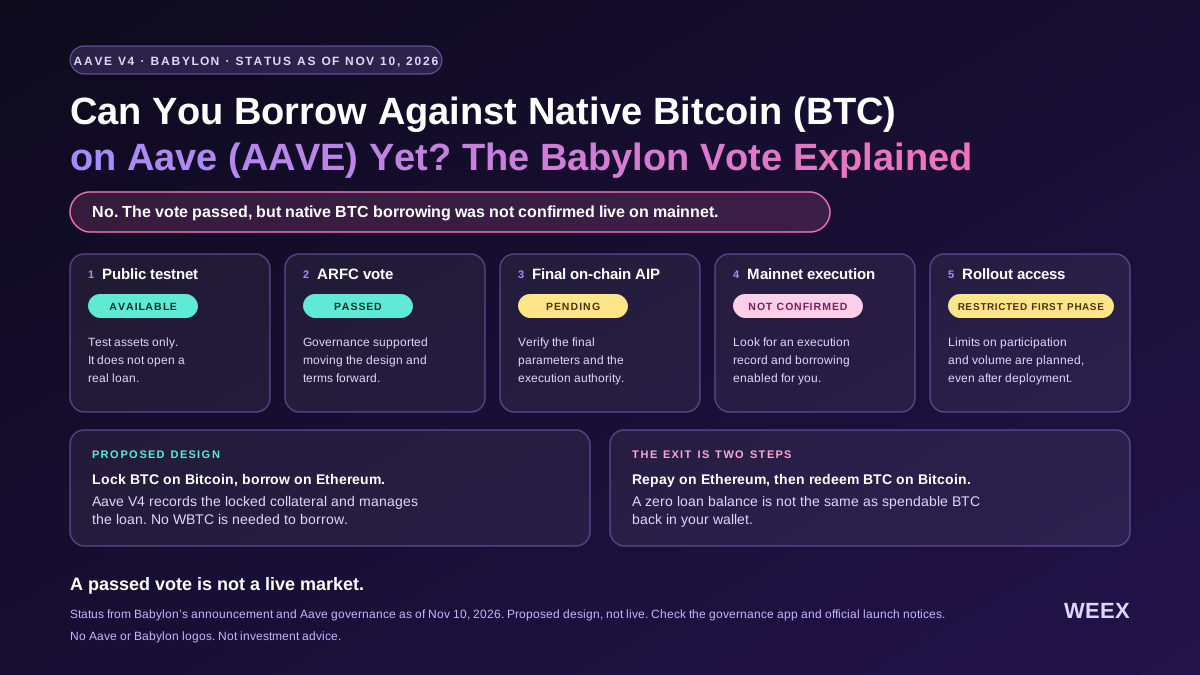
Can You Borrow Against Native Bitcoin (BTC) on Aave (AAVE) Yet? The Babylon Vote Explained
Can you borrow against native Bitcoin on Aave yet? See what the Babylon vote approved, what still needs to launch, and how BTC liquidation would work.
Why Doesn't Bitcoin Always Rise When Stocks Rally?

Financial Commission to Manage Stock Market Volatility with Sidecars and High-Frequency Trading Checks
IMF urges Kenya to make crypto firms share customer data under Travel Rule

Kim & Chang Lawyer: "Excessive Responsibility Should Not Be Imposed on Stablecoin Issuers"

Why Did Avalanche (AVAX) Rise? What the NYSE Settlement Plan Means for AVAX Demand
See why Avalanche (AVAX) rallied after the NYSE settlement announcement, how the dedicated chain would work, and what could create demand for AVAX.

Cryptocurrency Security Checklist: Four Lessons from Phemex Safety Hub Vol. 05–08

Solana's Former DEX Leader Prepares to Go All In on US Stocks

PIEVERSE Price Up Nearly 80% in a Week: Futures Activity, the November 14 Unlock and What Is Confirmed
PIEVERSE rose about 79% in seven days with futures volume far above spot. See what is confirmed about the November 14 unlock and the WEEX Lucky Eggs campaign.

Unauthorized Access to Gnosis Pay's Old Card System Leads to Customer Data Breach

Alchemy Pay Says Mississippi Licence Expands US Money Transmission Coverage to 20 States

Hong Kong Approves Crypto Asset Reporting Rules - Fintech World

Biden's Son's LAPTOP Burns 5.5% as Conditions Met in U.S. Midterm Elections

TRON surpasses 413 million accounts, but what do network stats show?

Countdown to the GENIUS Act: Only USDC and PYUSD Pass Among the Top Ten Dollar Stablecoins

NVDA Stock Falls 4.3% After Board Opens Investigation: What Is Confirmed and What Is Not
NVDA closed at $178.67 on November 9, 2026, down about 4.3%, after Nvidia’s board confirmed an independent investigation. Other claims come from media reports. WEEX’s Lucky Eggs campaign runs until November 25.
How to Resolve Data Center Controversies? This U.S. State Wants to Tokenize Computing Power to Share Benefits with Residents

Lombard Systems Raises $4M to Make Tokenized Assets Easier to Borrow Against

When is the launch date of Bitcoin Hyper? Testnet, tokens, and mainnet are separate milestones
Horizen Holders Face November 4 Bridge Cutoff Before L3 Wind-Down
Boca Concerned: Adam Bareiro Could Miss Entire Season
Google Play Removes VK and Max Apps Due to Sanctions
Trump Media adds 1,510 Bitcoin in Q3 as treasury reaches $1.17B
Bank of Korea: Consider Existing Financial Regulations When Introducing Stablecoins
Dormant Ethereum Wallet Moves $4.6 Million. Scammers Set a Trap in Three Minutes
Latest articles

Latest coin listings on WEEX


