
Sun Yuchen Prize Confirms Neel Somani as Latest Awardee! Successfully Solved Two Math Problems JSP-000239 and JSP-000327

 Prefer us on Google


In the cryptocurrency circle (120btc.CoM): On the evening of October 28, Beijing time, the official social media account of the Sun Yuchen Prize officially released the latest feature of the award winner, confirming that renowned quantitative researcher Neel Somani has successfully won the award, becoming the officially recognized solver of the two difficult problems JSP-000239 and JSP-000327 in the question bank. The official honor roll has formally listed him as the mathematician for the year 2026, alongside the corresponding code formalization verifiers.
As a scholar with a cross-disciplinary background holding three degrees in mathematics, computer science, and business administration from the University of California, Berkeley, Somani previously worked as a quantitative researcher at the top hedge fund Citadel. His academic achievements have been selected for top computer systems conferences such as USENIX Security and OOPSLA. Previously, he successfully identified performance degradation vulnerabilities in the CPython underlying sorting algorithm using the formal interactive proof tool Lean.
In tackling the first problem JSP-000327—investigating whether there exist a finite number of equalities between the products of distinct central binomial coefficients under specific constraints—he innovatively bound traditional mathematical derivation with cutting-edge algorithms. After inputting the proposition into the GPT 5.2 Pro model to obtain preliminary combinatorial clues, he verified the basis for the proposition's validity through rigorous manual algebraic calculations. That night, upon submission to a professional academic forum, the solution received substantial independent verification from mathematician Daniel Larsen, and subsequently, the mathematical tool Aristotle developed by the Harmonic team automatically generated the corresponding Lean formalization code, achieving a complete closed loop from natural language conjecture to machine-readable proof.
Forming University Teams for Systematic Problem Solving
After the initial victory, Somani rapidly expanded individual research into an industrialized human-machine collaboration project. He formed a special task force with outstanding undergraduates from the University of California, Berkeley, Northwestern University, and Rice University, fully integrating large language models to systematically screen the Erdős open question bank.
Under this assembly line-style problem-solving system, the team successfully tackled the second problem JSP-000239—verifying whether infinite residual class coverage can be uniformly approximated by a finite subfamily in measure density. For the logical paths that were successfully executed, the team uniformly submitted them to the Aristotle tool for underlying formalization code translation. More methodologically valuable, Somani systematically documented and open-sourced a "failure case ontology" targeting the frequent deviations of AI large models in solving complex mathematical logic in his personal technical blog, aiming to help academia accurately locate the bottleneck boundaries of AI in formal reasoning. In his acceptance speech, Somani expressed gratitude for the funding from the Sun Yuchen team and emphasized that the evolution of AI in mathematical reasoning over the past year is remarkable, noting that code formalization can not only be used for the review of pure mathematical theorems but can also become a key industrial tool for ensuring the absolute correctness of general software systems.
On-Chain Fund Closed-Loop Standard Distribution Mechanism
From candidate nomination to formal entry into the hall of honor, the entire review system adhered to strict on-chain and open-source community audit standards. According to the proposal record numbered 5051 in the official GitHub bounty code repository:
Node One: The candidate solutions for the two problems were officially submitted and posted online for public review on September 30;
Node Two: After 14 days of peer review in the open-source community without objections, they were officially moved to the final award list on October 14, and project initiator Sun Yuchen also confirmed to the outside world on the same day that both problems had successfully passed formal verification;
Node Three: On the evening of October 28, Beijing time, the official announcement of the awardee's in-depth interview was made, fully disclosing the details of the problem-solving process.
In terms of financial and prize payment mechanisms, the award has established clear rules for the division of responsibilities and rights. According to the official guidelines, the prize pool for each problem is strictly divided according to a ratio of 70% for the solver and 30% for the Lean formalization code translator; if the same scholar independently holds both functions, they can enjoy the full prize. The highest level Pinnacle award amounts to $1 million, while other levels are executed based on difficulty ratings, with all prizes uniformly paid on-chain through the two mainstream compliant stablecoins USDT and USDC. To prevent online fraud and privacy leakage risks, after the public announcement period ends, awardees must submit their identity information and payment address through the official encrypted email channel for offline verification, and it is strictly prohibited to post private keys or on-chain addresses in the GitHub public discussion area.
-- Price
This content is provided for general informational purposes only and doesn't constitute financial, investment, legal, or tax advice. Any events, rewards, online promotions, or related information mentioned herein should not be considered a recommendation, solicitation, or invitation to purchase, sell, trade, or otherwise deal in any crypto assets. Crypto assets are highly volatile and may result in loss. The availability of WEEX services, products, and related events may vary by region. You are responsible for ensuring that your participation is in accordance with applicable local laws and regulations.
You may also like

After the Embodied AI Sector Cools Down, This Stanford Startup Secures Hundreds of Millions in Funding Against the Trend

The Mismatch Between Capital Frenzy and Deployment Economics in the Embodied Industry Clock Cycle

Ontology Suspends Block Production to Address Potential Security Risks

Who Defines Ethereum? Cultural Convergence and the Truth of Cryptocurrency

Three Blockchains Halted in Four Days, Only Chronos Rolled Back

Ontology Mainnet Resumes Operation, Sync Node Upgraded to v3.1.5

Ontology halts mainnet block production over potential security concern
Zhongqing Robotics Launches Engine Program, Opens SDK, Models, and Datasets

Tokenized U.S. Treasury Fund Reaches $16.15 Billion
Infosys Showcases Ontology and GraphDB Technology at AI Summit Seoul

Alex Karp and the Battle for AI Sovereignty in Companies

Huang Renxun GTC Speech Full Text: By 2027, Market Demand Will Exceed $1 Trillion; Everyone Should Develop an OpenClaw Strategy
For Web3, this time Cai Wensheng is determined to get his hands dirty

Enza Closes $6 Million Funding Round to Develop Payment Infrastructure

AI Fills Gaps in the Crypto Industry: Fifteen Startup Opportunities to Watch

Trump Media adds 1,510 Bitcoin in Q3 as treasury reaches $1.17B

Bank of Korea: Consider Existing Financial Regulations When Introducing Stablecoins

Dormant Ethereum Wallet Moves $4.6 Million. Scammers Set a Trap in Three Minutes

47% Top Tax Rate Approaches: Seven Tax Reduction Strategies for Australian Crypto Investors
WEEX P2P now supports ILS, BHD, OMR & QAR —Merchant Recruitment Now Open

Hyperliquid Strategies Reports 38.5M HYPE Treasury After $802M Deployment

No Music App on Work Laptops: The Small Rules Behind WEEX Security

SoftBank Reports First Quarterly Net Loss in Two Years, Intel and Data Center Dragging Down Performance
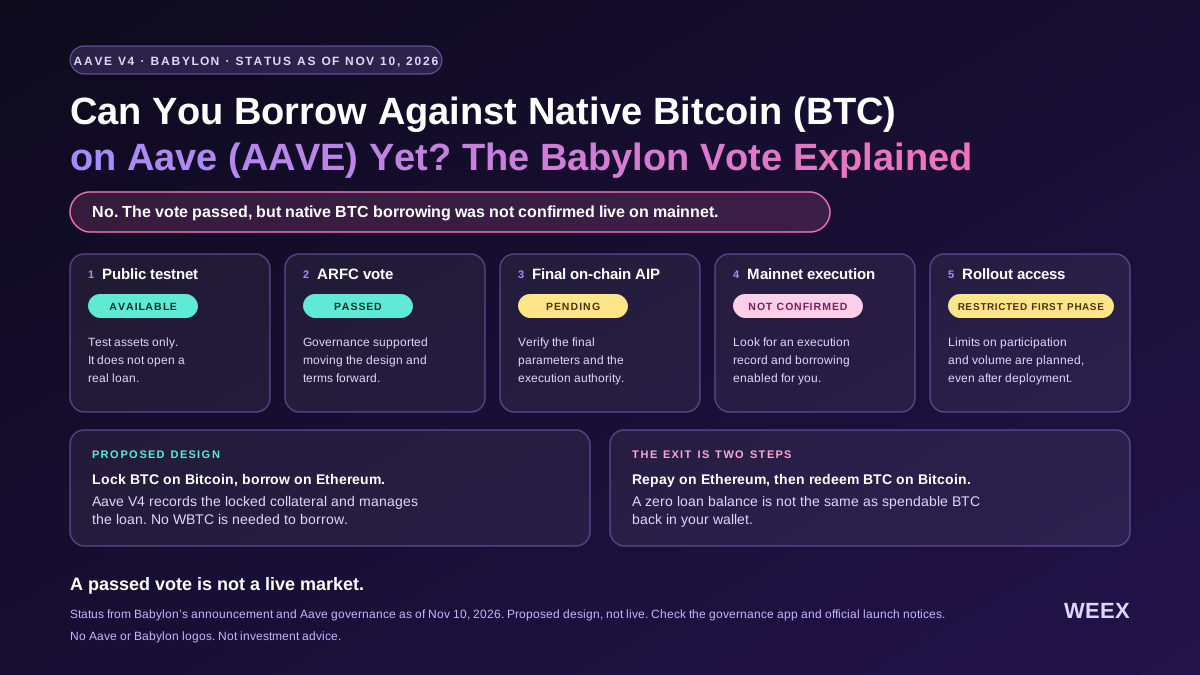
Can You Borrow Against Native Bitcoin (BTC) on Aave (AAVE) Yet? The Babylon Vote Explained
Can you borrow against native Bitcoin on Aave yet? See what the Babylon vote approved, what still needs to launch, and how BTC liquidation would work.
Why Doesn't Bitcoin Always Rise When Stocks Rally?

Financial Commission to Manage Stock Market Volatility with Sidecars and High-Frequency Trading Checks
IMF urges Kenya to make crypto firms share customer data under Travel Rule

Kim & Chang Lawyer: "Excessive Responsibility Should Not Be Imposed on Stablecoin Issuers"

Why Did Avalanche (AVAX) Rise? What the NYSE Settlement Plan Means for AVAX Demand
See why Avalanche (AVAX) rallied after the NYSE settlement announcement, how the dedicated chain would work, and what could create demand for AVAX.

Cryptocurrency Security Checklist: Four Lessons from Phemex Safety Hub Vol. 05–08
After the Embodied AI Sector Cools Down, This Stanford Startup Secures Hundreds of Millions in Funding Against the Trend
The Mismatch Between Capital Frenzy and Deployment Economics in the Embodied Industry Clock Cycle
Ontology Suspends Block Production to Address Potential Security Risks
Who Defines Ethereum? Cultural Convergence and the Truth of Cryptocurrency
Three Blockchains Halted in Four Days, Only Chronos Rolled Back
Ontology Mainnet Resumes Operation, Sync Node Upgraded to v3.1.5
Latest articles





Latest coin listings on WEEX


