
SpaceX launches classified mission USSF-153 for the U.S. Space Force

 Prefer us on Google

**SpaceX successfully launched the classified mission USSF-153 from California and recovered the Falcon 9 booster after its 27th flight. Although the payload remains secret, the landing trajectory fuels speculation that it could involve satellites based on Starshield.
- SpaceX launched the classified mission USSF-153 from Vandenberg Space Force Base on September 10, 2026.
- Booster B1081 landed on the drone ship "A Shortfall of Gravitas" after completing its 27th flight.
- The landing zones coincide with previous Starlink launches and support a possible connection to Starshield satellites.
On September 10, 2026, SpaceX launched a classified mission for the United States Space Force from the central California coast, in an operation whose exact objective remains undisclosed. The USSF-153 mission lifted off at 11:42 a.m. EDT, equivalent to 3:42 p.m. GMT and 8:42 a.m. local time, from Vandenberg Space Force Base.
The launch utilized a Falcon 9 rocket, a family of vehicles that SpaceX employs for commercial, scientific, civil, and national security missions. The company streamed part of the flight, but the broadcast ended shortly after the first stage recovery, without providing additional details about the payload or its exact orbital destination.
A classified flight from California
The classified nature of USSF-153 limits the public information available about the satellites or equipment transported, as well as the specific entity that will receive them. Coverage from Space.com confirmed the successful launch and landing of the booster but noted that the broadcast did not clarify what the Falcon 9 was carrying or where it was headed precisely.
Such levels of secrecy are common in certain missions linked to U.S. national security, where the publication of orbital parameters or technical capabilities may be restricted. In this case, the absence of a detailed description does not imply that the payload lacks significance, but rather that operational data remains beyond the reach of public communication.
The first stage returned to Earth approximately 8.5 minutes after liftoff and landed on the drone ship A Shortfall of Gravitas, located in the Atlantic Ocean. The vehicle used was booster B1081, which thus achieved its 27th flight, a figure that reflects the central role of reusability in SpaceX's operational model.
The company's reusability record stands at 37 flights for a single booster, a mark set the previous month during a Starlink satellite mission from Florida. Although B1081 is still far from that maximum, its twenty-seventh launch confirms that Falcon 9s can maintain a high cadence even in operations associated with sensitive payloads.
Clues about a possible Starshield payload
The main public clue about USSF-153 came from the location of the rocket's stage drop zones. According to NextSpaceflight.com, those points exactly match those used in previous launches of Starlink Group 15, a similarity that could indicate a flight profile related to satellites in low Earth orbit.
Based on that coincidence, the outlet suggested that the mission could be transporting a batch of classified satellites for a U.S. Government entity. The hypothesis also points to the possibility that these vehicles could be based on SpaceX's Starshield satellite bus, although the available information does not definitively confirm the identity of the payload.
Starshield leverages technology derived from Starlink and the launch capabilities of SpaceX to support national security efforts, according to the program description published by the company. The platform thus connects the company's experience in satellite constellations with governmental needs that require services and equipment intended for strategic environments.
The possible connection to Starshield should be read as an inference and not as an official confirmation of USSF-153, as the mission remains classified. Until documents, satellite identifiers, or additional orbital information are published, the trajectory match only provides a reasonable indication to guide the analysis of specialized observers.
The Advancement of Reusability and Starlink
The launch of USSF-153 was the 102nd flight of a Falcon 9 during 2026 and the 104th launch of the Falcon family, according to data cited in mission coverage. By September 5, SpaceX had completed its 80th Starlink mission of the year, showing how much the company's annual activity depends on the expansion of its own connectivity network.
Starlink had over 11,000 satellites in orbit, with more than 11,000 operational according to counts published at the end of August 2026. This scale makes the constellation one of the largest commercial orbital projects today. The same launch infrastructure that allows deploying internet satellites also provides SpaceX with experience, frequency, and capacity to handle institutional missions with different requirements.
Using a booster with 27 flights represents an additional signal about the maturity of the Falcon 9 system, although each mission may impose particular performance and recovery conditions. In USSF-153, the company once again demonstrated that a previously used rocket can carry a reserved payload and return to a maritime platform in the Atlantic.
The landing on A Shortfall of Gravitas also allowed the vehicle to be recovered without the first stage needing to return to solid ground. That choice depends on the mission profile and the energy required to reach the intended trajectory, but in all cases seeks to preserve the booster for future operations.
What is Known and What Remains Unanswered
For now, the confirmed information is limited to the time and place of the launch, the vehicle used, the recovery of the first stage, and the classified nature of the mission. The exact number of satellites, their capabilities, their final orbit, and the specific U.S. agency that will manage the payload are not publicly known.
Space.com coverage identified Mike Wall as the author of the information and updated the note at 11:55 a.m. ET on September 10 to incorporate confirmation of the launch and landing. The report also included analysis from NextSpaceflight.com, whose interpretation of the drop zones supports the possibility of a Starshield payload, without presenting it as a confirmed fact.
The mission adds to a list of previous flights of the booster identified as B1081, including Crew-7, CRS-29, PACE, Transporter-10, EarthCARE, NROL-186, Transporter-13, TRACERS, NROL-48, and COSMO-SkyMed Second Generation FM3, in addition to 16 Starlink missions. This trajectory evidences the variety of payloads that can share the same launch platform, from scientific and crewed projects to national security operations.
The next step will depend on any data that the United States Space Force or SpaceX decide to disclose about USSF-153. Until then, technical success is confirmed, while the identity of the payload and its exact function remain protected by the classified nature of the operation.
-- Price
This content is provided for general informational purposes only and doesn't constitute financial, investment, legal, or tax advice. Any events, rewards, online promotions, or related information mentioned herein should not be considered a recommendation, solicitation, or invitation to purchase, sell, trade, or otherwise deal in any crypto assets. Crypto assets are highly volatile and may result in loss. The availability of WEEX services, products, and related events may vary by region. You are responsible for ensuring that your participation is in accordance with applicable local laws and regulations.
You may also like

Musk Claims AI Data Center Companies Face Tightening Debt Financing Channels, Over 200 Cloud Service Providers May Face Elimination

Disputed Positions on Starlink Speed Limits for Ukrainian Military

Morgan Stanley Bullish on SpaceX, Target Price $300, Focus on AI and Manufacturing Growth

Vy Capital Holds $40 Billion in SpaceX Shares, Becomes Fifth Largest Shareholder

Fedorov Proposes Drone Swap with the US for Patriot Missiles

Elon Musk predicts SpaceX revenue of 3.5 trillion by 2033, Morgan Stanley estimates 2040

Government to Invest 22 Million Dollars in Starlink for 6000 Rural Schools
The number of Starlink users has increased about fourfold in four years, but the revenue per user continues to decline

WEEX P2P now supports ILS, BHD, OMR & QAR —Merchant Recruitment Now Open

Hyperliquid Strategies Reports 38.5M HYPE Treasury After $802M Deployment

No Music App on Work Laptops: The Small Rules Behind WEEX Security
SoftBank Reports First Quarterly Net Loss in Two Years, Intel and Data Center Dragging Down Performance
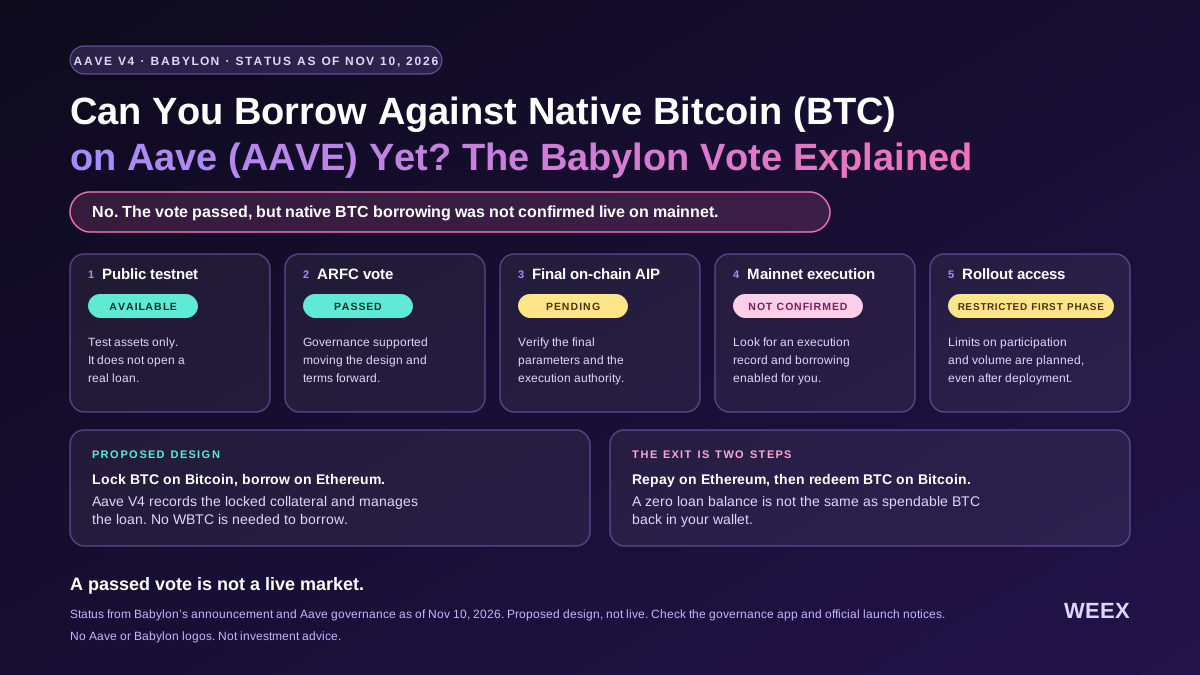
Can You Borrow Against Native Bitcoin (BTC) on Aave (AAVE) Yet? The Babylon Vote Explained
Can you borrow against native Bitcoin on Aave yet? See what the Babylon vote approved, what still needs to launch, and how BTC liquidation would work.
Why Doesn't Bitcoin Always Rise When Stocks Rally?

Financial Commission to Manage Stock Market Volatility with Sidecars and High-Frequency Trading Checks

IMF urges Kenya to make crypto firms share customer data under Travel Rule

Why Did Avalanche (AVAX) Rise? What the NYSE Settlement Plan Means for AVAX Demand
See why Avalanche (AVAX) rallied after the NYSE settlement announcement, how the dedicated chain would work, and what could create demand for AVAX.

Kim & Chang Lawyer: "Excessive Responsibility Should Not Be Imposed on Stablecoin Issuers"

Cryptocurrency Security Checklist: Four Lessons from Phemex Safety Hub Vol. 05–08

Solana's Former DEX Leader Prepares to Go All In on US Stocks

PIEVERSE Price Up Nearly 80% in a Week: Futures Activity, the November 14 Unlock and What Is Confirmed
PIEVERSE rose about 79% in seven days with futures volume far above spot. See what is confirmed about the November 14 unlock and the WEEX Lucky Eggs campaign.

Unauthorized Access to Gnosis Pay's Old Card System Leads to Customer Data Breach
Alchemy Pay Says Mississippi Licence Expands US Money Transmission Coverage to 20 States

Hong Kong Approves Crypto Asset Reporting Rules - Fintech World

Biden's Son's LAPTOP Burns 5.5% as Conditions Met in U.S. Midterm Elections

TRON surpasses 413 million accounts, but what do network stats show?

Countdown to the GENIUS Act: Only USDC and PYUSD Pass Among the Top Ten Dollar Stablecoins
NVDA Stock Falls 4.3% After Board Opens Investigation: What Is Confirmed and What Is Not
NVDA closed at $178.67 on November 9, 2026, down about 4.3%, after Nvidia’s board confirmed an independent investigation. Other claims come from media reports. WEEX’s Lucky Eggs campaign runs until November 25.

How to Resolve Data Center Controversies? This U.S. State Wants to Tokenize Computing Power to Share Benefits with Residents

Lombard Systems Raises $4M to Make Tokenized Assets Easier to Borrow Against
Musk Claims AI Data Center Companies Face Tightening Debt Financing Channels, Over 200 Cloud Service Providers May Face Elimination
Disputed Positions on Starlink Speed Limits for Ukrainian Military
Morgan Stanley Bullish on SpaceX, Target Price $300, Focus on AI and Manufacturing Growth
Vy Capital Holds $40 Billion in SpaceX Shares, Becomes Fifth Largest Shareholder
Fedorov Proposes Drone Swap with the US for Patriot Missiles
Elon Musk predicts SpaceX revenue of 3.5 trillion by 2033, Morgan Stanley estimates 2040
Latest articles
Latest coin listings on WEEX


