
How a public firm’s $70 million altcoin bet crashed 77% and left it facing Nasdaq delisting

 Prefer us on Google


Greenlane Holdings is a Nasdaq-listed company holding about 81.3 million BERA and BERA-equivalent units. Its token treasury ended the second quarter valued at about 77% below cost. A stayed Nasdaq rule could eventually expose the company to a $5 million listing test with no ordinary cure period.
At June 30, the treasury's $70.2 million cost basis compared with $16.4 million of fair value, according to Greenlane's quarterly filing. The 76.6% gap was a mark-to-market shortfall, not a realized loss from selling the tokens.
CryptoSlate Berachain market data puts the price at roughly $0.142. At that price, the same 81.3 million units would be worth about $11.6 million. That estimate is illustrative, not a company-reported current value. It assumes the holding was unchanged after quarter-end and that all BERA-equivalent positions value one-for-one.
Greenlane's liquidity and losses
Greenlane reported $6.1 million of cash at June 30, down from $32.5 million at the end of 2025. In addition, it held $8.1 million of aUSDC and sUSDe protocol instruments, presented separately from cash, against $6.5 million of current liabilities. The filing flags liquidity, redemption, counterparty, protocol and valuation risks around those instruments.
The company's $24.8 million second-quarter net loss included a $19.1 million noncash change in digital-asset fair value. It also included a separate $1.8 million impairment of its Airgraft investment. Meanwhile, Greenlane's operating loss was $3.3 million, while cash used in operations totaled about $7.1 million for the first half. These figures separate the accounting hit from cash consumed by the business.
The treasury markdown does not mechanically cause a listing failure. Nasdaq's Market Value of Listed Securities metric uses the consolidated closing bid price multiplied by listed securities. It does not use the value of Greenlane's BERA, cash or protocol assets. Nevertheless, those balances matter indirectly because they can affect investor valuation and the company's financing options.
A stayed rule with no ordinary cure
The SEC approved Nasdaq's new $5 million MVLS requirement on July 22. The Commission stayed that approval on July 29 while it reviews the decision. The official SEC docket showed no later merits order or timetable as of Aug. 15.
The rule therefore creates no current trigger for Greenlane. If it becomes operative, however, 30 consecutive business days below $5 million in MVLS would produce a Staff Delisting Determination. That process would not include the ordinary compliance period used for many listing deficiencies. A hearing request would not stay trading suspension. A panel could reverse an error or allow up to 180 days to meet all applicable initial-listing standards. That is not a standard cure period.
Greenlane said that, as of Aug. 14, it would be below the threshold without the stay. It had received no deficiency notice or Staff Delisting Determination and was evaluating unspecified alternatives to increase MVLS.
Using Greenlane's disclosed 694,544 shares and its $1.93 Aug. 13 close gives a one-day proxy of about $1.34 million. With that share count fixed, $5 million would require roughly $7.20 per share, about 273% above $1.93.
Separately, a dilutive raise is not mathematically required. A sufficient share-price recovery could lift MVLS without issuing stock. For that reason, at the disclosed share count, clearing the threshold would require that steep price increase. Greenlane disclosed no specific route, and a single day's price cannot establish a 30-business-day compliance result.
-- Price
This content is provided for general informational purposes only and doesn't constitute financial, investment, legal, or tax advice. Any events, rewards, online promotions, or related information mentioned herein should not be considered a recommendation, solicitation, or invitation to purchase, sell, trade, or otherwise deal in any crypto assets. Crypto assets are highly volatile and may result in loss. The availability of WEEX services, products, and related events may vary by region. You are responsible for ensuring that your participation is in accordance with applicable local laws and regulations.
You may also like

A New Chapter in the History of Rug Pulls in Crypto

OlympusDAO completes OHM bridge migration to CCIP, adds Robinhood Chain

New Public Chains Use Incentives to Buy TVL, Why Can't They Retain Funds? A Guide to Protocol Deployment

The Death of Hsin-Ju: A Prelude to Conspiracy

OpenSea Launches Solana NFT Trading Feature, Four Years After Initial Beta Release

City Protocol Raises $11 Million: Will It Bring Hedging, Arbitrage, and Private Equity on-chain?

TermMax Scheduled TGE on August 25, 2026

Berachain mainnet PoL Next is launched, and the BGT model transitions to the sWBERA incentive system

DeFi has reached its most dangerous moment: the real vulnerabilities are not in the code

WEEX Labs Co-Hosts ETHMilan 26 Openguin Party: Rooftop AI Trading Calling

Berachain blacklists the reward treasury and suspends BGT rewards in response to the Wasabi private key leak

Trump Media adds 1,510 Bitcoin in Q3 as treasury reaches $1.17B

Bank of Korea: Consider Existing Financial Regulations When Introducing Stablecoins

Dormant Ethereum Wallet Moves $4.6 Million. Scammers Set a Trap in Three Minutes

47% Top Tax Rate Approaches: Seven Tax Reduction Strategies for Australian Crypto Investors

WEEX P2P now supports ILS, BHD, OMR & QAR —Merchant Recruitment Now Open

Hyperliquid Strategies Reports 38.5M HYPE Treasury After $802M Deployment

No Music App on Work Laptops: The Small Rules Behind WEEX Security

SoftBank Reports First Quarterly Net Loss in Two Years, Intel and Data Center Dragging Down Performance
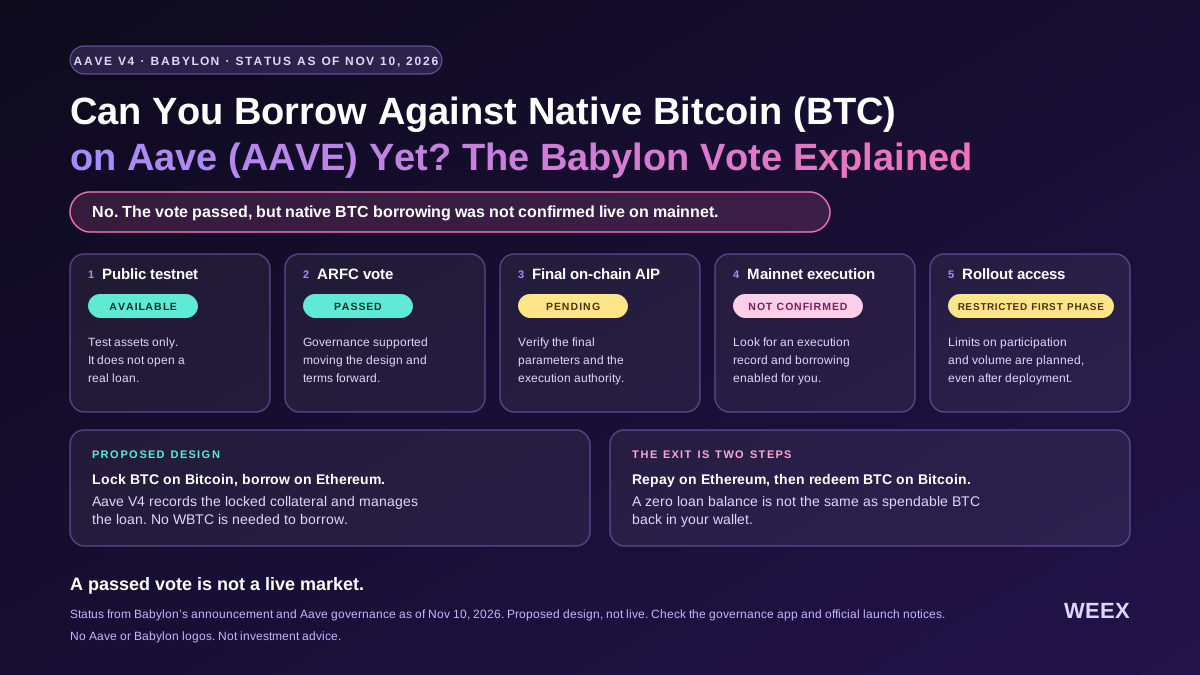
Can You Borrow Against Native Bitcoin (BTC) on Aave (AAVE) Yet? The Babylon Vote Explained
Can you borrow against native Bitcoin on Aave yet? See what the Babylon vote approved, what still needs to launch, and how BTC liquidation would work.
Why Doesn't Bitcoin Always Rise When Stocks Rally?

Financial Commission to Manage Stock Market Volatility with Sidecars and High-Frequency Trading Checks
IMF urges Kenya to make crypto firms share customer data under Travel Rule

Kim & Chang Lawyer: "Excessive Responsibility Should Not Be Imposed on Stablecoin Issuers"

Why Did Avalanche (AVAX) Rise? What the NYSE Settlement Plan Means for AVAX Demand
See why Avalanche (AVAX) rallied after the NYSE settlement announcement, how the dedicated chain would work, and what could create demand for AVAX.

Cryptocurrency Security Checklist: Four Lessons from Phemex Safety Hub Vol. 05–08

Solana's Former DEX Leader Prepares to Go All In on US Stocks

PIEVERSE Price Up Nearly 80% in a Week: Futures Activity, the November 14 Unlock and What Is Confirmed
PIEVERSE rose about 79% in seven days with futures volume far above spot. See what is confirmed about the November 14 unlock and the WEEX Lucky Eggs campaign.

Unauthorized Access to Gnosis Pay's Old Card System Leads to Customer Data Breach

Alchemy Pay Says Mississippi Licence Expands US Money Transmission Coverage to 20 States
A New Chapter in the History of Rug Pulls in Crypto
OlympusDAO completes OHM bridge migration to CCIP, adds Robinhood Chain
New Public Chains Use Incentives to Buy TVL, Why Can't They Retain Funds? A Guide to Protocol Deployment
The Death of Hsin-Ju: A Prelude to Conspiracy
OpenSea Launches Solana NFT Trading Feature, Four Years After Initial Beta Release
City Protocol Raises $11 Million: Will It Bring Hedging, Arbitrage, and Private Equity on-chain?
Latest articles


Latest coin listings on WEEX


