
From High Expectations to Controversial Turnaround, Genius Airdrop Triggers Community Backlash

 Prefer us on Google




Original Article Title: "Genius Launches Airdrop Rules: TGE Means Either Receive 70% Immediately, or Lockup for One Year to Get the Full Amount"
Original Article Author: Asher, Odaily Planet Daily
Yet another anti-rug project has emerged...
Following the last update on the token airdrop with a total token supply of 21% (divided into three seasons: Season 1, Season 2, Season 3, each season accounting for 7%), yesterday, YZi Labs, with "tens of millions of dollars" invested, and with CZ joining as an advisor, Genius updated its Season 1 airdrop document. According to the latest content, a total of 70 million GENIUS tokens will be distributed during TGE, and early users have two ways to claim:
· Choose to Claim Immediately at TGE: The deadline for immediate claiming is 7 days after TGE. If a user chooses to claim immediately, 70% of the tokens will be automatically burned. For example, if a user's total claim amount is 100 GENIUS tokens and they choose to claim immediately, they will lose 70 GENIUS tokens, ultimately receiving only 30 GENIUS, while the remaining 70 GENIUS will be permanently destroyed;
· Choose to Lock for One Year and Claim later: This claiming method will not be subject to any penalties. Users do not need to take any action but wait for the airdrop claiming window to close. After that, the user's token allocation will be locked in the smart contract for one year. For example, if a user's total claim amount is 100 GENIUS tokens and they choose to lock up for one year before claiming, they will receive 100 GENIUS after one year.
According to the latest information from the official Telegram, Genius explains that this airdrop distribution scheme aims to provide an exit path for users who are not concerned about the project's long-term development while also rewarding those who stay and truly believe in the product.
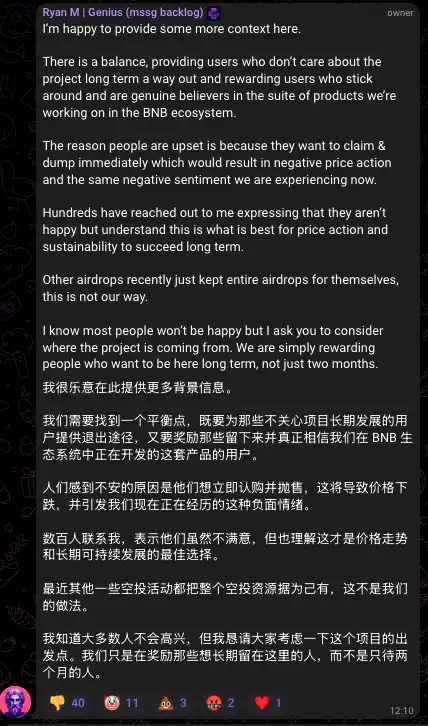
Genius Official Explanation of Airdrop Rules
Even more interestingly, the official document includes a section on the airdrop featuring a past tweet from CZ (Tweet content: "If you ever envied those who bought crypto at a low price and endured through the cycles, think about what they did at moments like this.")
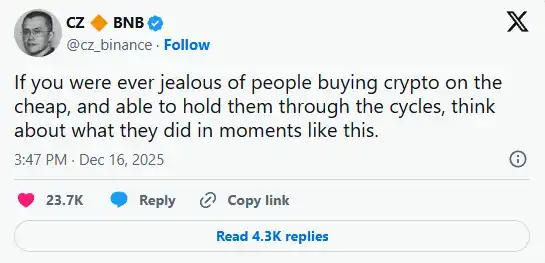
This airdrop claiming rule has ignited strong dissatisfaction in the rug pull community.
YZi Labs Invests “Tens of Millions of Dollars” with CZ as Advisor: Genius
Genius is a privacy-centric decentralized trading platform that offers spot, perpetual, and copy trading, supporting over 10 blockchains including BNB Chain and Solana. Its goal is to become Binance's on-chain alternative - bringing CEX-like speed, liquidity, and privacy to the blockchain while remaining fully self-custodial, non-custodial (users holding their private keys).
As early as October 2024, Genius announced the completion of a $6 million seed round with CMCC Global leading, and participation from Cadenza Ventures, AVA Labs, Arca, Flow Traders, and other institutions.
Then on January 13 this year, Genius announced that YZi Labs had invested “tens of millions of dollars” in it, with CZ personally joining as an advisor.
Textbook-Level Anti-Rug Pull Process: From Hype to Rule Reversal
After the rules were announced, the community's most immediate feeling was of being “betrayed.” Community members complained that with CZ's endorsement and a detailed TGE schedule, everyone was willing to spend real money on trading volume for months, only to be told just before the TGE that they had to “cut 70% off” - “either take the remaining balance and leave, or spend another year with the project team.”
If we break down the whole process, this looks more like a “textbook-level anti-rug pull process” involving continuous adjustment of expectations and ultimately rule adjustments on the eve of TGE.
Initially, what was presented was a narrative with hardly any controversy: the funds, advisors, airdrop ratio, and timing were all clearly displayed, with a logical flow and clear expectations. Within this framework, continuing to generate volume, invest time and money actually became the “rational choice” for rug pullers.
Expectations were then recalibrated. Airdrop ratio reductions and distribution structure adjustments, these changes themselves were not uncommon and could even be explained in the market environment at the time. Many rug pullers chose to continue to invest at this stage, essentially accepting the new expectation of “lower returns but still room for growth.”
The real turning point came on the eve of TGE. After the claiming rules were redesigned, the previously determined allocation turned into a multiple-choice question with constraints - either accept a significant loss in exchange for liquidity, or bear the time cost for the full amount. At this point, the gap between expectation and reality was rapidly magnified.
Cost Reassessment: Aside from Early Users, Recent "Whale Farmers" Users May Face Collective "Rug Pull"
According to feedback from several long-term participants in the "farming" activity, the cost of acquiring GP points through transaction volume in recent weeks ranged from approximately $0.025 to $0.045 per point.
However, for a project that has been live for a few months and has yet to even fix the turntable function, early users find it challenging to maintain high expectations for the listing price or the second-quarter airdrop. Given this expectation, most people are more likely to choose to burn 70% during the TGE, immediately claim the remaining 30%, which means that the actual cost is directly amplified. In equivalent terms, the actual cost has now risen to $0.083 to $0.15 per point.
According to user Nathan's analysis, if the total points issuance is 200 million, for users who have been farming GP points through transaction volume in recent weeks, Genius' listing FDV would need to be at least $8 billion to avoid a "rug pull".
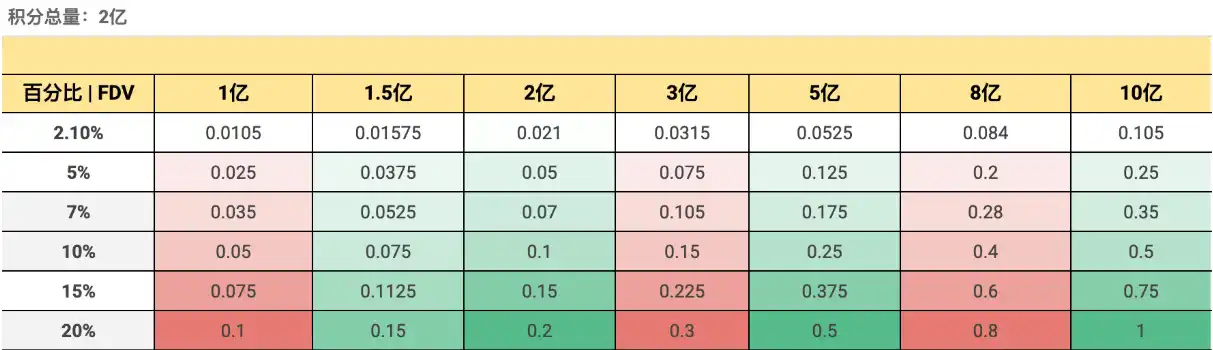
Airdrop Ratio vs. FDV Relationship
Perhaps, only the very early users will not lose money.
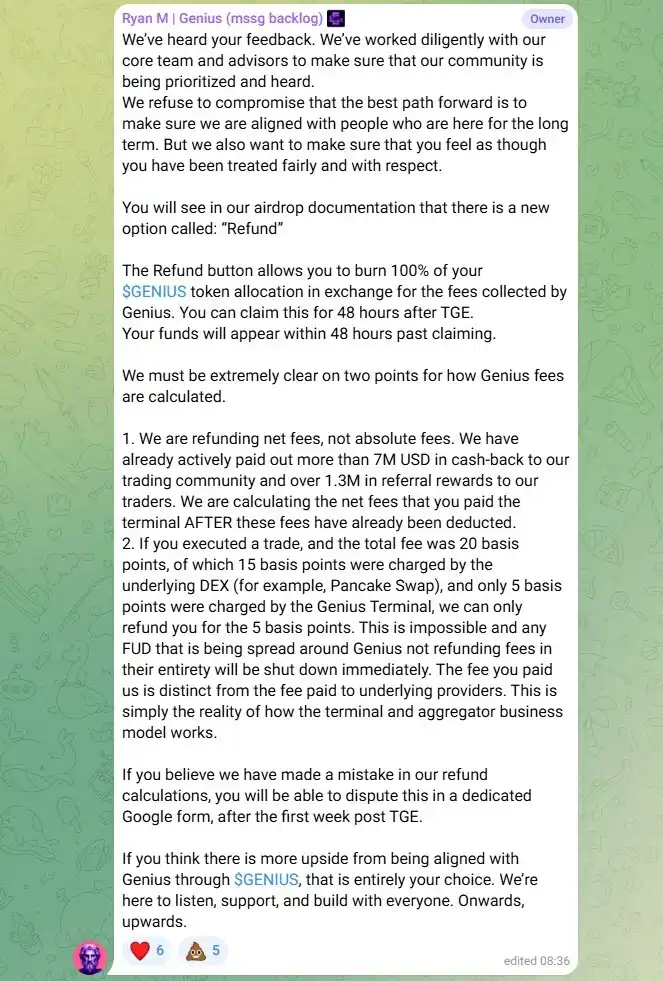
Team Response: Burning All Airdropped Tokens Can Refund All Fees Generated in Genius
After announcing the airdrop rules, the Genius community was filled with dissatisfaction. This morning, following feedback from the community, the team posted on the official Telegram channel stating that a "refund" option will be added during the airdrop claiming process. Choosing the refund option means destroying 100% of the GENIUS airdrop allocation in exchange for the fees charged by Genius. Users can request a refund within 48 hours after the TGE ends, and the refund will be processed within 48 hours after the request. Additionally, regarding the calculation of Genius fees, users need to understand the following two points:
What is refunded is the net fee, not the absolute fee. Genius has already distributed over $7 million in cash rebates to the trading community and over $1.3 million in referral rewards to traders. The team calculates the net fee that users actually paid to the trading terminal, which has already deducted the aforementioned expenses;
If a user conducts a transaction with a total fee of 20 basis points, where 15 basis points are charged by the underlying decentralized trading platform (such as PancakeSwap), and the Genius terminal only charges 5 basis points, Genius can only refund the 5 basis points fee to the user.
Genius cannot refund the user's full fee because the fee paid to Genius is different from the fee paid to the underlying provider.
Disclaimer: This content is provided for general branding and informational purposes only and doesn't constitute financial, investment, legal, or tax advice. Any events, rewards, online events, or related information mentioned herein should not be considered a recommendation, solicitation, or invitation to purchase, sell, trade, or otherwise deal in any crypto assets or to use any services. Crypto assets are highly volatile and may result in loss. WEEX services and online events may not be available in all regions and are subject to applicable laws, regulations, and eligibility requirements. You are responsible for ensuring that your use of WEEX services complies with local laws and for carefully assessing the risks before participating in any crypto-related activities.
You may also like

Suspension of Telegram's 't.me' Domain Affects Access to TON Wallet and Cryptocurrency Ecosystem

Understanding Circle Founder Jeremy Allaire's Paper on the 'Agent Economy': Insights into How Economic Structures Will Transform in the Next Decade

The Age of Exploration for HashKey On-Chain: Fully Embracing RWA and Building a New Paradigm for On-Chain Financial Infrastructure

On-Chain Financial Strategies of the Three Mega Banks: How Stablecoins and AI Will Transform the Future of Banking | WebX 2026

US Banking Associations Demand Strengthening of Stablecoin Interest Regulations

Three Positive Conditions in the Bitcoin Market, but Recovery Trend Remains Uncertain - Wintermute
A Year Later, 'Lean Ethereum' Sets Off Again: What Does Ethereum Aim to Deliver?
NEAR Governance Vote To Scrap Gas Rebates Puts Developer Incentives Under Review
eToro’s Extended Stake Shows Retail Brokers Are Still Eyeing On-Chain Derivatives
Deflation in the US in June: What It Means for Your Investments

OFAC FirstVPN Sanctions Show Crypto Enforcement Is Moving Up The Infrastructure Stack

Kraken Card Launch Brings Everyday Crypto Spending Back Into The Exchange Race

Ethereum Research Thread Puts Sybil Resistance Back In Focus For Decentralized Networks
Predicted 'Apocalypse of DeFi Hacks' Did Not Occur; Is This Sector Safer in the Age of AI?
Fed's Barr: AI Boosts Productivity but May Widen Wealth Gap
Tether targets $11T payroll market with major USAT expansion push
NFT Skill Registry Proposal Gives ERC-721s A More Active Role In On-Chain Automation

Starknet Memory Protocol Draft Puts User-Owned AI Data On The Crypto Agenda
Circle Bets on Argentina and Aims to Bring Stablecoins to the Financial System
Chainalysis Adds Automatic Stablecoin Support As Compliance Teams Face Token Sprawl
CoinFund's David Pakman says crypto hasn't solved tokenomics
Ethereum Governance Debate Turns To Who Really Controls Voting Power
The Clarity Act isn't a ticket to sanctions evasion, actually

Ethereum Foundation Clear Signing Push Targets Crypto’s Blind Approval Problem
Bitcoin Sees a Major Shift Between Old and New Investors
US Transfers $288 Million in Cryptocurrencies, Raising Market Alarm; 'The Missing Catalyst,' Says Coinext CEO
Injective SDK Compromise Puts Wallet Private Keys Back In The Security Spotlight
EMPIRES Opens Registrations, Betting on Solving the Economic Problem of Web3 Games

Blockchain.RIO to Feature 13 Content Tracks Discussing the Future Financial Infrastructure of Latin America

Timelock Account Recovery Gives Ethereum Smart Accounts A Safer Backup Route
Suspension of Telegram's 't.me' Domain Affects Access to TON Wallet and Cryptocurrency Ecosystem
Understanding Circle Founder Jeremy Allaire's Paper on the 'Agent Economy': Insights into How Economic Structures Will Transform in the Next Decade
The Age of Exploration for HashKey On-Chain: Fully Embracing RWA and Building a New Paradigm for On-Chain Financial Infrastructure
On-Chain Financial Strategies of the Three Mega Banks: How Stablecoins and AI Will Transform the Future of Banking | WebX 2026
US Banking Associations Demand Strengthening of Stablecoin Interest Regulations
Three Positive Conditions in the Bitcoin Market, but Recovery Trend Remains Uncertain - Wintermute
Contents
Latest articles






Latest coin listings on WEEX


