
Fogo Foundation Reports Unauthorized Transfer of 400 Million FOGO Tokens

 Prefer us on Google


The Fogo Foundation reported that an unknown attacker has transferred approximately 400 million FOGO tokens, while the blockchain continues to operate normally and efforts with exchanges, authorities, and forensic experts are ongoing.
- The Fogo Foundation attributed the transfer of approximately 400 million FOGO tokens to an unknown attacker.
- The incident has not affected the Fogo blockchain, which continues to operate normally.
- The organization has notified exchanges and is coordinating the investigation with authorities and forensic experts.
The Fogo Foundation reported that it was recently compromised by an unknown attacker, in an incident that allegedly resulted in the transfer of approximately 400 million FOGO tokens to an address linked to the aggressor. The announcement, dated August 29 in the UTC+8 timezone, opened an investigation into the access used and the destination of the assets, although the organization has not yet publicly identified the perpetrator or provided a detailed technical explanation.
According to information released by KuCoin based on a report from ME News, the foundation immediately notified relevant exchanges and began coordinating actions with authorities and forensic analysis specialists. The response aims to track the movement of the tokens and limit the possibilities of trading the funds, but no names of platforms, additional addresses, or specific measures applied to the involved accounts have been disclosed.
What Happened to the FOGO Tokens
The central fact of the case is a transfer of approximately 400 million FOGO tokens from the foundation to an address associated with the attacker. This figure represents the volume reported by the organization and does not, by itself, equate to a monetary valuation of the damage, as the original news does not provide a market price, a reference quote, or an estimate of the total value of the assets.
The foundation described the episode as a compromise of its own structure, not as a general disruption of the network. This distinction is relevant for users, as unauthorized access to the accounts or reserves of an entity does not necessarily imply that the attacker has altered the consensus mechanism, the blocks, or the transactions of the entire blockchain.
The organization also did not attribute the incident to a specific group, person, or jurisdiction. By classifying the perpetrator as unknown, the statement keeps the investigation open and avoids presenting any hypothesis about the access route, the tools used, or the identity of the holder of the receiving address as conclusive.
The temporal reference also requires precision: the report places the announcement on August 29 under the UTC+8 timezone and notes that the compromise occurred recently, without providing an exact time or a complete timeline of the transfers. For now, the confirmed data is limited to the reported compromise, the approximate volume moved, and the address that the foundation identified as linked to the attacker.
The Fogo Network Remains Operational
One of the main messages from the foundation is to separate the unauthorized transfer of assets from the operation of the Fogo blockchain. The entity assured that the incident did not affect the network itself, which continues to function normally, so the announcement does not describe a service outage or an interruption in transaction processing.
Fogo presents itself in the disclosed information as a Layer 1 network based on SVM architecture. Generally speaking, a Layer 1 chain maintains its own validation and recording infrastructure, while SVM refers to an environment compatible with the execution of programs developed for the Solana virtual machine; however, the news does not attribute the incident to a specific failure of that technology.
The operational continuity of the network does not diminish the seriousness of the compromise suffered by the foundation. A blockchain can continue producing blocks while a related entity loses control over a reserve of tokens, so users must distinguish between the availability of the infrastructure and the security of the accounts managing funds or project allocations.
The organization did not report a pause in the network, a rollback of transactions, or a modification of the protocol. It also did not indicate that validators or general users had lost funds, so any conclusion about a broader impact would exceed the confirmed facts so far.
Coordination with Exchanges and Authorities
After detecting the transfer, the foundation stated that it immediately notified the relevant exchanges. This type of notification allows platforms to be alerted about possible deposits related to the moved funds, although the available statement does not confirm that any exchange has frozen assets, blocked an account, or rejected operations linked to the flagged address.
Cooperation with forensic experts aims to reconstruct the sequence of the incident by analyzing addresses, on-chain movements, and possible points of access. This work can help identify patterns and track the tokens, but the published information does not detail which firm is involved, what tools will be used, or if there is already a preliminary conclusion about the method employed.
The foundation also stated that it is coordinating actions with the authorities, without specifying which agencies received the notification or in which jurisdiction the investigation is taking place. This reserve prevents anticipating legal outcomes and forces treating any hypotheses about responsible parties, accomplices, or asset recovery as unconfirmed.
The case illustrates why post-incident communication must differentiate between verified facts, ongoing measures, and promises of follow-up. In this episode, the transferred amount, the attacker's address, the notifications, and the continuity of the network are part of the announcement; the identity of the aggressor, the intrusion mechanism, and the final destination of the tokens remain open.
What to Expect from Upcoming Updates
The foundation has committed to promptly disclose new updates, a promise that places transparency at the center of the response. Upcoming statements could specify when the transfer was detected, which accounts were compromised, what additional movements were observed, and what measures the notified platforms adopted, but none of these details are confirmed in the initial information.
For ecosystem participants, the coming hours and days will be important to differentiate the original movement from any subsequent transfers. Public tracking of the flagged address may provide signals about attempts to split, exchange, or move the tokens, although observing a transaction does not in itself prove who controls an address nor guarantees the recovery of the funds.
It will also be relevant for Fogo to explain whether the impact was limited to a reserve managed by the foundation or if it involved other connected systems. So far, the organization has maintained that the blockchain continues to operate normally and has not reported additional losses among users, so the confirmed scope remains confined to the approximately 400 million FOGO transferred.
As the investigation progresses, the incident adds pressure on the management of treasuries and institutional accounts within digital asset projects. Fogo's technical continuity may prevent a network disruption, but trust will depend on the foundation providing a clear timeline, keeping exchanges informed, and accurately explaining what happened without confusing the security of the protocol with that of its custodians.
The available information does not allow us to assert that the tokens have been sold, recovered, or frozen, nor that the network has suffered a structural vulnerability. For now, the fact communicated by the foundation is that an unknown attacker allegedly transferred approximately 400 million FOGO from a reserve of the organization, while it maintains coordination with exchanges, authorities, and forensic experts.
-- Price
This content is provided for general informational purposes only and doesn't constitute financial, investment, legal, or tax advice. Any events, rewards, online promotions, or related information mentioned herein should not be considered a recommendation, solicitation, or invitation to purchase, sell, trade, or otherwise deal in any crypto assets. Crypto assets are highly volatile and may result in loss. The availability of WEEX services, products, and related events may vary by region. You are responsible for ensuring that your participation is in accordance with applicable local laws and regulations.
You may also like

Fogo mainnet back online after recovery of 237 million stolen tokens

Fogo Mainnet Has Been Stopped For 46 Hours With No Restart Timeline

Trump Media adds 1,510 Bitcoin in Q3 as treasury reaches $1.17B

Bank of Korea: Consider Existing Financial Regulations When Introducing Stablecoins

Dormant Ethereum Wallet Moves $4.6 Million. Scammers Set a Trap in Three Minutes

47% Top Tax Rate Approaches: Seven Tax Reduction Strategies for Australian Crypto Investors

WEEX P2P now supports ILS, BHD, OMR & QAR —Merchant Recruitment Now Open

Hyperliquid Strategies Reports 38.5M HYPE Treasury After $802M Deployment

No Music App on Work Laptops: The Small Rules Behind WEEX Security

SoftBank Reports First Quarterly Net Loss in Two Years, Intel and Data Center Dragging Down Performance
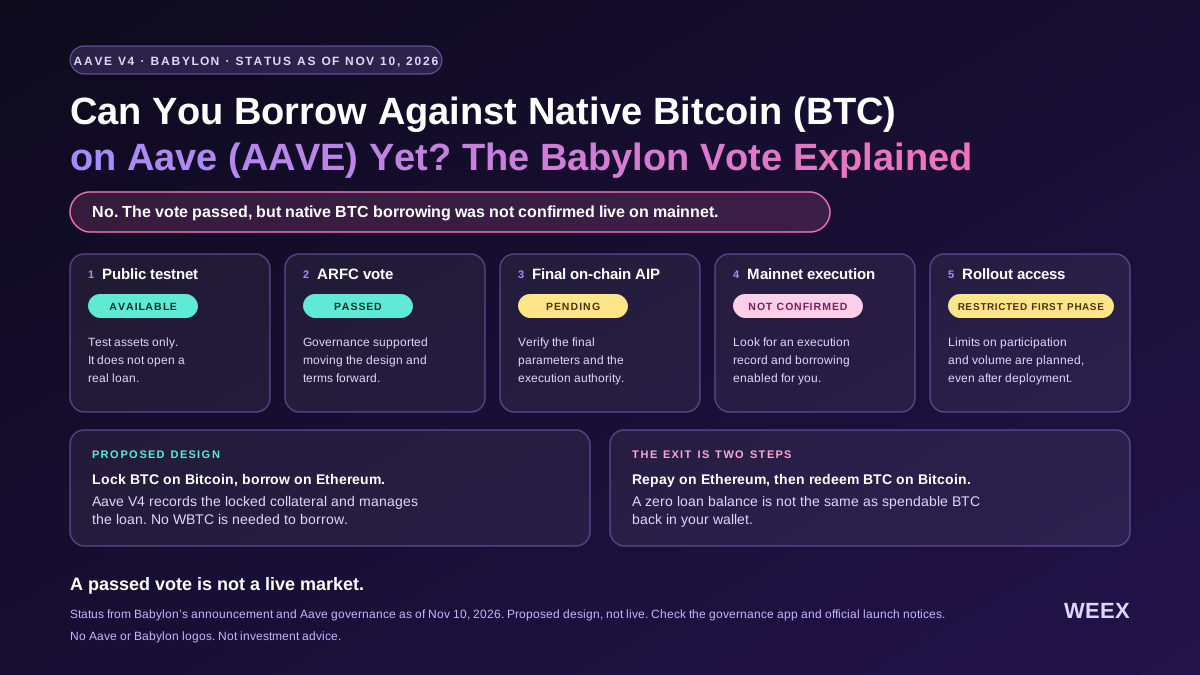
Can You Borrow Against Native Bitcoin (BTC) on Aave (AAVE) Yet? The Babylon Vote Explained
Can you borrow against native Bitcoin on Aave yet? See what the Babylon vote approved, what still needs to launch, and how BTC liquidation would work.
Why Doesn't Bitcoin Always Rise When Stocks Rally?

Financial Commission to Manage Stock Market Volatility with Sidecars and High-Frequency Trading Checks
IMF urges Kenya to make crypto firms share customer data under Travel Rule

Kim & Chang Lawyer: "Excessive Responsibility Should Not Be Imposed on Stablecoin Issuers"

Why Did Avalanche (AVAX) Rise? What the NYSE Settlement Plan Means for AVAX Demand
See why Avalanche (AVAX) rallied after the NYSE settlement announcement, how the dedicated chain would work, and what could create demand for AVAX.

Cryptocurrency Security Checklist: Four Lessons from Phemex Safety Hub Vol. 05–08

Solana's Former DEX Leader Prepares to Go All In on US Stocks

PIEVERSE Price Up Nearly 80% in a Week: Futures Activity, the November 14 Unlock and What Is Confirmed
PIEVERSE rose about 79% in seven days with futures volume far above spot. See what is confirmed about the November 14 unlock and the WEEX Lucky Eggs campaign.

Unauthorized Access to Gnosis Pay's Old Card System Leads to Customer Data Breach

Alchemy Pay Says Mississippi Licence Expands US Money Transmission Coverage to 20 States

Hong Kong Approves Crypto Asset Reporting Rules - Fintech World

Biden's Son's LAPTOP Burns 5.5% as Conditions Met in U.S. Midterm Elections

TRON surpasses 413 million accounts, but what do network stats show?

Countdown to the GENIUS Act: Only USDC and PYUSD Pass Among the Top Ten Dollar Stablecoins

NVDA Stock Falls 4.3% After Board Opens Investigation: What Is Confirmed and What Is Not
NVDA closed at $178.67 on November 9, 2026, down about 4.3%, after Nvidia’s board confirmed an independent investigation. Other claims come from media reports. WEEX’s Lucky Eggs campaign runs until November 25.
How to Resolve Data Center Controversies? This U.S. State Wants to Tokenize Computing Power to Share Benefits with Residents

Lombard Systems Raises $4M to Make Tokenized Assets Easier to Borrow Against

When is the launch date of Bitcoin Hyper? Testnet, tokens, and mainnet are separate milestones

Westpac's Cryptocurrency Payment Limit (A$10,000): What Changes on December 1, 2026
Fogo mainnet back online after recovery of 237 million stolen tokens
Fogo Mainnet Has Been Stopped For 46 Hours With No Restart Timeline
Trump Media adds 1,510 Bitcoin in Q3 as treasury reaches $1.17B
Bank of Korea: Consider Existing Financial Regulations When Introducing Stablecoins
Dormant Ethereum Wallet Moves $4.6 Million. Scammers Set a Trap in Three Minutes
47% Top Tax Rate Approaches: Seven Tax Reduction Strategies for Australian Crypto Investors
Latest articles

Latest coin listings on WEEX


