
Cardano’s police evidence system could bring 1.5 million annual transactions

 Prefer us on Google
Cardano has highlighted plans to use its blockchain to secure criminal evidence records across India's police and judicial systems, as developer Trivolve Tech seeks treasury funding to expand an existing forensic management application.
Summary
- Cardano has highlighted Trivolve Tech's plans to expand blockchain evidence tracking across India's police and judicial systems, covering investigations, storage, prosecution and court proceedings.
- Trivolve Tech is seeking 9.6 million ADA in treasury funding to develop its Police Force Management System, with an initial deployment planned across approximately 3,500 facilities in Telangana.
- The proposed system could generate more than 1.53 million Cardano mainnet transactions in its first year, with approximately 113,000 personnel and 3.2 million evidence items covered.
- Trivolve Tech already operates a forensic evidence management application in Uttar Pradesh that has processed more than 156,000 Cardano mainnet transactions.
In a November 10 Governance Hour video, Trivolve Tech founder and CEO Rahul Konudula explained how the proposed Police Force Management System, or PFMS, would track evidence from the earliest stages of police work through investigations, storage, prosecution and courtroom proceedings.
Cardano Governance Hour:
Securing the Entire Chain of Evidence on Cardano | @Rahulkonudula Explains:
"PFMS is the Police Force Management System. What the Police Force Management System does is it secures the entire chain of evidence. The entire chain of evidence starts with... pic.twitter.com/9HnW5Y7GnO
--- Cardano (@Cardano) November 10, 2026
"The entire chain of evidence is now being tracked and secured on Cardano," Konudula said while describing the system's overall design.
The proposal builds on Trivolve Tech's existing Forensic Management System, which already operates with police in Uttar Pradesh. The company now wants to develop a common infrastructure that can connect separate stages of the criminal justice process without requiring authorities to replace their existing applications.
How Cardano would secure police evidence records
According to the Cardano Foundation's case study, the existing forensic application addresses a problem with how evidence is identified and handled as it moves between police stations and forensic laboratories.
Evidence boxes traditionally carry case numbers that remain visible to everyone handling them. Trivolve Tech's system replaces those shared identifiers with separate codes for each authorized participant, making it harder for individuals working at different stages to coordinate unauthorized changes.
Police officers record evidence through an application, while secure QR codes identify individual boxes. Laboratory personnel receive different identifiers when scanning the evidence, and each recorded action is linked to Cardano through a cryptographic hash.
The blockchain stores a digital fingerprint of the record, allowing authorities to check whether the underlying information has changed. Sensitive case files and personal information remain within government systems.
Trivolve Tech says the existing application has processed more than 156,000 mainnet transactions, with approximately 11,000 transactions generated monthly.
The proposed PFMS would take the same approach beyond forensic laboratories and cover five stages of criminal proceedings, including evidence collection before a crime, investigations, storage facilities, prosecution and courts.
Trivolve Tech seeks 9.6 million ADA for PFMS expansion
The company's treasury funding proposal requests 9.6 million ADA over 15 months to develop the infrastructure for deployment in Telangana, India.
Trivolve Tech estimates that the first deployment could generate more than 1.53 million Cardano mainnet transactions during its first year.
Its projections cover approximately 3,500 facilities, 113,000 personnel, 1.81 million devices and 3.2 million evidence items, with around 5.1 million decentralized identifiers expected across the system.
The developer has proposed making the core infrastructure open source under the Apache 2.0 license so other police departments and judicial authorities can adopt it.
Under the proposed arrangement, the government customer would pay ongoing blockchain transaction fees, infrastructure expenses and maintenance costs after deployment.
Trivolve Tech expects PFMS to generate revenue through an optional evidence verification service available to authorized parties, including defense lawyers and prosecutors.
Verification requests would start at $1.89, with higher charges for larger or more complicated datasets.
The proposed revenue distribution would return 70% to Cardano's treasury, allocate 20% to maintaining core Cardano libraries and provide the remaining 10% to Trivolve Tech.
Cardano treasury funding remains subject to community approval
The PFMS funding request comes as Cardano's governance community continues to review how treasury resources should support development and institutional adoption.
In October, Cardano's Project Catalyst selected 12 projects from 117 applications for a separate 2 million ADA funding program. The program ties most grant payments to adoption targets and sustained network activity.
Treasury spending has previously faced opposition from delegated representatives. As crypto.news reported in June, a 7.8 million ADA proposal for the Cardano Summit failed after receiving 65.2% support, below the required two-thirds threshold.
Cardano has meanwhile pursued other applications involving verifiable records in India.
In October, the Cardano Foundation reported that 100,000 farms had been registered through agricultural technology provider 5am.earth, which uses blockchain records alongside satellite observations and field information.
Trivolve Tech's earlier forensic project received support through Project Catalyst Fund 12, where the company and enterprise software provider Quixy requested 550,000 ADA to integrate Cardano into evidence management for Uttar Pradesh.
The original Catalyst proposal described a six-month development plan focused on securing evidence integrity through blockchain timestamps at the point of capture.
This content is provided for general informational purposes only and doesn't constitute financial, investment, legal, or tax advice. Any events, rewards, online promotions, or related information mentioned herein should not be considered a recommendation, solicitation, or invitation to purchase, sell, trade, or otherwise deal in any crypto assets. Crypto assets are highly volatile and may result in loss. The availability of WEEX services, products, and related events may vary by region. You are responsible for ensuring that your participation is in accordance with applicable local laws and regulations.
You may also like

Algorithmic Trading and Cryptocurrencies: How Do Robots React to Volatility?

Confidence at Zero! Goldman Sachs Interprets Hedge Fund Positions: 'Surrender Liquidation', Largest Loss Since the Pandemic

Any Bitcoin recovery faces a cash problem as Binance’s stablecoins fall to $32 billion

MARA Bitcoin Mining Costs Reach $62,862 Per Coin, With Electricity Costs at $39,674

Europe Prepares Common Standards for Tokenized Securities

D-Wave (QBTS) Earnings: Revenue Growth, Lower Bookings, and the Commercialization Test

Rigetti (RGTI) Stock Rebounds: Earnings, Backlog, and Commercial Progress
IonQ (IONQ) Stock Rallies: Q3 Results, Quantum Orders, and Business Expansion

CoreWeave (CRWV) Stock: Debt Pressure, Data Center Policy, and Earnings

Nebius Group (NBIS) Stock Rebound: AI Cloud Demand, Earnings, and Financing Risks

SK Hynix (SKHY) Stock Rebounds: AI Memory Demand, Cycle Risk, and Fab Plans

Core inflation excludes oil. Bitcoin investors still cannot ignore it

What Happened Today in the Crypto Market? A Review of the Most Important Cryptocurrency News (November 9, 2023)

Coinbase, Kalshi, and Kraken Support CFTC in Court Dispute Over Perpetual Stock Contracts

US Congress Calls for Limiting NVIDIA Chip Exports to China Amid Spy Scandal

Bloomberg: With Democrats Regaining Control of Congress, Are Good Days Over for the Crypto Industry in Washington?

Cryptocurrency Anarchism Lacks Commitment, Coordination, and Reputation, Not New Tokens

Pharos Network Integrates Fireblocks for Institutional-Grade Custody Workflow for RealFi Assets

230,000-Follower 'Crypto Guru' Exposed: 30 Alt Accounts Uncovered for Fan Harvesting

Enza Closes $6 Million Funding Round to Develop Payment Infrastructure

AI Fills Gaps in the Crypto Industry: Fifteen Startup Opportunities to Watch

Trump Media adds 1,510 Bitcoin in Q3 as treasury reaches $1.17B

Bank of Korea: Consider Existing Financial Regulations When Introducing Stablecoins

Dormant Ethereum Wallet Moves $4.6 Million. Scammers Set a Trap in Three Minutes

47% Top Tax Rate Approaches: Seven Tax Reduction Strategies for Australian Crypto Investors

WEEX P2P now supports ILS, BHD, OMR & QAR —Merchant Recruitment Now Open

Hyperliquid Strategies Reports 38.5M HYPE Treasury After $802M Deployment

No Music App on Work Laptops: The Small Rules Behind WEEX Security

SoftBank Reports First Quarterly Net Loss in Two Years, Intel and Data Center Dragging Down Performance
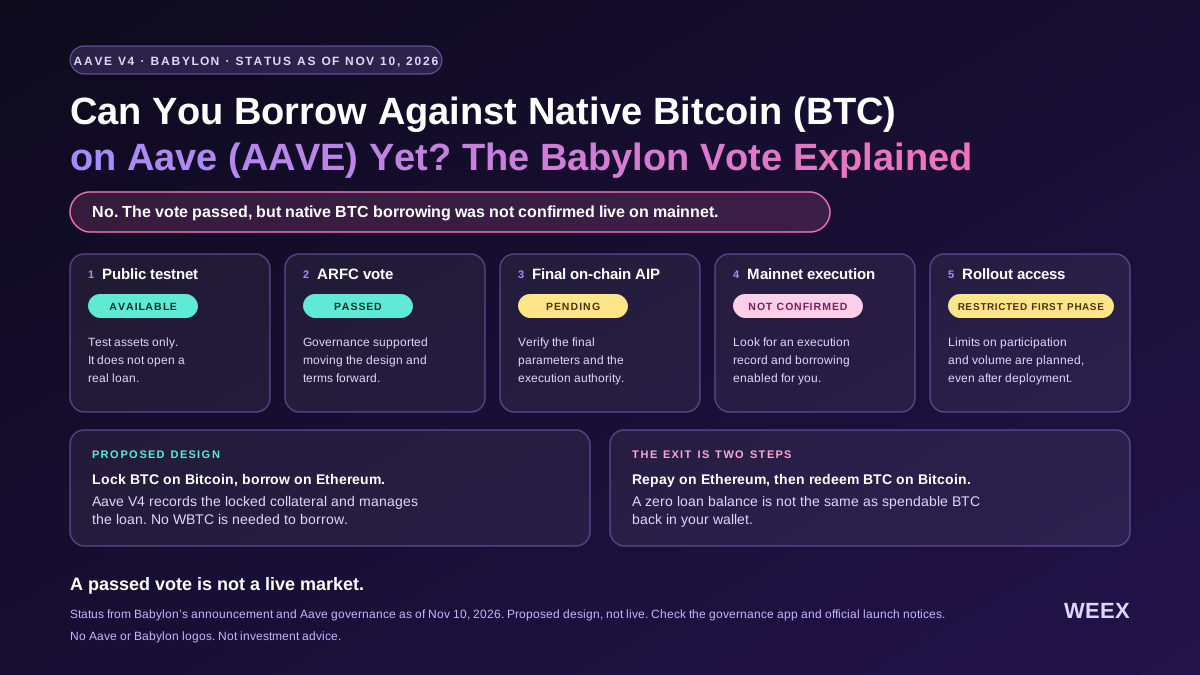
Can You Borrow Against Native Bitcoin (BTC) on Aave (AAVE) Yet? The Babylon Vote Explained
Can you borrow against native Bitcoin on Aave yet? See what the Babylon vote approved, what still needs to launch, and how BTC liquidation would work.
Algorithmic Trading and Cryptocurrencies: How Do Robots React to Volatility?
Confidence at Zero! Goldman Sachs Interprets Hedge Fund Positions: 'Surrender Liquidation', Largest Loss Since the Pandemic
Any Bitcoin recovery faces a cash problem as Binance’s stablecoins fall to $32 billion
MARA Bitcoin Mining Costs Reach $62,862 Per Coin, With Electricity Costs at $39,674
Europe Prepares Common Standards for Tokenized Securities
D-Wave (QBTS) Earnings: Revenue Growth, Lower Bookings, and the Commercialization Test
Latest articles
Latest coin listings on WEEX


