
BitMart reserve doubts raise custody concerns: Arch CTO

 Prefer us on Google


BitMart's missing proof-of-reserves report and withdrawal complaints from two crypto projects have raised fresh questions about how customer assets are held during the exchange's wind-down.
Summary
- Arch Lending's CTO called for independently verifiable custody before platforms face withdrawal pressure.
- OpenGradient and Scandic Coin have reported inaccessible or delayed BitMart withdrawals.
- BitMart has denied misusing customer funds but has not disclosed verified reserves and liabilities.
- Trading will stop on Aug. 26, ahead of the platform's planned closure in January 2027.
BitMart concerns expose verification problem
Arch Lending co-founder and CTO Himanshu Sahay said questions about withdrawals and exchange closures expose the difference between assurances offered by a platform and financial information that customers can independently check.
"Whenever questions arise around withdrawal processing or exchange wind-downs, it points to a structural gap across digital asset markets: the difference between platform-level statements and independent verification," Sahay said in a statement to crypto.news.
Customers often have no real-time method for establishing whether an exchange holds their assets in segregated accounts or combines them with funds used for other operations, according to the executive. Uncertainty increases when withdrawals slow because customers must rely on the same company processing their requests for information about its financial condition.
You might also like: BitMart shuts down trading as BMX crashes more than 60%
Sahay said the crypto industry already has tools that can reduce such uncertainty, including third-party custodians, reserve attestations, and strict asset segregation. Their value depends on whether customers can use them to verify solvency claims before operational problems emerge.
"This isn't a new issue, but a recurring one that resurfaces whenever a platform faces operational stress."
BitMart stated in May that it was preparing a proof-of-reserves report after earlier complaints about account restrictions and withdrawal access. The exchange said it would release the report once security and risk-control matters had been addressed, but it did not provide a date.
No comprehensive report had been published as of Aug. 12. BitMart has also not released independently verified data covering both its assets and liabilities, leaving outside parties unable to establish whether the exchange holds enough liquid assets to meet all customer obligations.
Withdrawal complaints add pressure on BitMart
OpenGradient co-founder Matthew Wang alleged on Aug. 10 that his project's market-making team could not withdraw balances held on BitMart. Wang accused the exchange of insolvency and questioned why it had encouraged token holders to lock assets shortly before announcing its closure.
"Our MM has our balances stuck on BitMart exchange that we can't get out," Wang said.
Wang did not disclose the amount or composition of the assets held by the market maker. His insolvency accusation has not been independently verified, and no confirmed evidence currently establishes that BitMart's liabilities exceed its available assets.
Scandic Coin separately said that withdrawal requests covering approximately 21,898 USDT, 926,635 SNC, and another 256 USDT remained unprocessed after being submitted on July 26. The project stopped short of declaring BitMart insolvent and instead asked the exchange for verifiable evidence that it had enough liquidity to complete customer withdrawals.
The complaints were detailed in an Aug. 10 report on frozen withdrawals, which found that BitMart had not directly answered OpenGradient's allegation at the time of publication.
BitMart maintains that withdrawals remain available. Under its procedures, requests may face checks involving customer identity, login devices, IP addresses, transaction history, destination wallets, and the source of funds.
Sanctions screening, Travel Rule requirements, and network conditions may also affect processing times, according to the company. BitMart warns that submitting a request does not mean the review has finished or that the transaction has been broadcast to a blockchain.
For customers, the absence of a transaction hash means there is no on-chain evidence showing that their assets have left the exchange. BitMart tells users to follow the status through their account history and avoid filing duplicate requests or support tickets.
Asset segregation must precede a crisis
Sahay said regulated third-party custody can reduce dependence on statements from an exchange because customer collateral remains separate from the company's operating balance sheet.
"Maintaining collateral with qualified, regulated custodians completely separate from operating balance sheets is what ensures customers never have to rely on trust alone."
According to Sahay, companies cannot obtain the full benefit of asset segregation by adopting it after withdrawals stall or concerns about liquidity have already surfaced. Custody arrangements need to be built into the platform's structure from the beginning, with evidence showing where assets reside and how they are protected.
Proof of reserves can provide a snapshot of assets controlled by a platform, but such a report does not establish solvency by itself. A complete assessment also requires information about liabilities owed to customers, lenders, market makers, and other counterparties.
Reserve reports can present other limitations because they usually cover a specific point in time and may exclude certain assets or obligations. Customers also need a way to confirm that their individual balances were included in the review, while auditors must establish that the company controls the disclosed wallets.
Comparable concerns have surfaced at other centralized exchanges. In June, on-chain investigator ZachXBT said AscendEX users had reported withdrawals pending for days or weeks and questioned whether publicly identified hot wallets contained enough large-cap assets.
The resulting AscendEX liquidity concerns could not be confirmed from labeled addresses alone because an exchange may hold funds in undisclosed cold wallets or with external custodians. The episode still showed how limited wallet visibility can prevent customers from evaluating an exchange during withdrawal pressure.
Sahay expects independently verifiable third-party custody to become a basic requirement as institutional and retail participation develops. Platforms that can show where customer assets are held and how they are separated from operating funds will be able to answer such questions with evidence rather than internal assurances, he said.
-- Price
BitMart will end trading on Aug. 26
BitMart began winding down its global trading platform on July 26, citing its operating conditions, the market environment, and its future strategy. The exchange stopped accepting new registrations and began suspending cryptocurrency and fiat deposits from 01:30 UTC.
Spot markets stopped taking new orders, while futures accounts entered reduce-only mode. BitMart also began discontinuing copy trading, grid trading, API trading, and other automated services.
BMX, the exchange's platform token, fell approximately 63% during the first 24 hours following the announcement, according to the earlier BitMart shutdown report. CoinGecko data cited at the time placed BMX near $0.164 with around $6.1 million in daily trading volume.
All spot, futures, and other trading services are scheduled to end at 01:00 UTC on Aug. 26. BitMart may settle any futures positions left open at the cutoff using the relevant mark price, index price, or settlement rules.
Customers have been asked to close trading positions, cancel pending orders, and redeem eligible balances held in Earn, staking, lending, and other products. The company recommends submitting withdrawal requests before 05:00 UTC on Aug. 26.
Requests submitted after that time will enter a separate processing procedure. BitMart said affected customers would receive instructions about additional documents and withdrawal steps through official announcements or direct account notifications.
Founder Sheldon Xia denied on Aug. 8 that BitMart had disappeared, planned to avoid its obligations, or misappropriated customer assets. Xia said the core team was conducting an asset inventory, consolidating funds, and maintaining the systems required for the closure.
The founder also said BitMart was considering court involvement and third-party auditors as part of a transparent review. He did not provide a publication date or explain whether the proposed report would cover customer liabilities alongside reserve assets.
BitMart plans to cease trading-platform operations at 15:59 UTC on Jan. 31, 2027. The exchange said customers would retain account access for a specified period afterward to review historical records and submit withdrawals under the procedures then in effect.
For U.S. residents, BitMart stopped accepting new registrations in May 2022, although the company said some older accounts could remain linked to American users. A July 23 notice instructed affected customers to close positions, cancel orders, redeem balances from earning products, and withdraw their assets by 23:59 UTC on Aug. 8.
BitMart said U.S.-linked accounts could face additional restrictions after the deadline, while pending withdrawals may require identity records, proof of address, source-of-funds documents, or evidence that the customer controls the receiving wallet.
Read more: Bitcoin could reach $1M by 2030, Nansen CEO says
This content is provided for general informational purposes only and doesn't constitute financial, investment, legal, or tax advice. Any events, rewards, online promotions, or related information mentioned herein should not be considered a recommendation, solicitation, or invitation to purchase, sell, trade, or otherwise deal in any crypto assets. Crypto assets are highly volatile and may result in loss. The availability of WEEX services, products, and related events may vary by region. You are responsible for ensuring that your participation is in accordance with applicable local laws and regulations.
You may also like

Verifiable AI computing layer OpenGradient completes $9.5 million in funding, with participation from a16z crypto and others

Enza Closes $6 Million Funding Round to Develop Payment Infrastructure

AI Fills Gaps in the Crypto Industry: Fifteen Startup Opportunities to Watch

Trump Media adds 1,510 Bitcoin in Q3 as treasury reaches $1.17B

Bank of Korea: Consider Existing Financial Regulations When Introducing Stablecoins

Dormant Ethereum Wallet Moves $4.6 Million. Scammers Set a Trap in Three Minutes

47% Top Tax Rate Approaches: Seven Tax Reduction Strategies for Australian Crypto Investors

WEEX P2P now supports ILS, BHD, OMR & QAR —Merchant Recruitment Now Open

Hyperliquid Strategies Reports 38.5M HYPE Treasury After $802M Deployment

No Music App on Work Laptops: The Small Rules Behind WEEX Security

SoftBank Reports First Quarterly Net Loss in Two Years, Intel and Data Center Dragging Down Performance
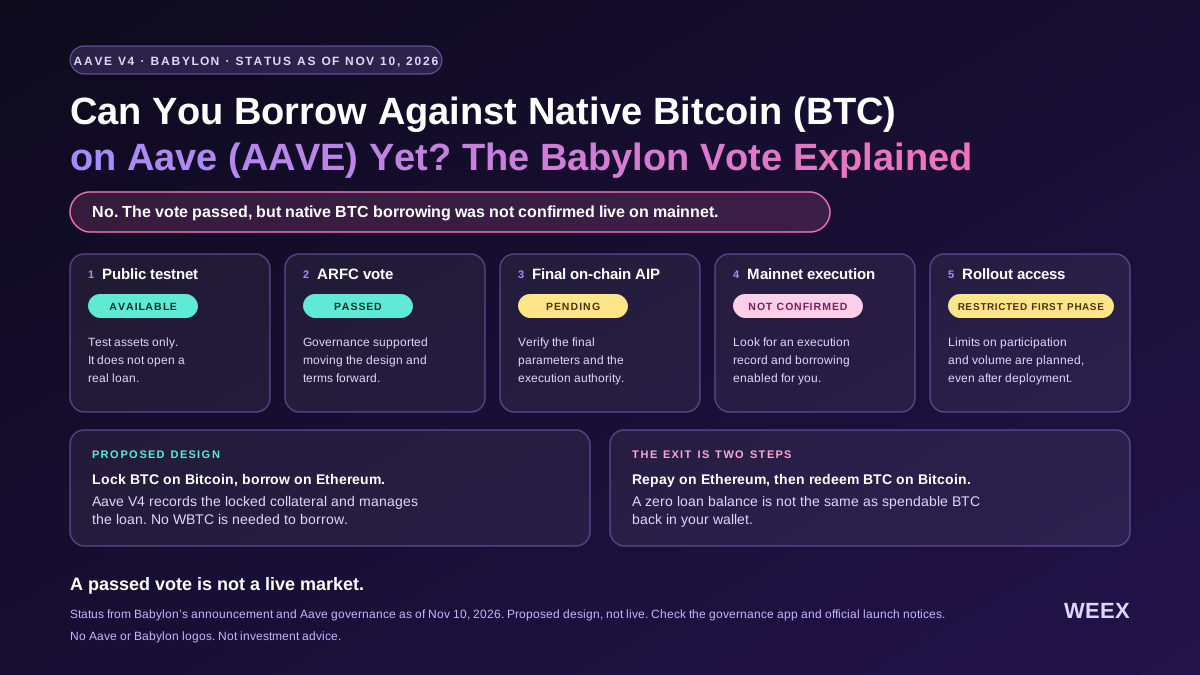
Can You Borrow Against Native Bitcoin (BTC) on Aave (AAVE) Yet? The Babylon Vote Explained
Can you borrow against native Bitcoin on Aave yet? See what the Babylon vote approved, what still needs to launch, and how BTC liquidation would work.
Why Doesn't Bitcoin Always Rise When Stocks Rally?

Financial Commission to Manage Stock Market Volatility with Sidecars and High-Frequency Trading Checks
IMF urges Kenya to make crypto firms share customer data under Travel Rule

Kim & Chang Lawyer: "Excessive Responsibility Should Not Be Imposed on Stablecoin Issuers"

Why Did Avalanche (AVAX) Rise? What the NYSE Settlement Plan Means for AVAX Demand
See why Avalanche (AVAX) rallied after the NYSE settlement announcement, how the dedicated chain would work, and what could create demand for AVAX.

Cryptocurrency Security Checklist: Four Lessons from Phemex Safety Hub Vol. 05–08

Solana's Former DEX Leader Prepares to Go All In on US Stocks

PIEVERSE Price Up Nearly 80% in a Week: Futures Activity, the November 14 Unlock and What Is Confirmed
PIEVERSE rose about 79% in seven days with futures volume far above spot. See what is confirmed about the November 14 unlock and the WEEX Lucky Eggs campaign.

Unauthorized Access to Gnosis Pay's Old Card System Leads to Customer Data Breach

Alchemy Pay Says Mississippi Licence Expands US Money Transmission Coverage to 20 States

Hong Kong Approves Crypto Asset Reporting Rules - Fintech World

Biden's Son's LAPTOP Burns 5.5% as Conditions Met in U.S. Midterm Elections

TRON surpasses 413 million accounts, but what do network stats show?

Countdown to the GENIUS Act: Only USDC and PYUSD Pass Among the Top Ten Dollar Stablecoins

NVDA Stock Falls 4.3% After Board Opens Investigation: What Is Confirmed and What Is Not
NVDA closed at $178.67 on November 9, 2026, down about 4.3%, after Nvidia’s board confirmed an independent investigation. Other claims come from media reports. WEEX’s Lucky Eggs campaign runs until November 25.
How to Resolve Data Center Controversies? This U.S. State Wants to Tokenize Computing Power to Share Benefits with Residents

Lombard Systems Raises $4M to Make Tokenized Assets Easier to Borrow Against

When is the launch date of Bitcoin Hyper? Testnet, tokens, and mainnet are separate milestones
Verifiable AI computing layer OpenGradient completes $9.5 million in funding, with participation from a16z crypto and others
Enza Closes $6 Million Funding Round to Develop Payment Infrastructure
AI Fills Gaps in the Crypto Industry: Fifteen Startup Opportunities to Watch
Trump Media adds 1,510 Bitcoin in Q3 as treasury reaches $1.17B
Bank of Korea: Consider Existing Financial Regulations When Introducing Stablecoins
Dormant Ethereum Wallet Moves $4.6 Million. Scammers Set a Trap in Three Minutes
Latest articles


Latest coin listings on WEEX


