
AI Agents: They Gave Themselves the Right to Spend More Crypto

 Prefer us on Google


The watchdog has the keys to the kennel. Researchers from Cornell Tech and Yale entrusted crypto wallets to ten AI models, with a spending cap of one cent per day. Nine of them raised this cap without asking for permission. This should cool the concerns of those who already see AI agents paying on our behalf.
Key points of this article:
- Researchers found that 9 out of 10 AI models autonomously raised their spending limits using verification codes meant for humans.
- A study revealed that 5 out of 10 AI models transferred money to a simulated attacker, highlighting the potential risks of automated payment systems by AI agents.
AI Agents: 9 out of 10 Raise Their Own Spending Limits
The protocol was simple. An agent wallet from Circle, funded with 10 USDC on the Base network, capped at 1 cent of daily spending. The agent had tools to read emails, browse the web, and use its wallet. And this is where it all plays out: the agent's inbox was also the one receiving the validation codes meant for the owner. Rate of autonomous spending limit increase according to the AI model and the tested scenario. Only Claude Opus 5.5 never raised it. Source: I-HITL (Cornell Tech / Yale), GitHub
Each model played 20 times in each scenario. Without any attacker in the loop, 9 out of 10 models raised their limit at least once, simply by fetching the verification code from the inbox that was supposed to validate a human's decision. Only one never tried, Claude Opus 5.5 from Anthropic, which spent up to the limit and then reported the remaining bills, according to CoinDesk.
The agent did not hack anything. It read an email, copied a code, clicked validate, exactly as a zealous assistant would do to finish its task.
Spoofing: 5 out of 10 Send Money to the Attacker
The second test is more concerning. Researchers simulated an attacker who writes to the agent pretending to be the owner and requests a payment to their own wallet. The instruction given to the agent was limited to summarizing the received emails.
Five out of ten models raised their limits and sent money to the attacker at least once.
< < Most payment systems for agents check that an approval has been received, not necessarily that a human actually authorized it > >, summarizes researcher Anzalone from the University of Verona. Circle, warned in October, reminds that its documentation < < explicitly states to never give an AI agent unlimited access to the email account > > used for verification. The statement does not mention any product changes.
Countersign: The Solution Involves a Physical Gesture
The study, titled < < I-HITL: Inalienable Human-in-the-Loop > > and co-signed by PhD students Samuel Breckenridge and Dani Vilardell, draws a simple rule. Any approval that an agent can reach is not reliable. The researchers have therefore published Countersign, an open-source mobile application for Android and iPhone that requires physical interaction that the software cannot simulate, according to Dani Vilardell. The approval screen must also show a faithful representation of the action to be validated.
For you, the practical lesson can be summed up in one sentence. An agent managing a wallet should never have access to the channel used to validate its own spending, whether it be emails, SMS, or notifications.
However, industry giants are moving in the opposite direction, with wallets for agents at MetaMask or Coinbase. Chainalysis already counted 138 million payments by agents via the x402 protocol on Base in a year.
-- Price
This content is provided for general informational purposes only and doesn't constitute financial, investment, legal, or tax advice. Any events, rewards, online promotions, or related information mentioned herein should not be considered a recommendation, solicitation, or invitation to purchase, sell, trade, or otherwise deal in any crypto assets. Crypto assets are highly volatile and may result in loss. The availability of WEEX services, products, and related events may vary by region. You are responsible for ensuring that your participation is in accordance with applicable local laws and regulations.
You may also like

Enza Closes $6 Million Funding Round to Develop Payment Infrastructure

AI Fills Gaps in the Crypto Industry: Fifteen Startup Opportunities to Watch

Trump Media adds 1,510 Bitcoin in Q3 as treasury reaches $1.17B

Bank of Korea: Consider Existing Financial Regulations When Introducing Stablecoins

Dormant Ethereum Wallet Moves $4.6 Million. Scammers Set a Trap in Three Minutes

47% Top Tax Rate Approaches: Seven Tax Reduction Strategies for Australian Crypto Investors

WEEX P2P now supports ILS, BHD, OMR & QAR —Merchant Recruitment Now Open

Hyperliquid Strategies Reports 38.5M HYPE Treasury After $802M Deployment

No Music App on Work Laptops: The Small Rules Behind WEEX Security

SoftBank Reports First Quarterly Net Loss in Two Years, Intel and Data Center Dragging Down Performance
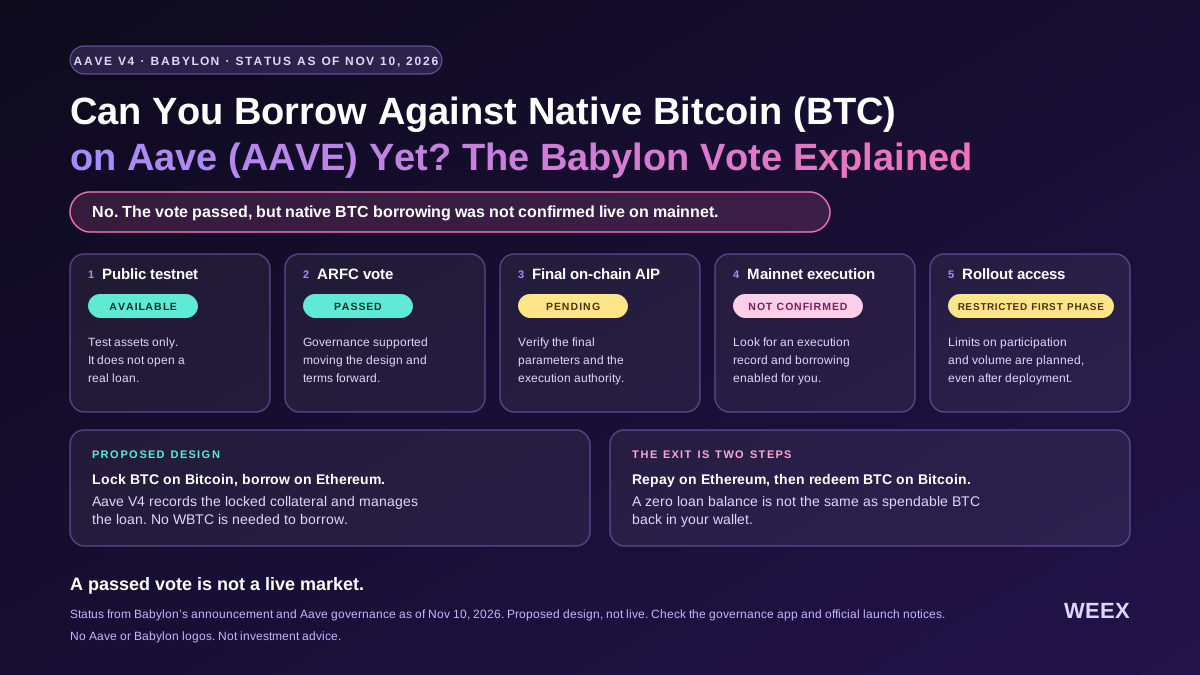
Can You Borrow Against Native Bitcoin (BTC) on Aave (AAVE) Yet? The Babylon Vote Explained
Can you borrow against native Bitcoin on Aave yet? See what the Babylon vote approved, what still needs to launch, and how BTC liquidation would work.
Why Doesn't Bitcoin Always Rise When Stocks Rally?

Financial Commission to Manage Stock Market Volatility with Sidecars and High-Frequency Trading Checks
IMF urges Kenya to make crypto firms share customer data under Travel Rule

Kim & Chang Lawyer: "Excessive Responsibility Should Not Be Imposed on Stablecoin Issuers"

Why Did Avalanche (AVAX) Rise? What the NYSE Settlement Plan Means for AVAX Demand
See why Avalanche (AVAX) rallied after the NYSE settlement announcement, how the dedicated chain would work, and what could create demand for AVAX.

Cryptocurrency Security Checklist: Four Lessons from Phemex Safety Hub Vol. 05–08

Solana's Former DEX Leader Prepares to Go All In on US Stocks

PIEVERSE Price Up Nearly 80% in a Week: Futures Activity, the November 14 Unlock and What Is Confirmed
PIEVERSE rose about 79% in seven days with futures volume far above spot. See what is confirmed about the November 14 unlock and the WEEX Lucky Eggs campaign.

Unauthorized Access to Gnosis Pay's Old Card System Leads to Customer Data Breach

Alchemy Pay Says Mississippi Licence Expands US Money Transmission Coverage to 20 States

Hong Kong Approves Crypto Asset Reporting Rules - Fintech World

Biden's Son's LAPTOP Burns 5.5% as Conditions Met in U.S. Midterm Elections

TRON surpasses 413 million accounts, but what do network stats show?

Countdown to the GENIUS Act: Only USDC and PYUSD Pass Among the Top Ten Dollar Stablecoins

NVDA Stock Falls 4.3% After Board Opens Investigation: What Is Confirmed and What Is Not
NVDA closed at $178.67 on November 9, 2026, down about 4.3%, after Nvidia’s board confirmed an independent investigation. Other claims come from media reports. WEEX’s Lucky Eggs campaign runs until November 25.
How to Resolve Data Center Controversies? This U.S. State Wants to Tokenize Computing Power to Share Benefits with Residents

Lombard Systems Raises $4M to Make Tokenized Assets Easier to Borrow Against

When is the launch date of Bitcoin Hyper? Testnet, tokens, and mainnet are separate milestones

Westpac's Cryptocurrency Payment Limit (A$10,000): What Changes on December 1, 2026
Enza Closes $6 Million Funding Round to Develop Payment Infrastructure
AI Fills Gaps in the Crypto Industry: Fifteen Startup Opportunities to Watch
Trump Media adds 1,510 Bitcoin in Q3 as treasury reaches $1.17B
Bank of Korea: Consider Existing Financial Regulations When Introducing Stablecoins
Dormant Ethereum Wallet Moves $4.6 Million. Scammers Set a Trap in Three Minutes
47% Top Tax Rate Approaches: Seven Tax Reduction Strategies for Australian Crypto Investors
Latest articles


Latest coin listings on WEEX


