
Why SpaceX and OpenAI IPOs Are Draining Bitcoin Liquidity

 Prefer us on Google


\Key Takeaways
- SpaceX’s IPO is real and imminent: Reuters says pricing is set for June 11, 2026, trading may start June 12, and the company is targeting a $1.75 trillion valuation with a $135 IPO price.
- OpenAI is also moving closer to public markets, with Reuters reporting it is laying groundwork for an IPO that could value it at up to $1 trillion and could file as soon as the second half of 2026.
- Bitcoin is weak for a reason: Reuters says investors are shifting money from bitcoin ETFs into AI stocks and upcoming listings, while bitcoin has fallen about one-third in 2026 and ETF outflows have reached $3.1 billion year to date.
- The liquidity drain is indirect, not magical. SpaceX and OpenAI do not “pull BTC out of wallets,” but they compete for the same risk capital, ETF allocations, and growth-focused money.
- The biggest message for traders is simple: when megacap IPOs and AI narratives are hot, Bitcoin often stops being the market’s favorite speculative asset.
SpaceX and OpenAI are not literally draining Bitcoin out of the blockchain. They are draining the marginal cash, attention, and risk budget that often fuels Bitcoin rallies. Reuters has already tied Bitcoin’s weak 2026 performance to booming AI stocks and glittering new listings such as SpaceX, while also noting heavy ETF outflows from bitcoin products and large inflows into semiconductor funds. OpenAI’s IPO groundwork adds a second giant AI narrative competing for the same capital pool. That is why the real story is capital rotation, not a conspiracy.
Wanna Trade Safe & Fast? Join WEEX and Earn!
Why This Matters Now
The timing is important. Reuters reports that SpaceX is heading toward a June 12 Nasdaq debut under the ticker SPCX, with a $1.75 trillion valuation target, only about 7% of shares freely tradeable at launch, and major index providers already preparing early inclusion rules that could force passive funds to buy the stock. OpenAI, meanwhile, is laying groundwork for a possible IPO that could value it at up to $1 trillion, with preliminary talk of filing in the second half of 2026. Those are not small events. They are some of the biggest prospective liquidity magnets in public markets right now.
Bitcoin is feeling the pressure because markets rarely have unlimited dry powder. Reuters says bitcoin is down about 33% so far in 2026 and has lost about 40% from where it was when Trump took office in January 2025. At the same time, U.S. semiconductor stocks have surged 170% over the last year, and the largest bitcoin ETFs have seen record outflows of $2.7 billion in a single week, bringing 2026 net outflows to $3.1 billion. That is the kind of money flow pattern that tells you where speculative capital is going.
The key idea is simple: if AI megacaps and huge IPOs are offering the strongest narrative in the market, traders and institutions will often reallocate from Bitcoin into those names. This is not because Bitcoin suddenly stopped mattering. It is because Bitcoin is competing against a more glamorous, more institution-friendly theme at the exact moment liquidity is being priced carefully again.
The Real Meaning of “Liquidity Drain”
When people say SpaceX and OpenAI are draining Bitcoin’s liquidity, they usually do not mean that Bitcoin’s on-chain liquidity has disappeared. They mean that capital that might have flowed into Bitcoin, bitcoin ETFs, or crypto derivatives is now being redirected into AI stocks, semiconductor ETFs, and anticipated mega-IPOs. Reuters explicitly says the capital going into AI-related stocks has to come from somewhere, and it shows investors pulling money out of bitcoin ETFs while semiconductor ETFs soak up billions.
That distinction matters. Bitcoin liquidity has several layers: exchange order books, ETF flows, derivative funding, and broader investor risk appetite. SpaceX and OpenAI do not touch all of those directly. But they do affect the broadest layer, which is the pool of money available for speculative allocation. If a pension fund, hedge fund, family office, or retail trader decides to chase AI instead of BTC, the result is the same for Bitcoin: less buying pressure.
This is exactly why the phrase “secretly draining” works as a headline but should be understood carefully. The drain is not secret in a literal sense. It is hidden in portfolio decisions, ETF redemptions, benchmark rebalancing, and headline-driven sentiment shifts. Those flows are harder to see than a big Bitcoin sale, but they can matter more because they persist over time.
How SpaceX Pulls Capital Away From Bitcoin
SpaceX is especially powerful because it combines several traits that the market loves: Elon Musk, scarcity of shares, massive valuation, and index-driven demand. Reuters says MSCI’s early inclusion rules may clear SpaceX for global benchmarks, while Nasdaq and FTSE Russell have also made changes that could help newly listed megacaps join their indexes. That means the SpaceX IPO is not just a single stock event. It is a possible multi-index ownership event.
Why does that hurt Bitcoin? Because many of the same investors who buy BTC during “risk-on” periods are also the ones who chase big growth stories. When SpaceX becomes the hottest IPO of the year, it can absorb attention, margin, and cash that might otherwise have flowed into crypto. Reuters even reports that bitcoin is losing share to AI stocks and new listings such as SpaceX, which is an unusually direct statement about capital competition across asset classes.
There is also a psychological effect. SpaceX’s valuation is so extreme that it becomes a trade in its own right. Reuters says it is targeting a $1.75 trillion valuation and a $135 IPO price, while one analysis says that works out to 94.53 times 2025 sales. That kind of headline can dominate trading rooms and social feeds for weeks. When a new market obsession appears, Bitcoin often becomes the asset that investors “mean to get back to later.” Later often means not now.
How OpenAI Pulls Capital Away From Bitcoin
OpenAI is a different kind of liquidity drain, but it may be just as important. Reuters says the Sam Altman-led company is laying groundwork for an IPO that could value it at up to $1 trillion and may file as soon as the second half of 2026. That means investors are looking at another giant AI name with enormous brand power, enormous growth expectations, and a public-market debut that could attract both retail and institutional money.
The difference is that OpenAI is not a hard-asset scarcity story like Bitcoin. It is a future-growth narrative. But in capital markets, the competition is still the same. Investors only have so much risk budget. If OpenAI becomes the next must-own AI stock, it will compete with Bitcoin for the same “high-conviction growth” allocation. That is especially true for funds that already treat crypto as a speculative macro bet rather than a core portfolio holding.
OpenAI also has a retail angle. Reuters reported that OpenAI plans to reserve part of its IPO for individual investors. That matters because retail participation often overlaps with the same crowd that buys Bitcoin, meme stocks, and other high-beta assets. If that audience shifts toward AI IPOs, Bitcoin can lose not just institutional flow but also the emotional bid that usually helps it during risk-on stretches.
SpaceX, OpenAI, and Bitcoin: The Liquidity Map
| Capital Channel | How SpaceX affects it | How OpenAI affects it | Impact on Bitcoin |
|---|---|---|---|
| Retail speculation | SpaceX is a huge headline trade with Musk premium and scarcity of shares. | OpenAI is a brand-name AI trade with massive public interest. | Retail money can shift away from BTC into IPO hype. |
| Institutional growth allocation | MSCI, Nasdaq, and FTSE inclusion could force buying. | A $1 trillion AI IPO would compete for growth mandates. | Less cash left for bitcoin ETFs and crypto baskets. |
| Media attention | SpaceX dominates headlines because of valuation and Musk. | OpenAI dominates AI narrative coverage. | Bitcoin loses narrative share when attention moves elsewhere. |
| ETF and passive flows | Index inclusion can create persistent buying pressure. | OpenAI could become a new benchmark-style growth holding if it lists. | BTC funds compete for the same capital base. |
| Risk appetite | A richly priced SpaceX IPO absorbs high-beta capital. | OpenAI’s IPO would absorb the same type of capital. | Bitcoin struggles when speculative appetite is captured elsewhere. |
This is the cleanest way to think about the issue. SpaceX and OpenAI do not have to “sell Bitcoin” for Bitcoin to suffer. They only need to be better uses of marginal capital in the eyes of investors. That is enough to weaken Bitcoin’s liquidity profile, especially when the crypto market is already dealing with ETF outflows and slower momentum.
Why Bitcoin Feels the Pain First
Bitcoin is usually the first asset to feel this kind of pressure because it sits at the crossroads of macro risk, speculative demand, and liquidity sensitivity. Reuters notes that bitcoin’s big appeal used to be its volatility and low correlation with other asset classes, but that appeal has diminished as institutional money, ETFs, and mainstream finance became more involved. In plain English, Bitcoin now behaves more like a risk asset that has to compete for the same dollars as stocks.
That shift makes Bitcoin vulnerable when the market falls in love with another narrative. Right now, the favorite narrative is AI. Reuters says money has piled into hyperscalers, semiconductors, chips, and the infrastructure behind AI, while bitcoin has lagged badly. That is not just a coincidence. It is a reallocation story.
There is also the ETF angle. Bitcoin ETFs made it easier for mainstream money to buy crypto exposure, but they also made Bitcoin compete directly with traditional portfolio choices. When investors sell bitcoin ETFs, that selling pressure is visible. When they buy AI stocks or IPO allocations instead, the effect is less visible but economically similar. Reuters’ data showing $3.1 billion in net bitcoin ETF outflows and $21 billion in semiconductor ETF inflows makes the rotation hard to ignore.
Is This Just Temporary, or a Bigger Shift?
It could be either. If SpaceX and OpenAI are mainly headline events, then Bitcoin may only be under pressure until the IPO excitement passes. But if the market is entering a longer AI-led capital cycle, Bitcoin could remain out of favor for much longer. Reuters’ reporting suggests the latter is possible because AI now dominates stock markets and investors are actively choosing AI-related names over Bitcoin exposure.
Another reason this may last longer than people expect is index behavior. SpaceX could be added to MSCI, Nasdaq 100-related pathways, and FTSE Russell indexes relatively quickly if the rules line up. That means the IPO may not be a one-day event. It could turn into a repeated flow story as benchmark funds buy over time. If OpenAI eventually lists and attracts similar treatment, the liquidity competition with Bitcoin could become structural rather than temporary.
Still, Bitcoin is not dead money. Reuters notes that the market remains huge, stablecoins are taking more share, and Bitcoin still commands the largest share of the crypto market at 56%. But the days when BTC automatically absorbed all speculative enthusiasm are clearly over. That is the real lesson of the SpaceX and OpenAI IPO wave.
What Traders Should Watch Next
The most important Bitcoin watch item is not only price. It is flow. If bitcoin ETF outflows continue while AI and IPO demand stays hot, BTC may keep underperforming even if the macro backdrop does not worsen. Reuters already showed that capital going into AI stocks has to come from somewhere, and right now that somewhere appears to be Bitcoin, crypto funds, and other high-beta trades.
The second watch item is IPO timing. SpaceX has a June 11 pricing date and June 12 trading target, while OpenAI could file later in 2026. If SpaceX performs well out of the gate, it may encourage more investors to rotate capital toward megacap private-market listings. If OpenAI follows, the drain can continue. If both fade, Bitcoin may finally get some of that speculative capital back.
The third watch item is whether Bitcoin reclaims its old narrative. Reuters says its correlation with the S&P 500 has recently turned deeply negative as AI stocks rally and Bitcoin lags. That means Bitcoin is currently not even benefiting from the same macro wave as tech equities. Until that changes, it will remain vulnerable to every new source of capital competition.
Final Take
SpaceX and OpenAI are draining Bitcoin liquidity because they are competing for the same thing Bitcoin needs most: marginal investment capital. SpaceX does it with a near-historic IPO, a huge valuation, and possible index flows. OpenAI does it with the biggest AI IPO narrative in years. Together, they make Bitcoin look less like the obvious growth trade and more like one risk asset among many.
That does not mean Bitcoin cannot recover. It means Bitcoin must now compete harder for attention, ETF flows, and speculative money than it did in the past. If you trade BTC, the right response is not panic. It is awareness. Watch IPO demand, watch bitcoin ETF flows, and respect the fact that the market’s favorite story can change fast. In this cycle, liquidity follows the loudest growth narrative. Right now, that narrative is SpaceX and OpenAI.
FAQ
1. Are SpaceX and OpenAI really draining Bitcoin liquidity?
Yes, but indirectly. They are not taking Bitcoin off-chain; they are competing for the same investor cash, ETF allocations, and speculative risk budget that often supports Bitcoin rallies. Reuters has explicitly linked Bitcoin weakness in 2026 to AI stocks and major upcoming listings such as SpaceX.
2. Why is SpaceX such a big threat to Bitcoin flows?
SpaceX is a massive IPO with a $1.75 trillion valuation target, a tiny free float, and potential index demand from MSCI, Nasdaq, and FTSE-linked funds. That makes it a powerful magnet for capital that might otherwise have gone into Bitcoin.
3. How does OpenAI affect Bitcoin?
OpenAI is another giant growth narrative. Reuters says it is laying groundwork for an IPO that could value it at up to $1 trillion, which can attract the same institutional and retail money that often chases Bitcoin during risk-on periods.
4. Is Bitcoin’s weakness only because of SpaceX and OpenAI?
No. Reuters also cites record bitcoin ETF outflows, growing competition from stablecoins and altcoins, and a broader rotation into AI and semiconductor stocks. SpaceX and OpenAI are major parts of the story, but they are part of a larger capital shift.
5. Could Bitcoin bounce back after the IPO hype fades?
Yes. If the IPO excitement cools, ETF flows stabilize, and Bitcoin regains a stronger macro or risk-on narrative, BTC could attract capital again. But as long as AI remains the dominant market story, Bitcoin may keep fighting for attention.
Disclaimer: This article is for informational purposes only and does not constitute financial, investment, or trading advice. Markets are volatile, and prices can move sharply based on IPO news, ETF flows, and macro sentiment. Always do your own research before making any investment or trading decision.
Disclaimer: This content is provided for general branding and informational purposes only and doesn't constitute financial, investment, legal, or tax advice. Any events, rewards, online events, or related information mentioned herein should not be considered a recommendation, solicitation, or invitation to purchase, sell, trade, or otherwise deal in any crypto assets or to use any services. Crypto assets are highly volatile and may result in loss. WEEX services and online events may not be available in all regions and are subject to applicable laws, regulations, and eligibility requirements. You are responsible for ensuring that your use of WEEX services complies with local laws and for carefully assessing the risks before participating in any crypto-related activities.
You may also like

W26 Crypto Scam or Legit? World Cup 2026 Token Explained
W26 Crypto Scam or Legit? Explore what W26 token is, its World Cup 2026 connection, price trend, risks, and whether the hype can drive future growth.

GDWR Crypto Scam or Legit? A Complete Risk Analysis
Is GDWR Crypto legit or a scam? Learn what Global Digital Water Reserve is, review its on-chain data, risk factors, and whether the project is backed by real-world water assets.

AI Stock Outlook: Will Iran Tensions Change the Market Outlook?
Explore how Iran tensions, rising oil prices, interest rates, and Big Tech AI spending could shape the next phase of the AI stock rally.
SOXS vs. SOXL: Bull or Bear on AI Stocks Amid Iran Tensions?
SOXS vs. SOXL: Which semiconductor ETF is better amid rising Iran tensions? Explore how oil prices, AI earnings, and Big Tech spending could shape the next move.

KO Stock Forecast: Does Coca-Cola's 64th Dividend Increase Change the Outlook?
Does Coca-Cola's 64th dividend increase change KO stock's outlook? Explore forecast scenarios, valuation, key growth drivers, and alternative trading options.
MU Stock Forecast: Does Micron's $3 Billion Expansion Change the Outlook?
Micron plans a $3 billion expansion to strengthen its AI memory supply chain. Explore what it means for MU stock, future outlook, and alternative ways to gain price exposure.

France vs Morocco Prediction Crypto Odds
France vs Morocco Prediction Crypto Odds explained. Learn how Polymarket market data, blockchain prediction markets, liquidity, and crypto odds work during FIFA 2026.

Why Does SpaceX Own 18,712 Bitcoin? Here's What SPCX's Nasdaq 100 Entry Means for Crypto
SpaceX owns 18,712 Bitcoin worth $1.2B+. SPCX joined Nasdaq 100 on July 7 triggering $4.3B in passive buying. What it means for crypto and BTC price in 2026.

What Is Aptos (APT) Crypto and How Does It Work? The 2026 Complete Guide
What is Aptos (APT) crypto? Learn how it works, Block-STM tech, tokenomics, April 2026 reforms, current price, ecosystem, and whether APT is a good investment in 2026.

Where and How to Buy MSTR Futures: A Complete Trading Guide
Learn where and how to buy MSTR Futures, explore traditional stock access methods, and discover USDT-based MSTR price exposure through WEEX TradFi trading. Join the TradFi Trading Challenge for potential rewards.
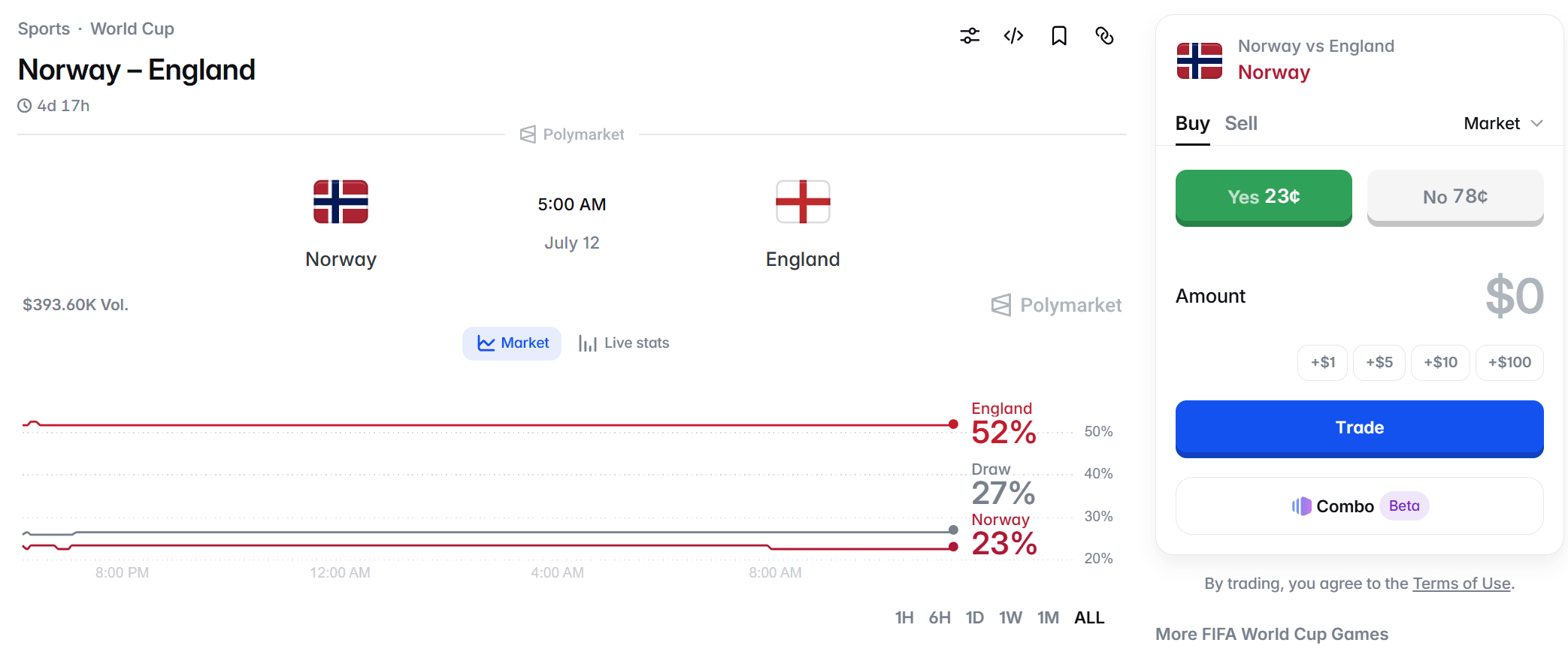
Norway vs England Prediction: Can Haaland Shock England?
Explore Norway vs England prediction, Polymarket crypto odds, Haaland impact, team analysis, and key factors shaping this World Cup clash.
Is Election Prediction Market Betting Legal in the US? The Complete 2026 Guide
Is election prediction market betting legal in the US? Get the full 2026 breakdown of Kalshi vs Polymarket legality, insider trading risks, state bans, and scam warnings. (160 characters)
Prediction Market Regulations: What WEEX Users Should Know Before Trading Event Contracts
Prediction market regulations vary by country, state, event type, and platform structure. This WEEX-style education guide explains the main regulatory issues around event contracts, election markets, sports outcomes, crypto prediction markets, and user risk checks without treating prediction markets as a WEEX trading product.
How to Make Money on Prediction Markets: Strategies, Risks, and What WEEX Users Should Know
Prediction markets can create profit opportunities when traders price future events better than the crowd, but they also carry liquidity, legal, settlement, and behavioral risks. This WEEX-style education guide explains how prediction market profits work, why they are not guaranteed, and how crypto users can treat prediction markets as an external research theme rather than a WEEX trading product.

How to Buy WXT Token: A Beginner’s Guide to WEEX Token Trading
WXT is the native platform token of the WEEX ecosystem. This beginner-friendly guide explains how to buy WXT on WEEX, what to check before trading, how to manage risk, and how users can review WXT’s role within the exchange ecosystem before placing an order.
Is WXT Token a Good Investment? Benefits, Risks, and Key Factors to Watch
WXT may interest users who want exposure to the WEEX ecosystem, but it is still a volatile crypto asset with platform, liquidity, and market-cycle risks. This WEEX-style guide explains how beginners can evaluate WXT’s potential benefits and risks before making any trading decision.

Polymarket vs. Polls: What Prediction Markets Say About the 2026 Midterm Races
Polymarket-style prediction markets and traditional polls measure different things. This WEEX-style market review explains how users can compare election odds, polling data, liquidity, and political risk signals around the 2026 U.S. midterm races without treating prediction markets as a WEEX trading product.
Is Election Prediction Market Legal? State Bans vs. CFTC Lawsuits Explained
Election prediction markets sit between federal derivatives law, state gambling rules, and crypto-native event trading. This WEEX-style guide explains why legality depends on platform structure, jurisdiction, CFTC oversight, and state enforcement, while reminding users to treat election markets as an external regulatory topic rather than a WEEX trading product.

AI Memory Supercycle Debate: Why Big Tech's Margin Panic Just Confirmed SanDisk's NAND Advantage
Why is SanDisk (SNDK) surging in 2026's AI memory supercycle? See how Apple, Microsoft, and Big Tech's margin panic confirmed NAND pricing power, plus Bernstein's $3,000 target, key risks, and what to watch next.
SNDK Stock Dip After Apple's Price Shock: Trap or Last Chance Before $3,000?
SNDK stock dipped 12%+ after Apple's price hike shock — but Bernstein just raised its target to $3,000. Is the SanDisk dip a trap or a buying opportunity? Full analysis with latest data, analyst targets, and risks.
United States Water Reserve (USWR): Can You Buy It Now? Price Outlook and Risk Guide
United States Water Reserve (USWR) has attracted attention because of its water-reserve narrative, but users should first confirm whether the token is actually tradable before looking for a buy route. This guide explains how WEEX users can track USWR, avoid fake links, and evaluate its price outlook with caution.

Is America 250 Coin a Cryptocurrency? Official Commemorative Coin vs Meme Token Explained
America 250 Coin can refer to official U.S. commemorative coinage or unofficial crypto tokens using similar patriotic branding. This guide explains the difference between physical commemorative coins and speculative meme tokens, and what WEEX users should verify before trading any America 250-themed crypto asset.

Gold Crash or Buying Opportunity? What the Market Is Really Telling Us
Gold crash or buying opportunity? Learn why gold prices fell, how Fed policy and crowded trades affect the market, and how PAXG and XAUT fit into tokenized gold trading.
WXT Token Trading Risks: Liquidity, Platform Dependence, and Price Volatility Explained
WXT is connected to the WEEX ecosystem, but traders still need to understand liquidity, platform dependence, volatility, market cycles, and execution risk before entering a position. This guide explains how WEEX users can evaluate WXT with a practical risk framework.

Why Are Prediction Markets Booming? Polymarket, Kalshi, and the On-Chain Trading Narrative
Prediction markets are gaining attention because they turn real-world uncertainty into tradable probabilities. This WEEX-style market review explains why Polymarket, Kalshi, stablecoins, social media, and on-chain trading narratives are pulling more traders toward event-based markets.

Are Prediction Markets Investing or Gambling? Key Regulatory Risks Before Trading
Prediction markets sit between finance, forecasting, speculation, and gambling. This WEEX Wiki article explains why the regulatory line is blurry, what beginners should check before trading event contracts, and why users should treat prediction market odds as external research rather than a WEEX trading product.

QCOM Stock Forecast 2026: Will Qualcomm's AI Push Revalue the Stock?
QCOM stock forecast 2026: Explore Qualcomm’s AI data center push, AI phones, growth drivers, risks, and USDT-based TradFi trading on WEEX.

SpaceX Starlink Launch Vandenberg June 2026: Southern California Visibility Guide
SpaceX Starlink launch Vandenberg June 2026 visibility guide for Southern California with today’s liftoff time, best viewing areas, weather-based outlook, and live update details.
SpaceX Starlink Launch Vandenberg: Live Updates and Liftoff Time for Today
SpaceX Starlink launch Vandenberg live updates and liftoff time for today’s launch. Get the latest timing, Starlink 17-28 details, 24-satellite payload info, and current countdown updates.
Is SpaceX IPO a Good Investment? SpaceX Stock, Valuation, Risks & Future Growth Explained
Is SpaceX IPO a good investment? Explore SpaceX stock valuation, Starlink growth, IPO risks, future potential, and whether buying SpaceX shares makes sense in 2026.
W26 Crypto Scam or Legit? World Cup 2026 Token Explained
W26 Crypto Scam or Legit? Explore what W26 token is, its World Cup 2026 connection, price trend, risks, and whether the hype can drive future growth.
GDWR Crypto Scam or Legit? A Complete Risk Analysis
Is GDWR Crypto legit or a scam? Learn what Global Digital Water Reserve is, review its on-chain data, risk factors, and whether the project is backed by real-world water assets.
AI Stock Outlook: Will Iran Tensions Change the Market Outlook?
Explore how Iran tensions, rising oil prices, interest rates, and Big Tech AI spending could shape the next phase of the AI stock rally.
SOXS vs. SOXL: Bull or Bear on AI Stocks Amid Iran Tensions?
SOXS vs. SOXL: Which semiconductor ETF is better amid rising Iran tensions? Explore how oil prices, AI earnings, and Big Tech spending could shape the next move.
KO Stock Forecast: Does Coca-Cola's 64th Dividend Increase Change the Outlook?
Does Coca-Cola's 64th dividend increase change KO stock's outlook? Explore forecast scenarios, valuation, key growth drivers, and alternative trading options.
MU Stock Forecast: Does Micron's $3 Billion Expansion Change the Outlook?
Micron plans a $3 billion expansion to strengthen its AI memory supply chain. Explore what it means for MU stock, future outlook, and alternative ways to gain price exposure.