
Why Do Financial Crises Repeat? Considering Risks and Financial Regulations from History ("So That's Blockchain Ep.19" Yoshihiko Uchida, Yuya Sakai, Shinya Otsuga)

 Prefer us on Google


"So That's Blockchain" Ep.19
In this podcast, Yoshihiko Uchida, who has a background in banking supervision at the Bank of Japan and the Financial Services Agency and currently teaches blockchain at Shunan University, Yuya Sakai, a founder of a gourmet app who has combined Web2 services with blockchain to build a Web3 business, and Shinya Otsuga, deputy editor of the crypto media "New Economy," introduce what you should know about blockchain today.
In this 19th episode, building on previous discussions about "stablecoins" and "DeFi," we delve into the theme of "market stability and financial order," exploring what financial regulations aim to protect.
First, we organized the concept of "risk" from the perspective of business continuity. In this discussion, we focus on the potential for "business continuity to be compromised" due to unexpected events causing capital impairment or liquidity shortages.
We explained that financial regulations have two main objectives: "protection of investors and consumers" and "stability of the financial system." We acknowledge that even if individual participants act rationally, the overall system can still lead to a crisis, and we confirm the role of supporting the economy to continue operating at "cruising speed."
Additionally, we touched on the idea that vulnerabilities can accumulate even in peaceful times when crises are not occurring, and that it is necessary to capture the stability of the financial system from both the interconnectedness of financial institutions and markets and the changes over time.
Next, we traced the history of financial crises from the time of Emperor Tiberius of the Roman Empire, through the speculative booms of the South Sea Company and Mississippi Company, the London Panic, the Great Depression, and the Lehman Shock. We organized the mechanisms by which excessive credit expansion and sudden contraction, along with the interdependence of market participants, lead to crises. We also confirmed that the collapse of a "bubble" fueled by rising expectations of asset prices is not necessarily the same as a financial crisis. We touched on the perspective that fiat currency itself is not always the cause of a crisis.
Furthermore, we explained that the stability of the financial system is not about fixing prices but is supported by the mechanisms of rights and obligations, settlement, and credit that continue to operate "predictably." The purpose of regulation is not to eliminate losses entirely but to "burden those who can bear the losses" and to maintain the settlement function. We highlighted the perspective of preventing localized failures from spreading to the entire real economy.
Finally, we posed the question of what kind of finance on-chain finance wants to realize. We discussed the balance between enhancing the certainty of settlements and supporting economic activities through credit.
The next episode, Episode 20, is scheduled to be released on October 6, 2026. We will delve into the thinking behind avoiding financial crises and the role of financial regulations. We will also consider perspectives on evaluating new financial transaction mechanisms, including on-chain finance and crypto.
Public Recording Vol.3 Scheduled for 10/1 at 19:00
In addition, "So Bro" will hold the third public recording on October 1 at 19:00 in Yotsuya!
The theme is "How to Work with Lawyers in Blockchain Business."
This time, we will welcome Yuya Hara, a partner lawyer at AZX Law Office, and delve into "So That's Blockchain" regarding how to work with lawyers.
On the day, besides "what you should know about legal compliance," Mr. Hara and the three regular members will deep dive into recent topics from a blockchain perspective.
Details and participation registration can be found here.
Listen to the Podcast
You can listen to the program from the following links. Please press the play button (wait about 10 seconds after clicking).
-- Price
Participants
Yoshihiko Uchida: 1994-2023 at the Bank of Japan. Roles included planning at the Financial Research Institute and the Financial Institutions Bureau (Group Leader). He has provided various insights into risk management and management of financial institutions. During this time, he also worked at the Financial Services Agency, Osaka University, and the University of Tokyo. From June to November 2023, he served as a director at Questory Co., Ltd., and from April to December 2024, he will participate as a director at Kashei, engaging in Web3 startups. Currently, he is a professor at the Faculty of Information Science at Shunan University (since June 2023) and also serves as an outside director at Cyberlinks Co., Ltd. (from March 2024), promoting businesses related to digital ID and electronic signatures, as well as consulting related to blockchain utilization as the representative director of Yuidzumu Co., Ltd. (from October 2025).
X Account: https://x.com/uchida_tomato
Yuya Sakai: Co-founded SARAH Co., Ltd. during his student days. In addition to Japan's largest menu-focused gourmet app "SARAH," he built a big data service for the food service industry called "FoodDataBank" for major food manufacturers. As COO, he led fundraising of 1 billion yen and M&A, PMI. Since 2019, he has led the Web3 transformation of SARAH. He developed a Layer 1 proprietary blockchain called "ONIGIRI Chain" focused on data management in food and healthcare and built a token economy. After stepping down as representative director in 2025, he became independent. He is currently engaged in consulting focused on the practical application of blockchain utilization and Web3 businesses.
X Account: https://x.com/skyuya03
Interviewer: Shinya Otsuga, Deputy Editor of New Economy
Official X of So That's Blockchain: https://x.com/soublock
Official Site of So That's Blockchain: https://soublock.com/
This content is provided for general informational purposes only and doesn't constitute financial, investment, legal, or tax advice. Any events, rewards, online promotions, or related information mentioned herein should not be considered a recommendation, solicitation, or invitation to purchase, sell, trade, or otherwise deal in any crypto assets. Crypto assets are highly volatile and may result in loss. The availability of WEEX services, products, and related events may vary by region. You are responsible for ensuring that your participation is in accordance with applicable local laws and regulations.
You may also like

Enza Closes $6 Million Funding Round to Develop Payment Infrastructure

AI Fills Gaps in the Crypto Industry: Fifteen Startup Opportunities to Watch

Trump Media adds 1,510 Bitcoin in Q3 as treasury reaches $1.17B

Bank of Korea: Consider Existing Financial Regulations When Introducing Stablecoins

Dormant Ethereum Wallet Moves $4.6 Million. Scammers Set a Trap in Three Minutes

47% Top Tax Rate Approaches: Seven Tax Reduction Strategies for Australian Crypto Investors

WEEX P2P now supports ILS, BHD, OMR & QAR —Merchant Recruitment Now Open

Hyperliquid Strategies Reports 38.5M HYPE Treasury After $802M Deployment

No Music App on Work Laptops: The Small Rules Behind WEEX Security

SoftBank Reports First Quarterly Net Loss in Two Years, Intel and Data Center Dragging Down Performance
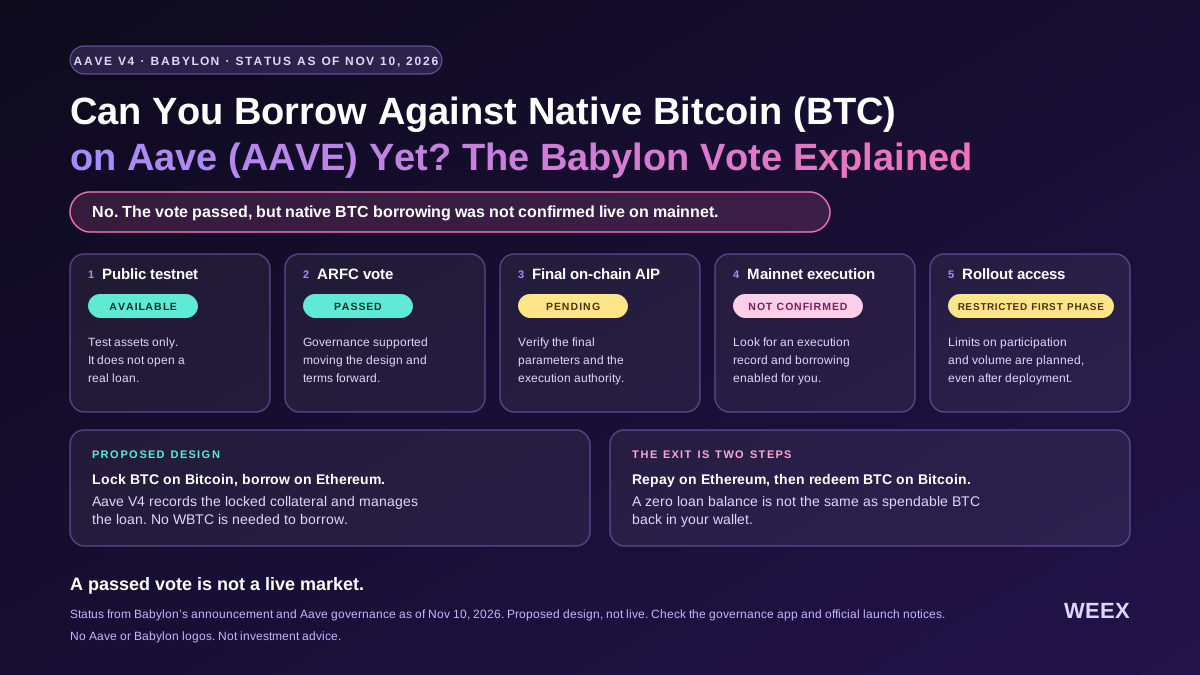
Can You Borrow Against Native Bitcoin (BTC) on Aave (AAVE) Yet? The Babylon Vote Explained
Can you borrow against native Bitcoin on Aave yet? See what the Babylon vote approved, what still needs to launch, and how BTC liquidation would work.
Why Doesn't Bitcoin Always Rise When Stocks Rally?

Financial Commission to Manage Stock Market Volatility with Sidecars and High-Frequency Trading Checks
IMF urges Kenya to make crypto firms share customer data under Travel Rule

Kim & Chang Lawyer: "Excessive Responsibility Should Not Be Imposed on Stablecoin Issuers"

Why Did Avalanche (AVAX) Rise? What the NYSE Settlement Plan Means for AVAX Demand
See why Avalanche (AVAX) rallied after the NYSE settlement announcement, how the dedicated chain would work, and what could create demand for AVAX.

Cryptocurrency Security Checklist: Four Lessons from Phemex Safety Hub Vol. 05–08

Solana's Former DEX Leader Prepares to Go All In on US Stocks

PIEVERSE Price Up Nearly 80% in a Week: Futures Activity, the November 14 Unlock and What Is Confirmed
PIEVERSE rose about 79% in seven days with futures volume far above spot. See what is confirmed about the November 14 unlock and the WEEX Lucky Eggs campaign.

Unauthorized Access to Gnosis Pay's Old Card System Leads to Customer Data Breach

Alchemy Pay Says Mississippi Licence Expands US Money Transmission Coverage to 20 States

Hong Kong Approves Crypto Asset Reporting Rules - Fintech World

Biden's Son's LAPTOP Burns 5.5% as Conditions Met in U.S. Midterm Elections

TRON surpasses 413 million accounts, but what do network stats show?

Countdown to the GENIUS Act: Only USDC and PYUSD Pass Among the Top Ten Dollar Stablecoins

NVDA Stock Falls 4.3% After Board Opens Investigation: What Is Confirmed and What Is Not
NVDA closed at $178.67 on November 9, 2026, down about 4.3%, after Nvidia’s board confirmed an independent investigation. Other claims come from media reports. WEEX’s Lucky Eggs campaign runs until November 25.
How to Resolve Data Center Controversies? This U.S. State Wants to Tokenize Computing Power to Share Benefits with Residents

Lombard Systems Raises $4M to Make Tokenized Assets Easier to Borrow Against

When is the launch date of Bitcoin Hyper? Testnet, tokens, and mainnet are separate milestones

Westpac's Cryptocurrency Payment Limit (A$10,000): What Changes on December 1, 2026
Enza Closes $6 Million Funding Round to Develop Payment Infrastructure
AI Fills Gaps in the Crypto Industry: Fifteen Startup Opportunities to Watch
Trump Media adds 1,510 Bitcoin in Q3 as treasury reaches $1.17B
Bank of Korea: Consider Existing Financial Regulations When Introducing Stablecoins
Dormant Ethereum Wallet Moves $4.6 Million. Scammers Set a Trap in Three Minutes
47% Top Tax Rate Approaches: Seven Tax Reduction Strategies for Australian Crypto Investors
Latest articles




Latest coin listings on WEEX


