
The Chip Industry's Most Secure Middleman Just Took a Very Risky Turn

 Prefer us on Google


Between $40 billion and $150 billion is not a growth curve, but a self-disruption of a business model.
On March 24, Arm unveiled its first in-house data center CPU in the company's 35-year history in San Francisco. This chip, named AGI CPU, features 136 Neoverse V3 cores, TSMC 3nm process, 300W TDP, with Meta as the first customer for large-scale deployment within the year. Also announced as partners are OpenAI, Cerebras, Cloudflare, SAP, and SK Telecom.
Arm CEO Rene Haas provided a set of target numbers at the event, stating that the chip business is expected to achieve $15 billion in annual revenue by 2031, with total company revenue of $25 billion and earnings per share of $9.
What do these numbers mean? Arm's total company revenue for FY2025 (ending March 2025) was $40.07 billion, according to Arm's annual report data, with licensing revenue of $18.39 billion, royalty revenue of $21.68 billion, and a 97% gross margin. In other words, a company with $40 billion in annual revenue aims to achieve a scale close to Intel's entire data center division in just 5 years through a single new business. According to Intel's Q4 2024 financial report, Intel's DCAI (Data Center and AI) division had full-year revenue of $12.8 billion in 2024.
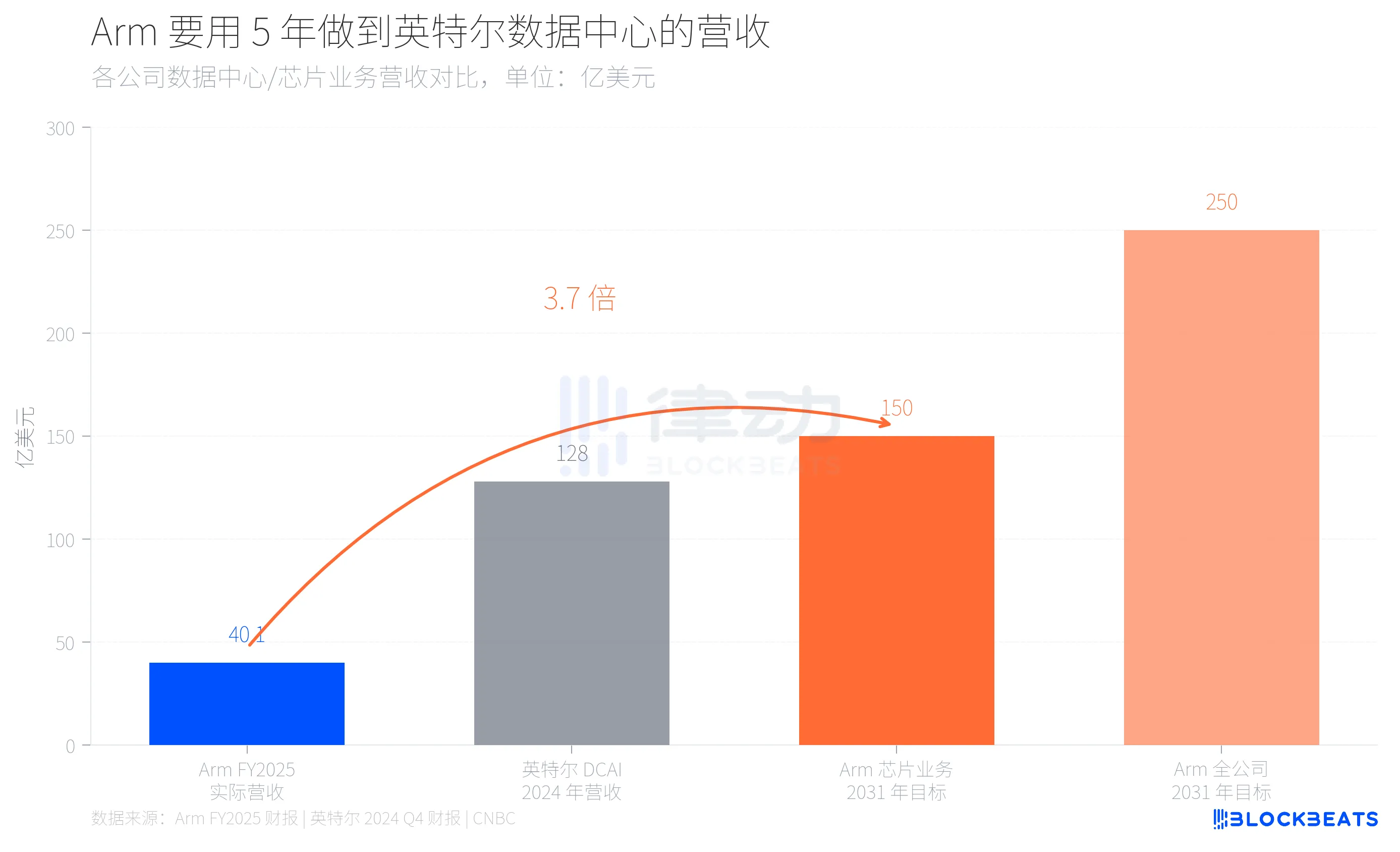
From $40 billion to $150 billion, behind the 3.7x leap is Arm's attempt to transform from a pure IP licensing company to a hybrid that sells both design blueprints and finished products. There is no precedent for this in the chip industry.
Why is Arm taking this risk? The answer lies in its customer list.
Over the past three years, Arm's largest data center customers have been doing the same thing. According to public data from AWS, Amazon has migrated over 50% of EC2 compute to its in-house Graviton chips, with the latest Graviton5 featuring 192 cores. As disclosed by Google Cloud, Google's Axion chip has already migrated over 30,000 internal applications, achieving an 80% energy efficiency gain. Microsoft's Cobalt 200 is also based on Arm Neoverse architecture, TSMC 3nm process, with 132 cores.
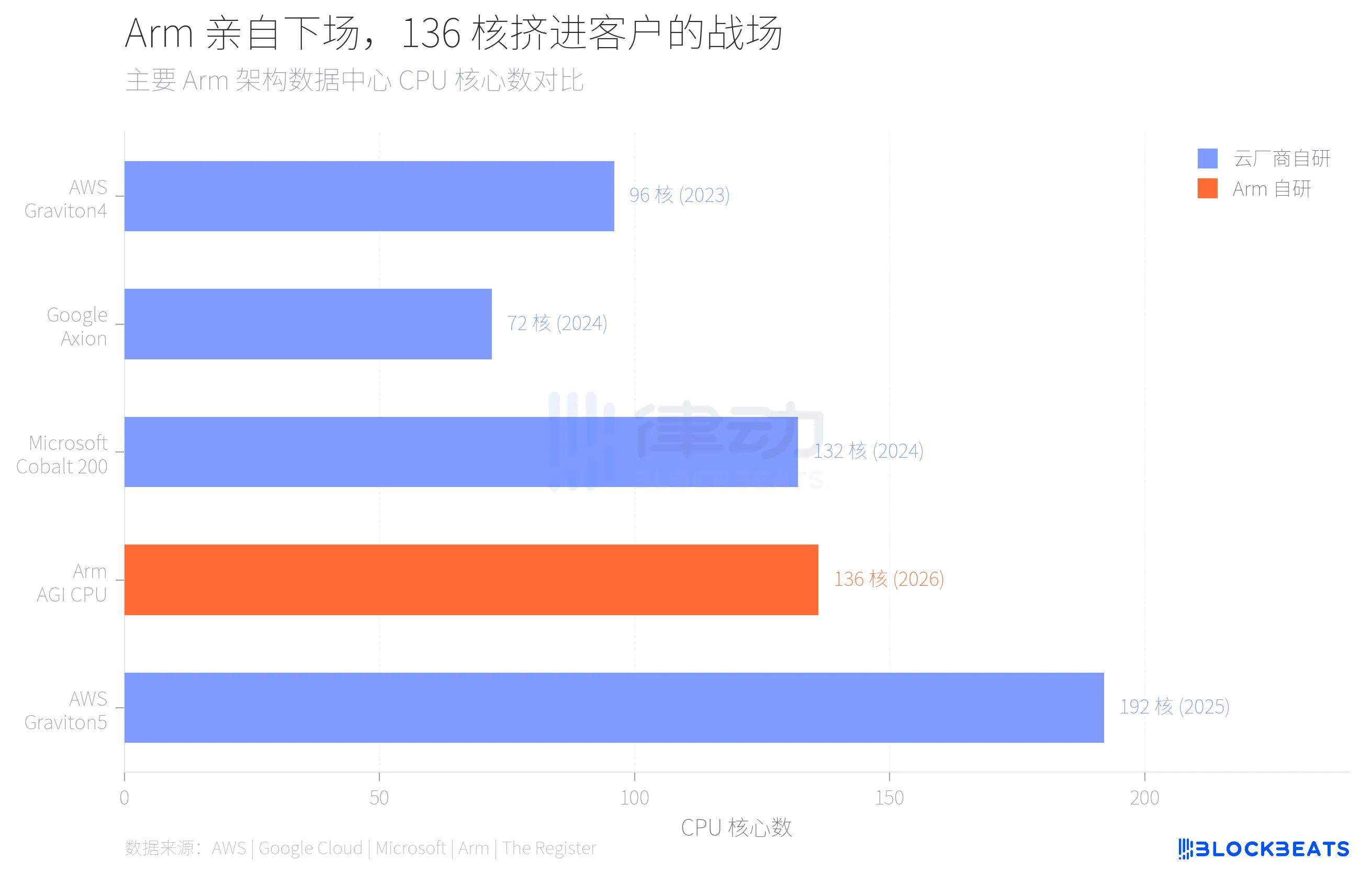
These cloud providers all use Arm's architecture license, but the chips are self-designed, self-fabricated, and self-deployed. Arm earns licensing fees and royalties rather than chip profits. As more and more computing power is consumed by these custom chips, Arm's revenue ceiling in data centers becomes clearer.
Looking at Arm's revenue structure over the past four years, the outline of this ceiling becomes more defined. According to Arm's annual reports, from FY2022 to FY2025, the company's total revenue is projected to grow from $27 billion to $40 billion, with a CAGR of around 14%. Royalty revenue is expected to increase from $15.62 billion to $21.68 billion, while licensing revenue is set to grow from $11.41 billion to $18.39 billion. The growth rate of royalties has slowed to 20% from previous years, and this 20% growth is largely driven by the upgrade to the Armv9 architecture in the mobile sector, not in data centers.
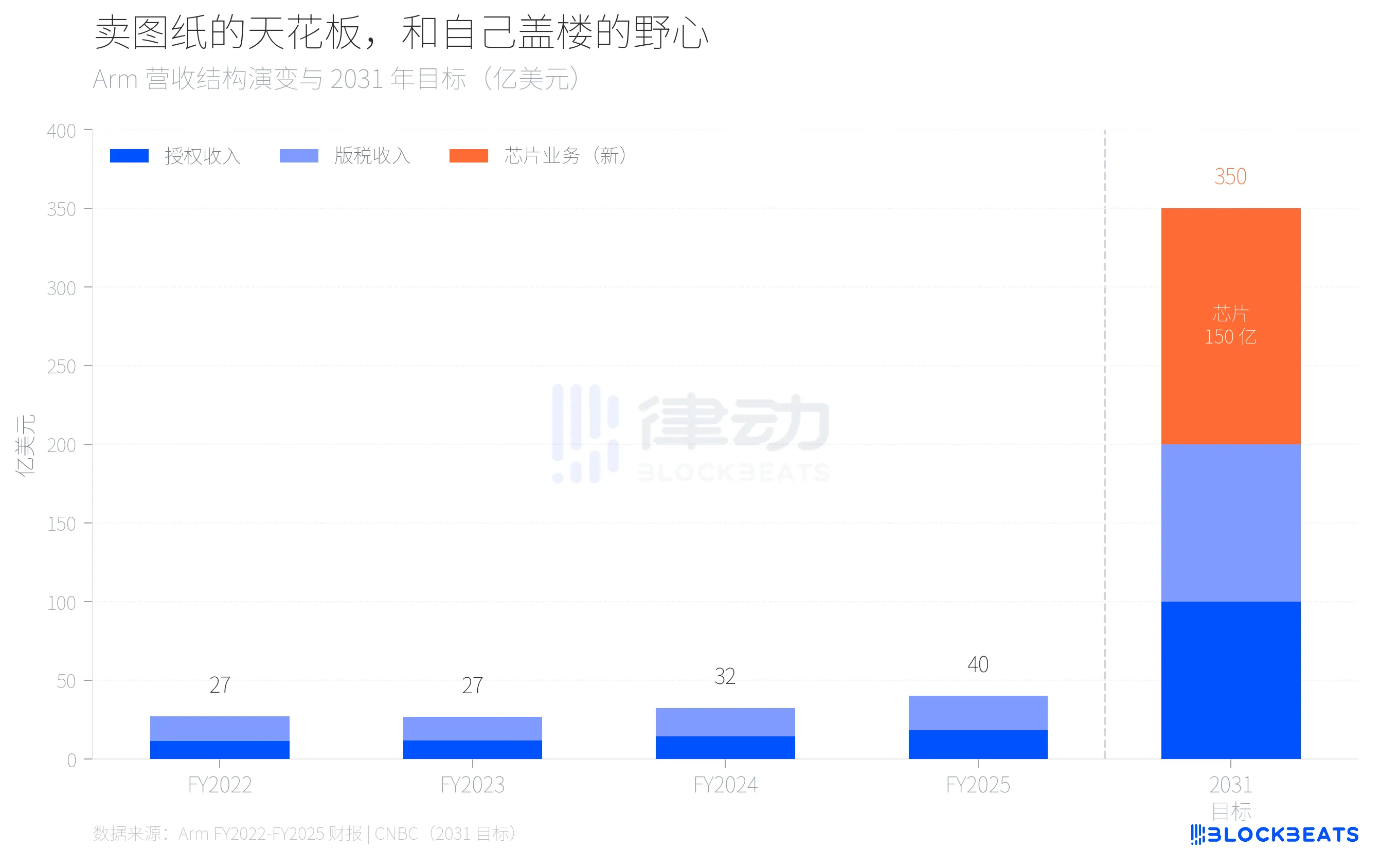
Extrapolating this growth rate, even if both licensing and royalty revenues maintain an annual growth rate of around 20%, by 2031, they will only reach about $10 billion. The remaining $15 billion must come from a business that does not yet exist today. This is the arithmetic logic behind Arm's decision to manufacture its own chips.
Arm's choice to produce its own chips fundamentally means competing with its own customers. A company that sells blueprints to others is now constructing buildings itself, while its blueprint buyers have been building for years.
This is the true background of the 136-core AGI CPU. According to The Register, this chip has a base frequency of 3.2 GHz, up to 3.7 GHz, 12-channel DDR5 memory, 6 GB/s per core bandwidth, 96 PCIe 6.0 lanes, and supports CXL 3.0. Arm positions it as the "computing foundation of the agentic AI cloud era," focusing on CPU-side task scheduling and data flow management in AI inference, rather than directly competing with GPUs.
The pace of market share change also speaks volumes. According to Omdia's estimates, by 2025, Arm architecture servers will account for approximately 21% of global shipments, with a 70% growth rate. However, within hyperscale data centers, this proportion is already close to 50%. The 40-year dominance of x86 is not collapsing but being replaced chip by chip.
The risk of Arm's in-house chip is not technical, but relational. Meta's willingness to be the first customer is partly because Meta itself does not have a mature in-house chip project like Amazon or Google. But how would Amazon, Google, or Microsoft view this? If a supplier starts competing with you, would you still hand over your most critical architecture to them?
Arm's bet is that the overall growth of the data center is faster than the deterioration of customer relationships. Rene Haas apparently believes that the incremental demand for CPUs in the AI era is large enough to allow for both in-house chips and architecture licensing to coexist. The $15 billion target is the pricing of this assessment.
After 35 years of selling blueprints, building their own building for the first time. While they continue to sell blueprints, they are also constructing the building, all on the same plot of land. It remains to be seen whether it will be too crowded.
Disclaimer: This content is provided for general branding and informational purposes only and doesn't constitute financial, investment, legal, or tax advice. Any events, rewards, online events, or related information mentioned herein should not be considered a recommendation, solicitation, or invitation to purchase, sell, trade, or otherwise deal in any crypto assets or to use any services. Crypto assets are highly volatile and may result in loss. WEEX services and online events may not be available in all regions and are subject to applicable laws, regulations, and eligibility requirements. You are responsible for ensuring that your use of WEEX services complies with local laws and for carefully assessing the risks before participating in any crypto-related activities.
You may also like

NEAR Governance Vote To Scrap Gas Rebates Puts Developer Incentives Under Review
eToro’s Extended Stake Shows Retail Brokers Are Still Eyeing On-Chain Derivatives

Deflation in the US in June: What It Means for Your Investments

OFAC FirstVPN Sanctions Show Crypto Enforcement Is Moving Up The Infrastructure Stack

Kraken Card Launch Brings Everyday Crypto Spending Back Into The Exchange Race

Ethereum Research Thread Puts Sybil Resistance Back In Focus For Decentralized Networks

Predicted 'Apocalypse of DeFi Hacks' Did Not Occur; Is This Sector Safer in the Age of AI?

Fed's Barr: AI Boosts Productivity but May Widen Wealth Gap
Tether targets $11T payroll market with major USAT expansion push

NFT Skill Registry Proposal Gives ERC-721s A More Active Role In On-Chain Automation

Starknet Memory Protocol Draft Puts User-Owned AI Data On The Crypto Agenda

Circle Bets on Argentina and Aims to Bring Stablecoins to the Financial System
Chainalysis Adds Automatic Stablecoin Support As Compliance Teams Face Token Sprawl

CoinFund's David Pakman says crypto hasn't solved tokenomics
Ethereum Governance Debate Turns To Who Really Controls Voting Power
The Clarity Act isn't a ticket to sanctions evasion, actually

Ethereum Foundation Clear Signing Push Targets Crypto’s Blind Approval Problem
Bitcoin Sees a Major Shift Between Old and New Investors
US Transfers $288 Million in Cryptocurrencies, Raising Market Alarm; 'The Missing Catalyst,' Says Coinext CEO
Injective SDK Compromise Puts Wallet Private Keys Back In The Security Spotlight
EMPIRES Opens Registrations, Betting on Solving the Economic Problem of Web3 Games
Blockchain.RIO to Feature 13 Content Tracks Discussing the Future Financial Infrastructure of Latin America

Timelock Account Recovery Gives Ethereum Smart Accounts A Safer Backup Route

Federal Reserve Chair to Congress: No Rescue for Crypto Markets; Controlling Inflation Remains Our Top Priority

A Home Miner Extracted $200,000 Worth of Bitcoin with a $200 Device!
Chainlink Reaches Record Number of Holders as Market Awaits Recovery Signal
How Long Can the Storage Boom Last?
Waller: Fed Has Zero Tolerance for Persistently High Inflation
Circle CEO Jeremy Allaire: When AI Meets Blockchain, the Familiar 'Company' is About to Disintegrate

Ethereum vs Cardano Whitepaper Comparison 2026: Architecture, Tokenomics & Governance
NEAR Governance Vote To Scrap Gas Rebates Puts Developer Incentives Under Review
eToro’s Extended Stake Shows Retail Brokers Are Still Eyeing On-Chain Derivatives
Deflation in the US in June: What It Means for Your Investments
OFAC FirstVPN Sanctions Show Crypto Enforcement Is Moving Up The Infrastructure Stack
Kraken Card Launch Brings Everyday Crypto Spending Back Into The Exchange Race
Ethereum Research Thread Puts Sybil Resistance Back In Focus For Decentralized Networks