
Stablecoin contraction forces Bitcoin drop despite Fed reserve gains

 Prefer us on Google


Bank reserve balances rose $67.5 billion between Oct. 28 and Nov. 4, according to the Federal Reserve's Nov. 5 release, but the more abundant dollar liquidity is not automatically bullish for Bitcoin.
Over the same period, data provider DefiLlama tracked dollar-pegged stablecoin circulation falling by more than 5.7 billion units, or 1.91%.
The split leaves an incomplete picture for a Bitcoin recovery. Higher bank reserve balances would still need to translate into financing and purchases, so the measured token contraction adds a crypto-side observation to that test.
A Nov. 5 Treasury-cash analysis considered a possible December funding window using projected cash paths and the older Oct. 28 reserve baseline. The new release updates that starting point with a rebound in realized reserves.
Coinbase's completed Nov. 5 daily BTC-USD candle closed at $75,969.06, down 5.54% from $80,428.31 on Nov. 4. That close-to-close fall followed the dated reserve observation, putting the price move outside the bank-balance comparison window.
Bank reserves rose as token supply contracted
The Fed's H.4.1 release puts Nov. 4 reserve balances at $2.96 trillion. Over the preceding week, the Treasury General Account, the government's account at the Fed, fell $79.4 billion to $936.2 billion.
Treasury payments move balances into depository institutions' accounts, increasing reserves all else equal, while receipts flowing into Treasury's account work in the opposite direction.
The final reserve change also incorporates movements elsewhere on the Fed's balance sheet. Total assets rose $2.5 billion, while other balance-sheet changes offset part of the effect of the Treasury-account drawdown.
Tether's USDT series fell 3.65 billion units, accounting for 63.37% of that measured contraction, while USD Coin (USDC) circulation declined 383 million units, contributing 6.64%. Other tracked dollar-pegged tokens together contracted a net 1.73 billion units.
The issuer breakdown locates the largest measured change in USDT. Whether, and to what extent, issuer redemptions, bridge-accounting adjustments, reclassification, or coverage revisions contributed remains unquantified.
Bank reserves rise as dollar-token circulation contracts
The October 28--November 4 comparison separates bank settlement balances from the tracked supply of dollar-pegged tokens.
Bank reserves rise while tracked dollar-token units decline, with each series indexed to 100 on October 28 OCT 28 = 10098100102Bank reserves102.33+$67.568bnDollar-token units98.09−5.769bn unitsOCT 28, 2026NOV 4, 2026Dated endpoints on an index. Underlying observation times differ.
Indexed bank reserves and dollar-token units, October 28 to November 4 OCT 28 = 10098100102Bank reserves102.33 / +$67.568bnDollar-token units98.09 / −5.769bnOCT 28NOV 4Dated endpoints. Observation times differ.
Inspect the two liquidity signals
Inspect the two liquidity signalsReserve bridgeToken contraction
The Treasury-account drawdown and asset increase exceeded the final reserve rise because other balance-sheet changes offset them.
Waterfall from Treasury-account drawdown and Fed asset changes to reserve growth RESERVE ACCOUNTING BRIDGE / USD BILLIONS+79.384+2.510−14.326*+67.568TGA drawdownFed assetsOther offsetsReserve rise*Derived net offset reconciles the three reported changes.
Reported Treasury drawdown and asset increase, derived other offsets and reported reserve increase RESERVE BRIDGE / USD BILLIONSTGA drawdown+79.384Fed assets+2.510Other offsets*−14.326Reserve rise+67.568*Derived net offset reconcilesthe three reported changes.
USDT accounts for 63.37% of the measured decline in tracked dollar-pegged circulating units.
USDT accounts for 63.37 percent of the measured dollar-pegged token-unit contraction 5.769 BILLION TOKEN-UNIT DECLINEUSDT63.37%3.655bn unitsUSDC6.64%0.383bn unitsOther, net29.99%1.730bn unitsAll three segments contribute to the measured contraction.
Composition of the token-unit decline, with USDT, USDC and the net remainder 5.769bn TOKEN-UNIT DECLINEUSDT63.37%3.655 billion unitsUSDC6.64%0.383 billion unitsOther, net29.99%1.730 billion unitsShares of the measured unit contraction.
The two measures moved in opposite directions across these calendar labels.
Calendar labels align, underlying collection times differ. Lines join two endpoints without describing a daily path. The index compares percentage changes across different measures. The token series uses circulating units in the dollar-pegged category. These observations leave Bitcoin buyer identity and the transmission into demand unmeasured.
Sources and evidence
Sources
- H.4.1, November 5, 2026, Tables 1 and 5
- Dollar-pegged circulating-unit history
- USDT historical circulating-unit chart, stablecoin ID 1
- USDC historical circulating-unit chart, stablecoin ID 2
- Stablecoin identities and peg classifications
- DefiLlama free API documentation
- DefiLlama chart aggregation implementation
- DefiLlama date normalization
Supporting facts
- The Fed's November 5 H.4.1 release reports bank reserve balances of $2.962804 trillion on Wednesday, November 4, up $67.568 billion from October 28. [1]
- Treasury's General Account fell $79.384 billion to $936.248 billion over the same Wednesday-to-Wednesday period, while total Fed assets rose $2.510 billion. [1]
- DefiLlama's date-labelled October 28 and November 4 observations show tracked dollar-pegged circulating units falling from 301.991331194 billion to 296.222728653 billion, a decline of 5.768602541 billion units, or 1.91%. [2]
- DefiLlama's USDT-filtered chart shows a decline of 3.655402168 billion circulating units across those dates, accounting for 63.37% of the aggregate dollar-pegged unit contraction. [3] [2] [5] [6]
- DefiLlama's USDC-filtered chart shows circulating units falling 383.060015 million over those dates, accounting for 6.64% of the aggregate contraction, while the other tracked dollar-pegged tokens together declined a net 1.730140358 billion units. [4] [3] [2] [5]
- DefiLlama's selected dates are labelled at 00:00 UTC, while the Fed reports Wednesday levels. The two series therefore support a date-labelled comparison without establishing a matched intraday observation. [2] [3] [4] [1] [7] [8]
Method
Both indices equal 100 on Oct. 28. Nov. 4 = 100 × outcome/baseline, giving reserves 102.33 and units 98.09. Waterfall uses USD billions. Other offsets = 79.384 + 2.510 − 67.568 = 14.326, a derived residual. Token segments use absolute unit declines divided by 5,768,602,541. Displayed units round to 3 decimals and shares to 2.
Scope
Calendar labels align, underlying collection times differ. Lines join two endpoints without describing a daily path. The index compares percentage changes across different measures. The token series uses circulating units in the dollar-pegged category. These observations leave Bitcoin buyer identity and the transmission into demand unmeasured.
Infographic by CryptoSlate
The Bitcoin recovery case still needs demand evidence
Reserves are banks' settlement balances at the Fed, while stablecoin circulation measures the tracked stock of dollar-pegged tokens.
DefiLlama's selected dates carry midnight UTC labels, while the Fed reports Wednesday levels. The comparison aligns calendar labels while leaving the underlying collection times unsynchronized.
For a liquidity-led recovery thesis, further evidence needs to connect reserve balances with financing and buying. A broader token supply could add evidence about crypto-native dollar availability, while proof of Bitcoin demand would still require its own observations.
Neither supply series resolves the cause of the subsequent selloff, and delayed liquidity effects remain possible. The observed divergence leaves the bank-to-Bitcoin demand channel open.
-- Price
This content is provided for general informational purposes only and doesn't constitute financial, investment, legal, or tax advice. Any events, rewards, online promotions, or related information mentioned herein should not be considered a recommendation, solicitation, or invitation to purchase, sell, trade, or otherwise deal in any crypto assets. Crypto assets are highly volatile and may result in loss. The availability of WEEX services, products, and related events may vary by region. You are responsible for ensuring that your participation is in accordance with applicable local laws and regulations.
You may also like

Trump Media adds 1,510 Bitcoin in Q3 as treasury reaches $1.17B

47% Top Tax Rate Approaches: Seven Tax Reduction Strategies for Australian Crypto Investors
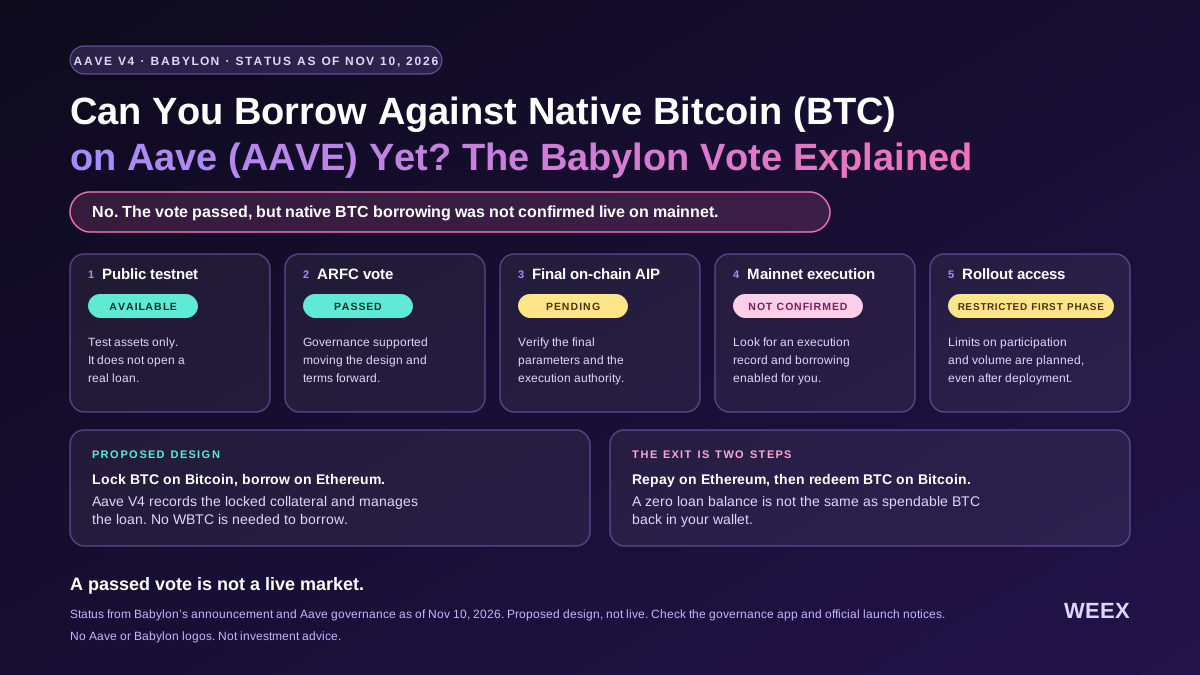
Can You Borrow Against Native Bitcoin (BTC) on Aave (AAVE) Yet? The Babylon Vote Explained
Can you borrow against native Bitcoin on Aave yet? See what the Babylon vote approved, what still needs to launch, and how BTC liquidation would work.

Kim & Chang Lawyer: "Excessive Responsibility Should Not Be Imposed on Stablecoin Issuers"

Mr&强 Analyzes Bitcoin and Ethereum Fluctuation Patterns

WEEX Exclusive:Middle East Easing Expectations Boost Stocks | WEEX Daily Brief (November 10, 2026)
On November 9 close, the S&P 500 and Dow both rose more than 2%. Middle East easing expectations pushed oil prices lower. Bitcoin and Ethereum spot ETFs saw net outflows last week. AVAX rose on reports of tokenized-stock clearing. PIEVERSE surged short-term. November 10 focus is October CPI, TSMC monthly sales data, CoreWeave earnings and others.

When is the launch date of Bitcoin Hyper? Testnet, tokens, and mainnet are separate milestones

Middle East Easing Expectations Boost Stocks | WEEX Daily Brief (November 10, 2026)
On November 9 close, the S&P 500 and Dow both rose more than 2%. Middle East easing expectations pushed oil prices lower. Bitcoin and Ethereum spot ETFs saw net outflows last week. AVAX rose on reports of tokenized-stock clearing. PIEVERSE surged short-term. November 10 focus is October CPI, TSMC monthly sales data, CoreWeave earnings and others.

Bitcoin non-empty wallets drop by 108700 amid retail capitulation

LNbits disables hosted Bitcoin services with no restart timeline

Bitcoin Spot ETF Sees Net Outflow of $201 Million for Three Consecutive Days

Ray Dalio Warns of Diminished Trust in U.S. Treasuries Amid Political Conflicts

BitPay Brings Apple Pay and Google Pay Checkout to Crypto Purchases

Four Security Strategies from the Wallet Theft Incident

Glassnode: Altcoin Trading Volume Returns to Normal Levels

Crypto: BlackRock Predicts Billions More in Its Crypto ETFs

Bakkt Aims for $6 Billion in Transaction Volume in Six Months, Doubling Annual Target; $10.4 Million Investment in Bitcoin Japan Recorded as of End of September

CoinShares: Data Center Ban Increases Value of Bitcoin Mining Companies' Power Assets
CoinShares: Data Center Ban Increases Value of Bitcoin Mining Companies' Power Assets

MARA Q3 Net Profit Rises to $632 Million, Sells 13,597 BTC in October to Repay Loans

Circle VP highlights AI agents driving demand for non-dollar stablecoins

Strive CIO advises BTC treasury firms on funding strategies

Barkin Highlights Inflation as Major Risk and Emphasizes Need for Cautious Monetary Policy Adjustment

Coldcard’s $116M exploit sparks fresh clash over NVK’s defense

The missing step in the warning that Japan could trigger Bitcoin’s next selloff

Two Bitcoin miners reported nearly $2 billion in profit. The biggest boost wasn’t cash
Super League buys 16 BTC for $1.23m as purchase sizes double
Bitcoin Lightning’s security update shuts one door. A critical Linux flaw remains

BlackRock: Bitcoin Whales Are Swapping Self-Custody For IBIT At Record Pace

Kraken Co-CEO Says Bitcoin Has Emerged from Bear Market
Trump Media adds 1,510 Bitcoin in Q3 as treasury reaches $1.17B
47% Top Tax Rate Approaches: Seven Tax Reduction Strategies for Australian Crypto Investors
Can You Borrow Against Native Bitcoin (BTC) on Aave (AAVE) Yet? The Babylon Vote Explained
Can you borrow against native Bitcoin on Aave yet? See what the Babylon vote approved, what still needs to launch, and how BTC liquidation would work.
Kim & Chang Lawyer: "Excessive Responsibility Should Not Be Imposed on Stablecoin Issuers"
Mr&强 Analyzes Bitcoin and Ethereum Fluctuation Patterns
WEEX Exclusive:Middle East Easing Expectations Boost Stocks | WEEX Daily Brief (November 10, 2026)
On November 9 close, the S&P 500 and Dow both rose more than 2%. Middle East easing expectations pushed oil prices lower. Bitcoin and Ethereum spot ETFs saw net outflows last week. AVAX rose on reports of tokenized-stock clearing. PIEVERSE surged short-term. November 10 focus is October CPI, TSMC monthly sales data, CoreWeave earnings and others.
Latest articles


Latest coin listings on WEEX


