
Grass Token Holder Call Unveils Strategic Insights

 Prefer us on Google

Key Takeaways
- Grass revealed its revenue trajectory, showcasing significant growth within just three quarters, with predictions for Q4 indicating continued upward momentum.
- The company’s revenue model predominantly relies on data services for AI companies, with a concentrated client base that could pose risks if the market shifts.
- Grass is planning an airdrop in 2026, with new methods and criteria for participation to encourage long-term network contributions.
- Expansion plans include the development of Live Context Retrieval (LCR) services, moving from just data sales to providing real-time data feeds for AI models.
- The company’s structure and transparency were highlighted, emphasizing its financial distribution and outsourced operational model.
WEEX Crypto News, 2025-11-27 07:59:19
In the ever-evolving realm of cryptocurrencies and blockchain projects, Grass has emerged as a noteworthy name, particularly in the DePIN (Decentralized Private Internet) narrative. On the 16th of November, 2025, the Grass token plunged to a historical low of $0.26, only to bounce back by over 45% within a week, surpassing broader market performances. This volatility was fueled by anticipation surrounding Grass’s inaugural Token Holder Call, a significant event promising insights into the company’s operational and strategic framework, unlike typical AMAs (Ask Me Anything) more commonly associated with the crypto industry.
Revenue Surge: A Testament to Rapid Growth
In its unprecedented transparency, Grass disclosed its impressive revenue trajectory. Just three quarters into 2025, the company’s earnings soared from virtually zero in the first quarter to an anticipated $1,280,000 by the fourth quarter. This surge is attributable to their strategic positioning in the distributed bandwidth network landscape where they harness users’ surplus bandwidth to access publicly available web data on behalf of their clients, who are primarily AI companies. These clients require vast datasets for training large models, allowing Grass to profitably serve as an intermediary by selling the gathered data at competitive rates.
Grass’s business strategy appears to be reaping rewards, yet the focus on a concentrated client base — predominantly AI firms looking for extensive training data — introduces an inherent risk. Should the demand or market conditions change within this niche, their revenue could be adversely impacted. Nonetheless, the emphasis on “multi-modal data” sales (comprising non-textual data such as audio, video, and images) that accounts for 90% of their income, coupled with their alignment with AI model training operations (generating 98% of revenue), underscores a well-defined, albeit narrow, operational focus.
Exploring Token Buybacks: A Minor but Symbolic Gesture
Amidst discussions of fiscal strategies, Grass’s announcement of a token buyback plan attracted considerable attention. The company has initiated this program with a modest purchase of $10,000 worth of GRASS tokens in the previous week and a planned $25,000 for the current cycle. This cumulative buyback represents about 5% of their revenue from the second and third quarters, symbolizing a strategic posture rather than a substantial fiscal maneuver.
The buyback is expected to transition from manual to automated execution over time, although specific guidelines and timelines remain undisclosed. Notably, token buybacks are not a panacea for price stabilization, as seen in past trends where similar efforts in the crypto space did not prevent significant price declines. Grass plans to balance resources between ongoing buybacks and expansion efforts, yet the exact formula for this allocation is pending clarification. The sustainability and scale of future buybacks hinge on continued revenue growth.
-- Price
Anticipating the Second Airdrop: Strategic Timing and New Mechanisms
Building on the success of its initial airdrop, Grass has projected a second round for the first half of 2026. Departing from the traditional means of external wallet distribution, this round will utilize Grass’s in-house wallet — integrated within their product interface via account abstraction technology. This innovation is poised to simplify the airdrop process, eliminating the need for third-party wallet connections and enhancing security and user-friendliness.
The forthcoming airdrop is designed to prioritize long-term network contribution, yet specifics regarding contribution metrics, duration benchmarks, and device or behavior weighting remain pending. The vagueness surrounding this initiative may be a tactical decision to navigate the current bearish market conditions in the crypto world until a more opportune moment.
Scaling Network Size: From Bandwidth Sharing to Real-time AI Data Solutions
Grass’s network infrastructure has witnessed remarkable growth. The network’s active user base expanded from an estimated 300,000 during the initial airdrop to a reported 850,000 currently. Notably, 38% of these users engage via mobile applications, highlighting the scalability and accessibility of their platform.
The company is now venturing into a novel domain: Live Context Retrieval (LCR). Unlike their existing model of delivering static datasets for AI training, LCR aims to furnish AI models with real-time data queries. This shift towards real-time data delivery (an emerging requirement for dynamic AI operations) introduces a new business model where transactions align more closely with blockchain capabilities, leveraging frequent, smaller transactions better suited to token-based commerce.
Although LCR is still in its developmental stages, being tested with several SEO firms and an AI lab, it represents a strategic pivot potentially elevating the GRASS token’s utility in everyday business operations. Meanwhile, plans for the Grasshopper hardware have been delayed due to customs issues, with a revised launch date yet to be announced.
Transparent Governance: Unveiling Structural Clarity
In a market often criticized for opacity, Grass distinguished itself by elucidating its corporate architecture during the call. The Grass Foundation, based in the Cayman Islands, serves as the parent entity, overseeing two subsidiaries: Grass OpCo, which manages network operations including staking and airdrops, and Grass DataCo, charged with business-to-business (B2B) engagements.
Product development is outsourced to Wynd Labs, a third-party service rather than a Grass affiliate. This separation ensures that revenues from B2B contracts, regardless of who secures them, are retained within Grass DataCo, with Wynd receiving service fees sans revenue shares. The transparency about these internal financial mechanics fosters trust and provides stakeholders with clearer insights into how profits and responsibilities are allocated.
Overlooked Insights: Cataloging What Wasn’t Said
Every unveiling leaves room for contemplation on what’s unsaid. While Grass shared pivotal data, it sidestepped disclosing specifics about its customer list, the precise scope of continued buybacks, or detailed parameters for the upcoming airdrop. These elements, either withheld for strategic confidentiality or pending further development, remain areas of curiosity and potential speculation.
Particularly notable was an omission from the official meeting minutes. Andre, the CEO, acknowledged during the call that “Gigabuds have no utility,” a candid admission about the NFT series under Grass’s portfolio. Despite being present in subtitles, this statement was curiously excluded from formal documentation, possibly to mitigate negative market reactions or to protect ancillary sentiments associated with NFT value expectations.
Conclusion: Navigating the Future with Nuance and Caution
In sum, Grass has endeavored to bring transparency and strategic foresight to its stakeholder communications through this token holder meeting. While certain operational details and projections remain unresolved, what is evident is Grass’s ambitious trajectory within a competitive, rapidly changing digital landscape. As the company paves its way toward more real-time, responsive data service capabilities, stakeholders would do well to remain vigilant, balancing encouragement from apparent successes against the inherently volatile nature of the sectors in which Grass operates.
This report on Grass’s progression underscores its potential in harnessing the productive intersections of distributed networks, AI needs, and blockchain technology. Moving forward, the depth of transparency and adaptability to market pressures will likely define Grass’s capacity to sustain and elevate its market posture.
FAQs
What is the core business of Grass?
Grass operates a distributed bandwidth network that leverages users’ idle bandwidth to collect data from publicly accessible web content. This data is then packaged and sold primarily to AI companies requiring substantial datasets for training large models.
How is Grass planning to conduct its next airdrop?
The upcoming round of airdrops, slated for 2026, will employ Grass’s proprietary in-house wallet rather than external wallets. This move is aimed at simplifying the process and enhancing user security.
What is Live Context Retrieval (LCR)?
LCR is an emerging product line by Grass focused on providing real-time data for AI models, unlike their current service of bulk data collection. It is in the testing phase but could significantly enhance the utility of the GRASS token for frequent micro-transactions.
Why is the financial transparency of Grass significant?
Grass’s transparent disclosure of its financial and operational structure helps build trust among stakeholders and sets a precedent for accountability within the crypto sector, an area often marred by opacity.
What should Grass token holders focus on moving forward?
Stakeholders are encouraged to monitor Grass’s expansion into real-time data services and its capacity to sustain revenue growth amid market uncertainties. Future disclosures regarding customer identities and precise airdrop criteria will also be pivotal.
This content is provided for general informational purposes only and doesn't constitute financial, investment, legal, or tax advice. Any events, rewards, online promotions, or related information mentioned herein should not be considered a recommendation, solicitation, or invitation to purchase, sell, trade, or otherwise deal in any crypto assets. Crypto assets are highly volatile and may result in loss. The availability of WEEX services, products, and related events may vary by region. You are responsible for ensuring that your participation is in accordance with applicable local laws and regulations.
You may also like
Crypto Company Backed by Robinhood Founder Aims to Create Data Layer for the AI Era

Delphi Dialogues with Grass Founder: We Are the Secret Data Suppliers of the AI Era

Financing Weekly Report | Crypto Enterprise Banking Platform Limited Raises $18.5 Million in Seed Round; SoftBank Completes $10 Billion Third Round Investment in OpenAI

Crypto VC funding: Jeeves raises $110m, World sells $49m
Multicoin Invests in Decentralized Bandwidth Network Grass

The 'Roller Effect' of AI and the 'Workshopization' of Software as a Prelude to the Internet of Intelligent Agents
Grass Reports Approximately $14.52 Million in Revenue for the First Half of the Year

Touch Grass Conducts Stock Token Reward Experiment on Robinhood Chain

Galaxy adds 24/7 emergency services at Helios

Rockawayx Acquires Relayer Capital, Incorporating 70% Return Long/Short Strategy

Started Making Soccer Cleats for Women and Seeks to Establish Itself in a Space Neglected by Major Brands
Grass Phase Two Rewards Now Open for Claiming
The latest disclosed candidate asset list from Gray includes HYPE, STX, VIRTUAL, and others

Trump Media adds 1,510 Bitcoin in Q3 as treasury reaches $1.17B

Bank of Korea: Consider Existing Financial Regulations When Introducing Stablecoins
Dormant Ethereum Wallet Moves $4.6 Million. Scammers Set a Trap in Three Minutes

47% Top Tax Rate Approaches: Seven Tax Reduction Strategies for Australian Crypto Investors
WEEX P2P now supports ILS, BHD, OMR & QAR —Merchant Recruitment Now Open

Hyperliquid Strategies Reports 38.5M HYPE Treasury After $802M Deployment

No Music App on Work Laptops: The Small Rules Behind WEEX Security

SoftBank Reports First Quarterly Net Loss in Two Years, Intel and Data Center Dragging Down Performance
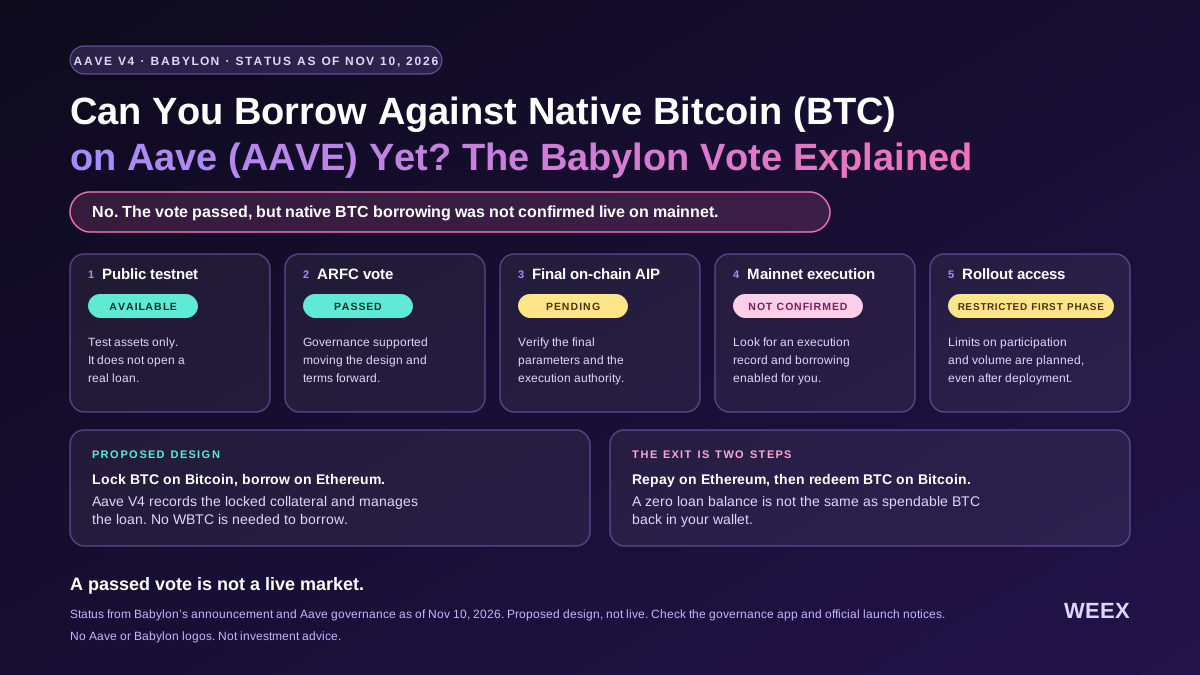
Can You Borrow Against Native Bitcoin (BTC) on Aave (AAVE) Yet? The Babylon Vote Explained
Can you borrow against native Bitcoin on Aave yet? See what the Babylon vote approved, what still needs to launch, and how BTC liquidation would work.
Why Doesn't Bitcoin Always Rise When Stocks Rally?

Financial Commission to Manage Stock Market Volatility with Sidecars and High-Frequency Trading Checks
IMF urges Kenya to make crypto firms share customer data under Travel Rule

Kim & Chang Lawyer: "Excessive Responsibility Should Not Be Imposed on Stablecoin Issuers"

Why Did Avalanche (AVAX) Rise? What the NYSE Settlement Plan Means for AVAX Demand
See why Avalanche (AVAX) rallied after the NYSE settlement announcement, how the dedicated chain would work, and what could create demand for AVAX.

Cryptocurrency Security Checklist: Four Lessons from Phemex Safety Hub Vol. 05–08

Solana's Former DEX Leader Prepares to Go All In on US Stocks

PIEVERSE Price Up Nearly 80% in a Week: Futures Activity, the November 14 Unlock and What Is Confirmed
PIEVERSE rose about 79% in seven days with futures volume far above spot. See what is confirmed about the November 14 unlock and the WEEX Lucky Eggs campaign.
Crypto Company Backed by Robinhood Founder Aims to Create Data Layer for the AI Era
Delphi Dialogues with Grass Founder: We Are the Secret Data Suppliers of the AI Era
Financing Weekly Report | Crypto Enterprise Banking Platform Limited Raises $18.5 Million in Seed Round; SoftBank Completes $10 Billion Third Round Investment in OpenAI
Crypto VC funding: Jeeves raises $110m, World sells $49m
Multicoin Invests in Decentralized Bandwidth Network Grass
The 'Roller Effect' of AI and the 'Workshopization' of Software as a Prelude to the Internet of Intelligent Agents
Latest articles


Latest coin listings on WEEX


