
BlackRock Analysis: BTC Allocation of 1-2% Increases Sharpe Ratio to 0.96

 Prefer us on Google


BlackRock's analysis indicates that the long-term investment rationale for Bitcoin (BTC) remains intact even after recent adjustments. Concerns over government debt, expanding fiscal deficits, and declining purchasing power of fiat currencies are said to highlight BTC's fixed supply structure.
In a report titled "Re-Underwriting Bitcoin: Still a Portfolio Diversifier" released on the 17th, BlackRock stated that while BTC is a highly volatile asset, it can be considered a global monetary alternative and a means of portfolio diversification in the long term. The report was authored by Robert Mitchnick, head of BlackRock's digital assets business, and Will Su, head of digital asset research at BlackRock.
The core of the report is scarcity. BlackRock believes that in an environment of increasing government debt and fiscal deficits, the strategic value of assets that central banks or governments cannot arbitrarily increase in supply may grow.
Gold and BTC are compared as both are assets with limited supply. However, the scarcity of gold arises from geological conditions and mining costs, while BTC's scarcity comes from code and mathematical rules.
BlackRock also addressed the long-term weakening of fiat currency purchasing power. The report explains that fiat currencies issued by major economies in the early 20th century have lost over 99% of their value in gold terms to date. It also mentioned that some countries, such as Turkey, Argentina, Brazil, and Russia, have experienced high inflation and multiple currency resets.
This does not mean that BTC is completely detached from global liquidity. BlackRock analyzed that BTC's performance over the past decade has shown a certain correlation with the changes in broad money (M2) in major economies, including the U.S., Eurozone, China, Japan, and the U.K. However, it cautioned against oversimplifying global M2 as a direct predictive indicator for BTC prices.
Correlation analysis is also a key aspect of the report. BlackRock stated that the average correlation coefficient between BTC and the S&P 500 index over the past decade was about 0.18. This suggests that while BTC may move with risk assets in the short term, it is not an asset that moves in the same direction as the stock market in the long term.
In short-term shock phases, the character may change. BlackRock explained that BTC could decline alongside stocks when the market undergoes rapid deleveraging, and price volatility could increase if leverage liquidations become concentrated. The report summarized these characteristics as a "dual nature."
This assessment aligns with previous reports indicating that BTC is a long-term diversification asset while also facing short-term liquidation risks within the same market. BlackRock's conclusion is not that BTC's risks have disappeared, but rather that despite its volatility, the long-term diversification rationale remains under consideration.
Changes in market structure were also presented as factors for volatility mitigation. BlackRock noted that BTC's annual volatility frequently exceeded 100% a decade ago, but has decreased in the long term as the spot, futures, options, and exchange-traded product (ETP) markets have grown.
Market infrastructure has expanded gradually. The report cited key examples such as the introduction of perpetual futures in 2016, CME BTC futures in 2017, CME BTC options in 2020, and the anticipated launch of U.S. spot BTC ETPs in 2024. As the spot, derivatives, and ETP markets have grown together, the means for institutional investors to engage in arbitrage, hedging, and risk management have also increased.
In portfolio analysis, the effect of small allocations was mentioned. BlackRock presented a historical regression analysis over 10 years, suggesting that reducing the stock allocation in a 60/40 U.S. stock-bond portfolio and allocating 1-2% to BTC could enhance performance.
The Sharpe ratio of the existing 60/40 portfolio was 0.81. When 1% of BTC was included, it rose to 0.90, and with 2% allocation, it increased to 0.96. The maximum drawdown was approximately 20.3% for the existing portfolio, 20.6% for the 1% BTC allocation portfolio, and 20.9% for the 2% allocation portfolio.
The Sharpe ratio is a measure of return relative to the risk taken. A higher figure indicates better performance for the same level of risk. However, given BTC's own high volatility, even a small allocation can impact the overall portfolio's return and risk characteristics.
These figures are based on hypothetical analyses using historical data. BlackRock also stated in the report that historical regression analysis does not guarantee future performance, and the actual allocation and proportion should vary based on the investor's goals, risk tolerance, and regulatory requirements.
The significance of this report for Korean investors lies in interpreting BTC not merely as a price fluctuation but within the context of macroeconomic conditions and portfolio structures. As previously reported, the expansion of U.S. fiscal deficits has once again put BTC's currency value dilution hedge theory to the test, indicating that fiscal burdens and trust issues in fiat currencies remain recurring themes in BTC investment rationale.
-- Price
This content is provided for general informational purposes only and doesn't constitute financial, investment, legal, or tax advice. Any events, rewards, online promotions, or related information mentioned herein should not be considered a recommendation, solicitation, or invitation to purchase, sell, trade, or otherwise deal in any crypto assets. Crypto assets are highly volatile and may result in loss. The availability of WEEX services, products, and related events may vary by region. You are responsible for ensuring that your participation is in accordance with applicable local laws and regulations.
You may also like
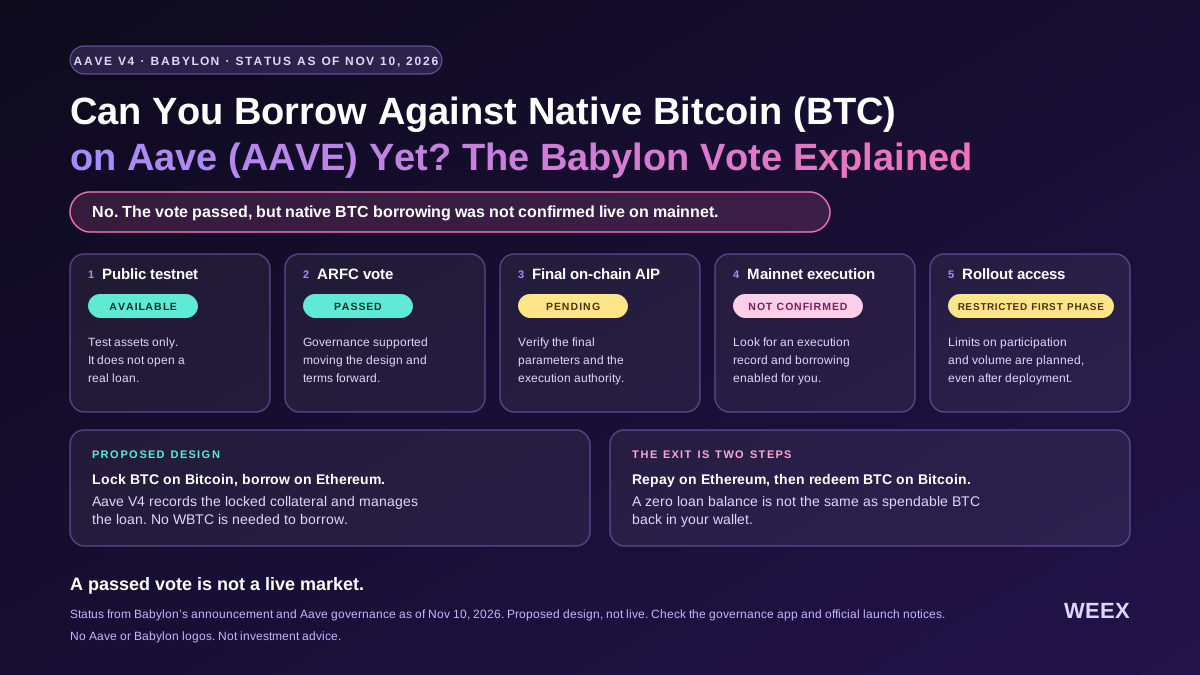
Can You Borrow Against Native Bitcoin (BTC) on Aave (AAVE) Yet? The Babylon Vote Explained
Can you borrow against native Bitcoin on Aave yet? See what the Babylon vote approved, what still needs to launch, and how BTC liquidation would work.

Kim & Chang Lawyer: "Excessive Responsibility Should Not Be Imposed on Stablecoin Issuers"

Mr&强 Analyzes Bitcoin and Ethereum Fluctuation Patterns

WEEX Exclusive:Middle East Easing Expectations Boost Stocks | WEEX Daily Brief (November 10, 2026)
On November 9 close, the S&P 500 and Dow both rose more than 2%. Middle East easing expectations pushed oil prices lower. Bitcoin and Ethereum spot ETFs saw net outflows last week. AVAX rose on reports of tokenized-stock clearing. PIEVERSE surged short-term. November 10 focus is October CPI, TSMC monthly sales data, CoreWeave earnings and others.

When is the launch date of Bitcoin Hyper? Testnet, tokens, and mainnet are separate milestones

Middle East Easing Expectations Boost Stocks | WEEX Daily Brief (November 10, 2026)
On November 9 close, the S&P 500 and Dow both rose more than 2%. Middle East easing expectations pushed oil prices lower. Bitcoin and Ethereum spot ETFs saw net outflows last week. AVAX rose on reports of tokenized-stock clearing. PIEVERSE surged short-term. November 10 focus is October CPI, TSMC monthly sales data, CoreWeave earnings and others.

Bitcoin non-empty wallets drop by 108700 amid retail capitulation

LNbits disables hosted Bitcoin services with no restart timeline

Bitcoin Spot ETF Sees Net Outflow of $201 Million for Three Consecutive Days

Ray Dalio Warns of Diminished Trust in U.S. Treasuries Amid Political Conflicts

BitPay Brings Apple Pay and Google Pay Checkout to Crypto Purchases

Four Security Strategies from the Wallet Theft Incident

Glassnode: Altcoin Trading Volume Returns to Normal Levels

Crypto: BlackRock Predicts Billions More in Its Crypto ETFs

Bakkt Aims for $6 Billion in Transaction Volume in Six Months, Doubling Annual Target; $10.4 Million Investment in Bitcoin Japan Recorded as of End of September

CoinShares: Data Center Ban Increases Value of Bitcoin Mining Companies' Power Assets
CoinShares: Data Center Ban Increases Value of Bitcoin Mining Companies' Power Assets

MARA Q3 Net Profit Rises to $632 Million, Sells 13,597 BTC in October to Repay Loans

Circle VP highlights AI agents driving demand for non-dollar stablecoins

Strive CIO advises BTC treasury firms on funding strategies

Barkin Highlights Inflation as Major Risk and Emphasizes Need for Cautious Monetary Policy Adjustment
Coldcard’s $116M exploit sparks fresh clash over NVK’s defense
The missing step in the warning that Japan could trigger Bitcoin’s next selloff
Two Bitcoin miners reported nearly $2 billion in profit. The biggest boost wasn’t cash
Super League buys 16 BTC for $1.23m as purchase sizes double
Bitcoin Lightning’s security update shuts one door. A critical Linux flaw remains

BlackRock: Bitcoin Whales Are Swapping Self-Custody For IBIT At Record Pace

Kraken Co-CEO Says Bitcoin Has Emerged from Bear Market

Aave DAO Supports Native BTC as Collateral for Aave V4 through Proposal
Bitcoin traders face an eight-hour blind spot as Deribit prepares to delay key market data
Can You Borrow Against Native Bitcoin (BTC) on Aave (AAVE) Yet? The Babylon Vote Explained
Can you borrow against native Bitcoin on Aave yet? See what the Babylon vote approved, what still needs to launch, and how BTC liquidation would work.
Kim & Chang Lawyer: "Excessive Responsibility Should Not Be Imposed on Stablecoin Issuers"
Mr&强 Analyzes Bitcoin and Ethereum Fluctuation Patterns
WEEX Exclusive:Middle East Easing Expectations Boost Stocks | WEEX Daily Brief (November 10, 2026)
On November 9 close, the S&P 500 and Dow both rose more than 2%. Middle East easing expectations pushed oil prices lower. Bitcoin and Ethereum spot ETFs saw net outflows last week. AVAX rose on reports of tokenized-stock clearing. PIEVERSE surged short-term. November 10 focus is October CPI, TSMC monthly sales data, CoreWeave earnings and others.
When is the launch date of Bitcoin Hyper? Testnet, tokens, and mainnet are separate milestones
Middle East Easing Expectations Boost Stocks | WEEX Daily Brief (November 10, 2026)
On November 9 close, the S&P 500 and Dow both rose more than 2%. Middle East easing expectations pushed oil prices lower. Bitcoin and Ethereum spot ETFs saw net outflows last week. AVAX rose on reports of tokenized-stock clearing. PIEVERSE surged short-term. November 10 focus is October CPI, TSMC monthly sales data, CoreWeave earnings and others.
Latest articles


Latest coin listings on WEEX


