
Bitcoin Finance: The New Institutional Custodian is the Code

 Prefer us on Google


- The Genesis Bond is a new financial instrument that operates on Stacks, a Layer 2 solution for Bitcoin.
- The yield in BTC comes from the consensus mechanism of Stacks.
<<Not your keys, not your bitcoin>> was born as a warning for the individual user. It names the distrust towards exchanges and custodians that manage other people's funds, summarizing a simple idea: those who do not control their private keys do not, in fact, control their bitcoin.
Institutional finance has been built on the opposite logic. For a bank, a fund, or a treasury to earn yield on an asset, that asset usually passes through the hands of a third party—a custodian, a broker, or a lending platform—that manages it on behalf of the original owner.
A new type of financial instrument on bitcoin (BTC) questions that assumption. It separates two operations that, until now, have traveled together: generating yield and delivering custody of the asset.
The most recent and largest-scale institutional case is the instrument called Genesis Bond, launched on September 10, 2026, by Stacks, a Layer 2 network that extends Bitcoin's functions without modifying the protocol, as reported by CriptoNoticias.
The mechanism of the Genesis Bond locks BTC from the investor on the main network, without that bitcoin ever passing through the hands of a custodian.
However, the fact that the capital does not change hands does not mean that the operation functions without relying on anything external. The question that this nuance leaves open is what the yield depends on, then.
Bitcoin Coins Locked in the Base Layer
The answer lies in the design of the Genesis Bond instrument. There, bitcoin coins are locked in the main network through a timelock (native commands of the Bitcoin protocol that function as a time lock that blocks BTC and cannot be spent until a certain date or block), without passing through the hands of a custodian, while the investor immobilizes STX tokens, the native token of Stacks, to reserve their place.
The yield, paid in bitcoin, does not come from a loan, but from Proof of Transfer, the consensus in which Stacks miners contribute real BTC to validate blocks. Operation of the yield generation of Stacks' Genesis Bond. Source: Stacks.
At its launch, the program locked 250 bitcoin from four institutions, including 21Shares and HashKey, and three of them executed the process with their keys under their own control throughout the journey. The bitcoin principle, so far, has reached the institutional world intact. But the case itself contains a nuance that is worth looking at closely.
Self-Custody is Not All or Nothing
Of the four institutions that participated, three, 21Shares, HashKey, and UTXO Management, executed the process directly, with their keys under their own control throughout the journey. The fourth, Sypher Capital, delegated the operation to StackingDAO, a liquid staking protocol that combines STX and bitcoin on behalf of the participant.
That difference matters. Delegating the operation does not mean handing over the bitcoin to a custodian, but it does mean relying on an external protocol to execute that process correctly. Within the same product, then, two different versions of what is now called institutional self-custody coexist.
Fireblocks, which offers custody and compliance tools to thousands of institutions, announced the integration of its platform with Stacks so that its clients can access this type of yield. Its arrival shows that institutional infrastructure does not disappear with self-custody, but rather reorganizes around it.
This coexistence of models leaves a fundamental question. If bitcoin never changes hands, what exactly is the institution relying on when participating in this product? The answer is not <
The New Place of Trust
When the custodian disappears, trust does not evaporate; it shifts. It moves from the third party that holds the funds to the infrastructure that produces the yield, that is, to the protocol, its consensus mechanism, and the code rules that determine how much is paid and when.
This displacement does not make the operation safer or riskier by definition. It changes its nature. The risk of a custodian going bankrupt or withholding funds is replaced by the risk of the protocol failing, having a code error, or not being able to validate blocks at the expected rate.
The case, for now, is small. It is a pilot program with four participants and limited capacity, not a consolidated standard. But it anticipates a question that the rest of the institutional Bitcoin market will have to answer with increasing frequency.
That is why <
Tags: Bitcoin (BTC)Investment FundPrivate KeyLatest
-- Price
This content is provided for general informational purposes only and doesn't constitute financial, investment, legal, or tax advice. Any events, rewards, online promotions, or related information mentioned herein should not be considered a recommendation, solicitation, or invitation to purchase, sell, trade, or otherwise deal in any crypto assets. Crypto assets are highly volatile and may result in loss. The availability of WEEX services, products, and related events may vary by region. You are responsible for ensuring that your participation is in accordance with applicable local laws and regulations.
You may also like
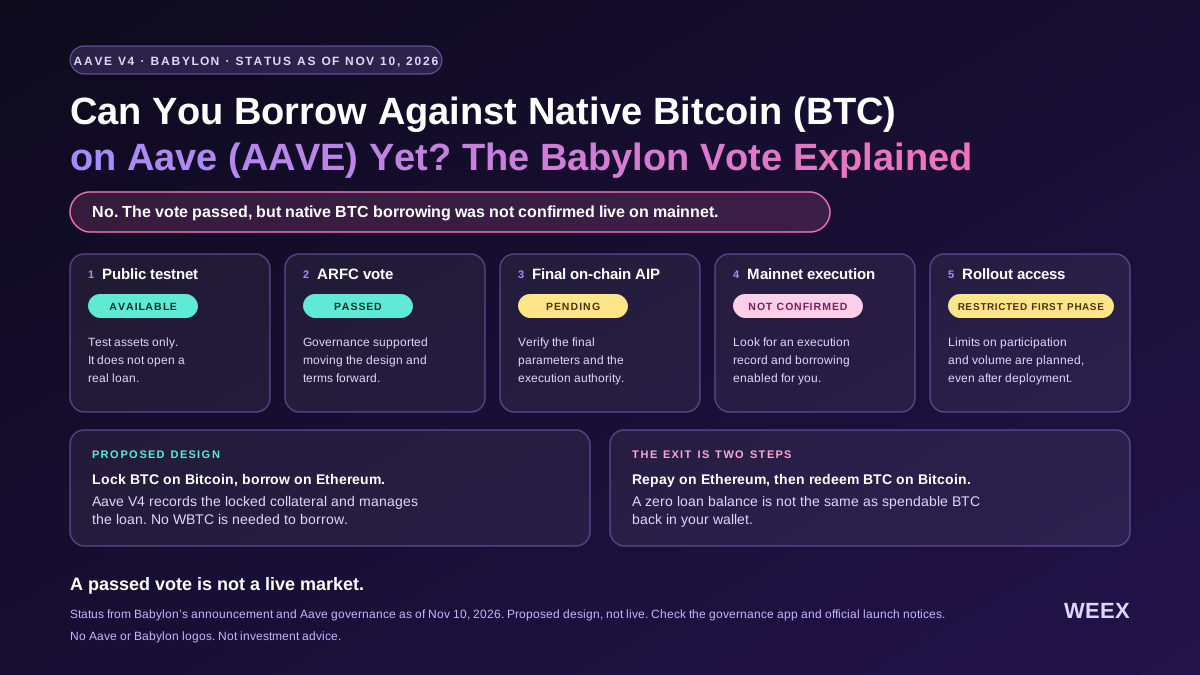
Can You Borrow Against Native Bitcoin (BTC) on Aave (AAVE) Yet? The Babylon Vote Explained
Can you borrow against native Bitcoin on Aave yet? See what the Babylon vote approved, what still needs to launch, and how BTC liquidation would work.

Kim & Chang Lawyer: "Excessive Responsibility Should Not Be Imposed on Stablecoin Issuers"

Mr&强 Analyzes Bitcoin and Ethereum Fluctuation Patterns

WEEX Exclusive:Middle East Easing Expectations Boost Stocks | WEEX Daily Brief (November 10, 2026)
On November 9 close, the S&P 500 and Dow both rose more than 2%. Middle East easing expectations pushed oil prices lower. Bitcoin and Ethereum spot ETFs saw net outflows last week. AVAX rose on reports of tokenized-stock clearing. PIEVERSE surged short-term. November 10 focus is October CPI, TSMC monthly sales data, CoreWeave earnings and others.

When is the launch date of Bitcoin Hyper? Testnet, tokens, and mainnet are separate milestones

Middle East Easing Expectations Boost Stocks | WEEX Daily Brief (November 10, 2026)
On November 9 close, the S&P 500 and Dow both rose more than 2%. Middle East easing expectations pushed oil prices lower. Bitcoin and Ethereum spot ETFs saw net outflows last week. AVAX rose on reports of tokenized-stock clearing. PIEVERSE surged short-term. November 10 focus is October CPI, TSMC monthly sales data, CoreWeave earnings and others.

Bitcoin non-empty wallets drop by 108700 amid retail capitulation

LNbits disables hosted Bitcoin services with no restart timeline

Bitcoin Spot ETF Sees Net Outflow of $201 Million for Three Consecutive Days

Ray Dalio Warns of Diminished Trust in U.S. Treasuries Amid Political Conflicts

BitPay Brings Apple Pay and Google Pay Checkout to Crypto Purchases

Four Security Strategies from the Wallet Theft Incident

Glassnode: Altcoin Trading Volume Returns to Normal Levels

Crypto: BlackRock Predicts Billions More in Its Crypto ETFs

Bakkt Aims for $6 Billion in Transaction Volume in Six Months, Doubling Annual Target; $10.4 Million Investment in Bitcoin Japan Recorded as of End of September

CoinShares: Data Center Ban Increases Value of Bitcoin Mining Companies' Power Assets
CoinShares: Data Center Ban Increases Value of Bitcoin Mining Companies' Power Assets

MARA Q3 Net Profit Rises to $632 Million, Sells 13,597 BTC in October to Repay Loans

Circle VP highlights AI agents driving demand for non-dollar stablecoins

Strive CIO advises BTC treasury firms on funding strategies

Barkin Highlights Inflation as Major Risk and Emphasizes Need for Cautious Monetary Policy Adjustment

Coldcard’s $116M exploit sparks fresh clash over NVK’s defense

The missing step in the warning that Japan could trigger Bitcoin’s next selloff
Two Bitcoin miners reported nearly $2 billion in profit. The biggest boost wasn’t cash
Super League buys 16 BTC for $1.23m as purchase sizes double
Bitcoin Lightning’s security update shuts one door. A critical Linux flaw remains

BlackRock: Bitcoin Whales Are Swapping Self-Custody For IBIT At Record Pace

Kraken Co-CEO Says Bitcoin Has Emerged from Bear Market

Aave DAO Supports Native BTC as Collateral for Aave V4 through Proposal

Bitcoin traders face an eight-hour blind spot as Deribit prepares to delay key market data
Can You Borrow Against Native Bitcoin (BTC) on Aave (AAVE) Yet? The Babylon Vote Explained
Can you borrow against native Bitcoin on Aave yet? See what the Babylon vote approved, what still needs to launch, and how BTC liquidation would work.
Kim & Chang Lawyer: "Excessive Responsibility Should Not Be Imposed on Stablecoin Issuers"
Mr&强 Analyzes Bitcoin and Ethereum Fluctuation Patterns
WEEX Exclusive:Middle East Easing Expectations Boost Stocks | WEEX Daily Brief (November 10, 2026)
On November 9 close, the S&P 500 and Dow both rose more than 2%. Middle East easing expectations pushed oil prices lower. Bitcoin and Ethereum spot ETFs saw net outflows last week. AVAX rose on reports of tokenized-stock clearing. PIEVERSE surged short-term. November 10 focus is October CPI, TSMC monthly sales data, CoreWeave earnings and others.
When is the launch date of Bitcoin Hyper? Testnet, tokens, and mainnet are separate milestones
Middle East Easing Expectations Boost Stocks | WEEX Daily Brief (November 10, 2026)
On November 9 close, the S&P 500 and Dow both rose more than 2%. Middle East easing expectations pushed oil prices lower. Bitcoin and Ethereum spot ETFs saw net outflows last week. AVAX rose on reports of tokenized-stock clearing. PIEVERSE surged short-term. November 10 focus is October CPI, TSMC monthly sales data, CoreWeave earnings and others.
Latest articles


Latest coin listings on WEEX


